Start Mining QUBIC: The Complete 2026 Guide
Most mining stories start with a warehouse full of specialised machines and an industrial power contract. Qubic tells a different one. Here, the computer you already own, a laptop, a desktop, an idle office machine, can join the network today and start earning QUBIC. And instead of burning electricity on puzzles that serve no one, every cycle you contribute feeds Aigarth’s research, the open-source artificial intelligence being built on top of the network. That is the promise of Useful Proof of Work: mining that pays you and produces something. This guide is the complete reference, from why Qubic mining is genuinely different, through the hardware and a full step-by-step setup, to the two 2026 upgrades that changed how mining works, the progression from miner to validator, a pool comparison, optimisation, security, and a glossary.
In brief
- Qubic mining runs on both CPU and GPU and requires no ASICs. Which is more efficient depends on the current algorithm: at the time of writing, with BPP-9000, a CPU is slightly more performant than an NVIDIA GPU (via CUDA), and both can run together.
- Its useful proof of work (uPoW) directs miner power towards Aigarth research tasks, the network’s AI layer, instead of arbitrary puzzles.
- Nearly 100,000 AI miners already contribute. The gross issuance is 1 trillion QUBIC per epoch (one week), but since the August 2026 halving, about 775 billion are burned, leaving approximately 225 billion net new supply, distributed to Computors and contributors according to their AI training performance.
- Two 2026 updates: BPP-9000, the current mining algorithm (in service since August 2026), and ant colony mining, the surrounding framework (in service at epoch 228) that allows miners to build on others’ results rather than starting from scratch.
- Rewards are paid at the end of each epoch (Wednesday 12:00 UTC to Wednesday 12:00 UTC), including the very first participation epoch on most pools.
Why Qubic mining is different: your CPU does AI research tasks
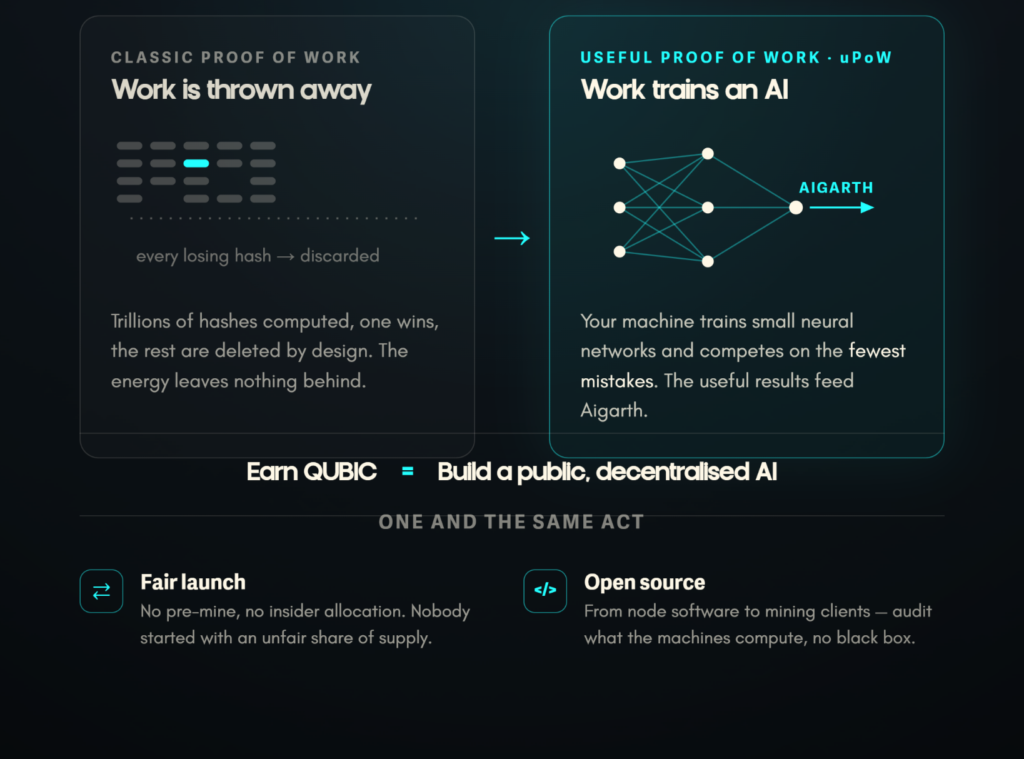
Traditional proof of work has one well-known flaw: the work itself is disposable. Trillions of hashes are computed, one wins, and all the rest are thrown away. Qubic’s answer is Useful Proof of Work (uPoW), a consensus model in which the effort that secures the network is simultaneously put to productive use, training artificial neural networks for Aigarth, the open-source AI the network is building.
When you mine Qubic you are not brute-forcing resolving equations. Your machine trains small AI networks and competes on making the fewest mistakes, and the useful results feed Aigarth. Earning QUBIC and helping build a decentralised, publicly available AI become the same act. This is the core idea the rest of the guide builds on, so it is worth holding onto: on Qubic, the electricity is not the point, the trained network is.
Two further design choices complete the picture. Qubic had a fair launch, with no pre-mine and no early allocation to insiders, so no group started with an unfair share of the supply. And the system is open source, from the node software to the mining clients, which means the community can audit what its machines actually compute rather than trusting a black box.
CPU and GPU, but no ASIC: what hardware Qubic mining runs on
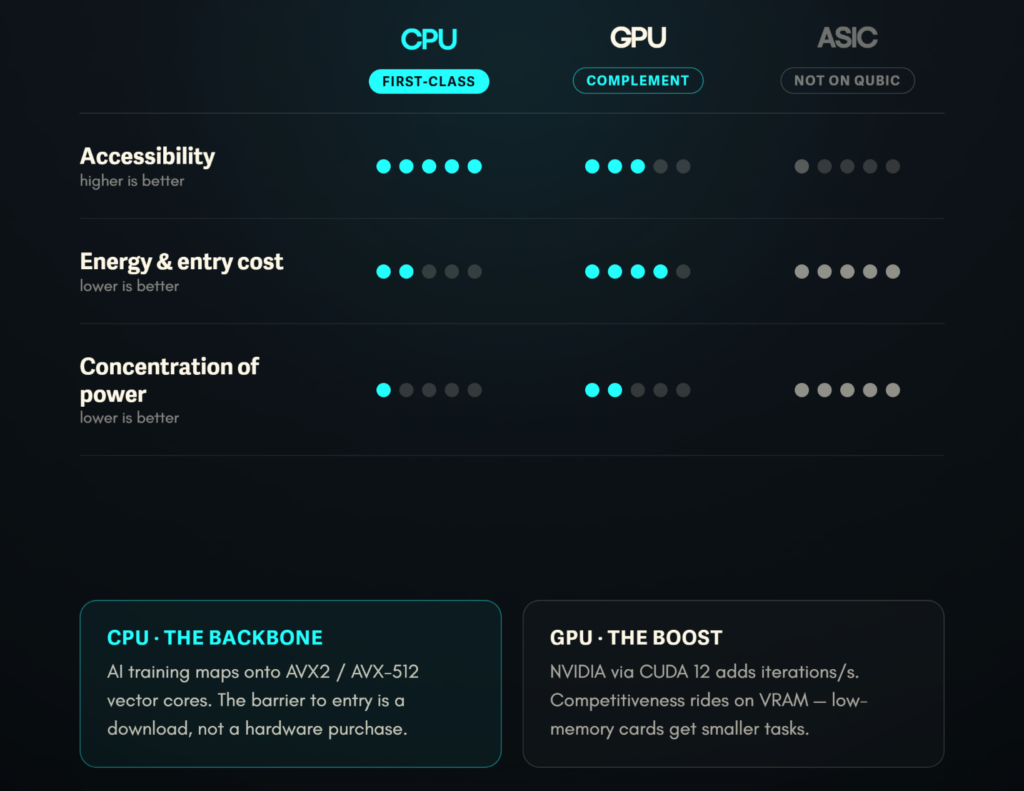
On most proof-of-work networks, the arms race ends with specialised ASIC hardware that ordinary users cannot compete against, which quietly concentrates mining in a few industrial operations. Qubic took the other road. There is no ASIC for Qubic, and none is planned. A standard CPU is a first-class participant, and CPUs and GPUs can run side by side; neither is merely an add-on to the other.
The reason is technical, not ideological. An AI-training workload maps naturally onto general-purpose CPU cores, and in particular onto the wide vector instructions (AVX2 and AVX-512) that modern processors carry, which is why a capable CPU is enough to begin and why the barrier to entry is a download rather than a hardware purchase.
GPUs run alongside CPUs rather than replacing them. GPU mining on Qubic is done with NVIDIA cards through CUDA: the official mining client supports them via CUDA 12 and recent drivers. The practical way to think about it is that a CPU is the most accessible entry point, while a modern NVIDIA GPU can run alongside it; which of the two is faster depends on the current algorithm, and at the time of writing, with BPP-9000, the CPU performs slightly better than the GPU. One caveat matters for anyone planning around a GPU: because Qubic mining is an AI-training workload, its memory requirements have been rising with successive algorithm updates, so a card competitiveness depends heavily on its VRAM and can change as the algorithm evolves. GPUs with limited memory receive smaller tasks.
What you need before you start
Before the step-by-step, here is the short checklist, with Qubic’s own hardware guidance from its Academy.
A modern multi-core CPU is the single most important component. More cores and better AVX2 or AVX-512 support mean more work per hour, so high-core-count chips shine: Qubic names the AMD Ryzen 9 family (7900X, 7950X, 7950X3D, 9950X, 9950X3D), Threadripper (7000 series and newer), and server-grade EPYC processors with AVX-512, with the Ryzen 7 line (7700 and above) as a strong mid-tier. Qubic states that AMD is strongly preferred for its AVX-512 efficiency, and that Intel works but is generally slower unless AVX-512 is enabled.
Alongside the processor: at least 16 GB of RAM, with 32 GB or more recommended and higher frequencies helping the iteration rate; an SSD, which is required for dataset and log access; and a stable internet connection of at least 10 Mbps up and down, where stability matters more than raw speed because low latency reduces stale or rejected work.
On the GPU side, VRAM is the figure that matters most, because Qubic AI-training tasks are memory-hungry and successive algorithm updates have increased the memory needed: cards with more VRAM stay competitive longer, while those with too little receive smaller tasks or fall off. If you plan to add a GPU, favour a recent NVIDIA card with generous memory, keep its drivers current, and remember that a GPU under sustained load draws considerably more power than a CPU. No ASIC is needed for any of this. Finally, you need a Qubic wallet ID to receive rewards, and an honest sense of your electricity price before you scale up.
Step-by-step: your first QUBIC in five moves
The sequence below follows Qubic’s official Academy tutorial. Read the security section further down before you download anything.
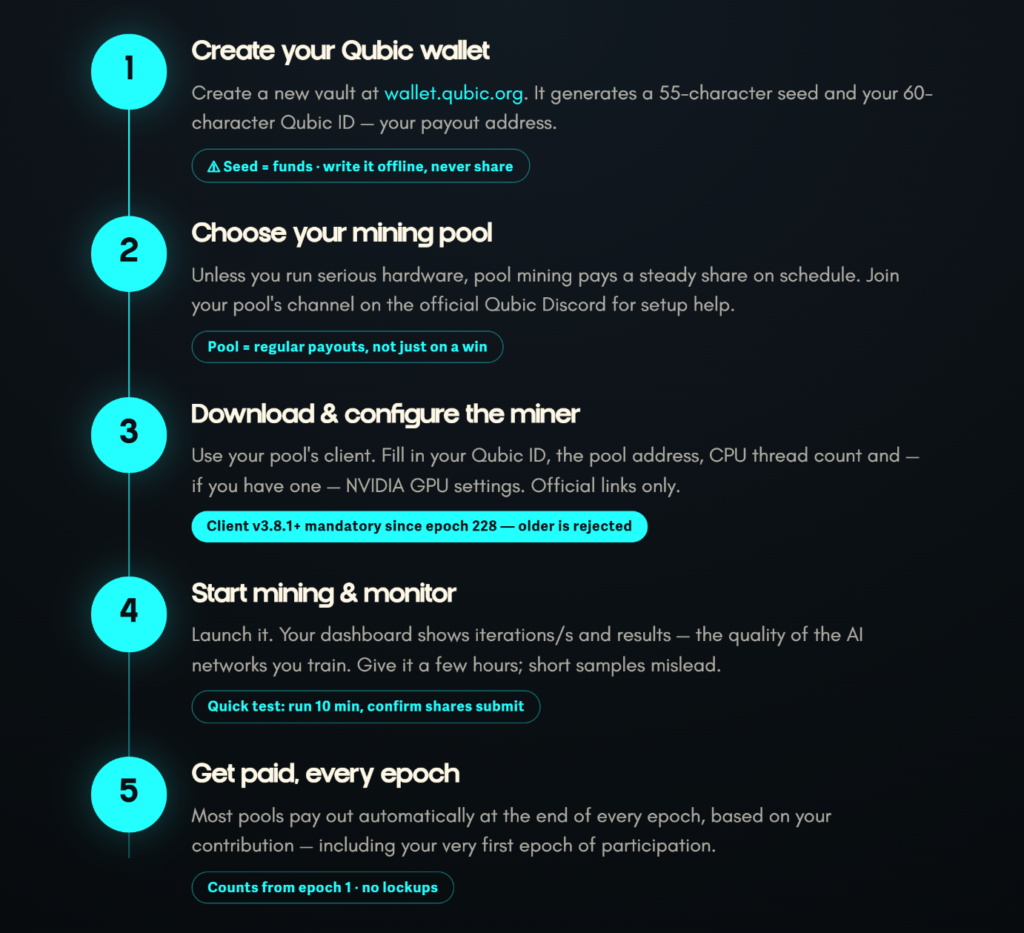
Step 1: Create your Qubic wallet. Go to the official wallet at wallet.qubic.org and create a new vault. Your wallet is generated from a 55-character lowercase seed; write it down offline, never store it in a plain text file or a screenshot, and never share it, because whoever holds the seed holds the funds. Set a secure password. The wallet then gives you your public Qubic ID, a 60-character string that is your payout address.
Step 2: Choose your mining pool. Unless you run serious hardware, pool mining is the sensible route, because it combines many participants’ work and pays you a share on a regular schedule rather than only when your own machine lands a top result. The pool comparison is further down. A good first move is to join your chosen pool’s channel on the official Qubic Discord, where operators post the current client and setup help.
Step 3: Download and configure the miner. Each pool provides its client. Configuration comes down to a few fields: your Qubic ID, the pool address, and, depending on your hardware, your CPU thread count and, if you use one, your NVIDIA GPU settings.
Step 4: Start mining and monitor your work. Launch the miner. Your dashboard shows your iterations per second and your results, which reflect the quality of the AI networks you are training. Give it a few hours before judging performance, because short samples are misleading. Qubic’s own hands-on test is to run the miner for at least ten minutes and confirm it is submitting shares successfully.
Step 5: Get paid, every epoch. Most pools pay out automatically at the end of every epoch, based on your contribution, and crucially they include your very first epoch of participation. There are no lockups.
The epoch: how a mining week actually works
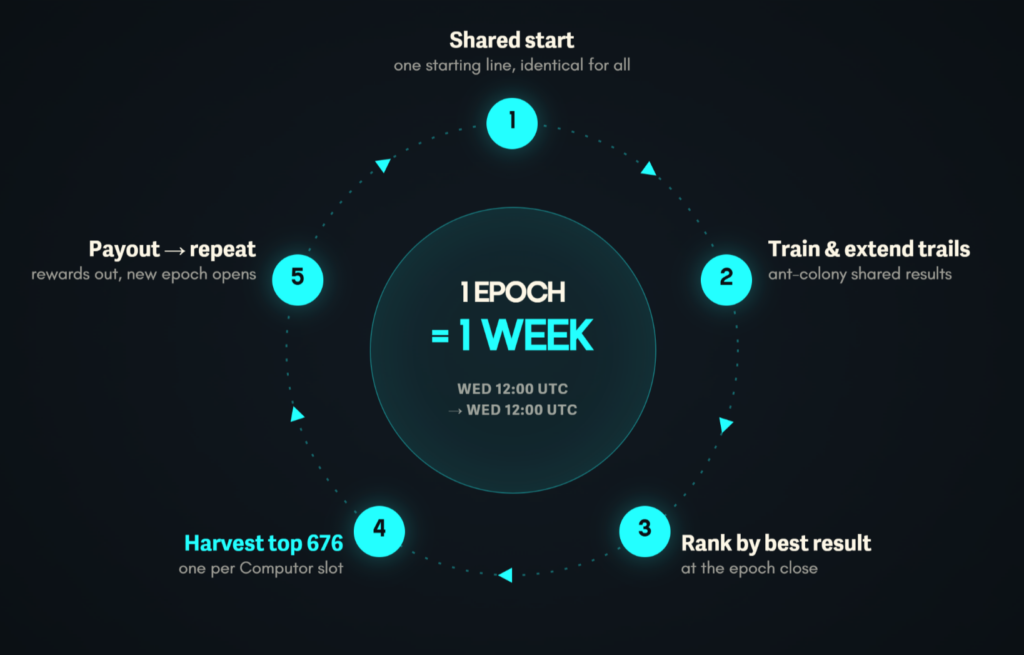
Everything on Qubic is paced by the epoch, a one-week cycle that runs from Wednesday 12:00 UTC to the following Wednesday 12:00 UTC. Understanding it explains both when you are paid and how the network measures you.
At the start of the epoch, the network sets a shared starting line, identical for everyone. Through the week, miners train networks and, since the ant colony upgrade, extend shared trails of results. At the close, the network ranks every miner by their single best result and harvests the top 676, one for each Computor slot that runs Qubic. Rewards are distributed, and a new epoch opens. Because QUBIC is a low-unit-price token, and because most of the gross issuance is now burned at the protocol level, the fiat value of any reward depends entirely on the market price on the day and on how much survives the burn.
BPP-9000 and ant colony mining: the 2026 upgrades explained
Two upgrades landed within a fortnight in August 2026, and they are often confused, so here is the clean distinction: BPP-9000 is the algorithm; ant colony mining is the framework it runs inside. They are complementary, not competing, and the ant colony framework did not replace BPP-9000, it wraps around it.
BPP-9000: the current mining algorithm
BPP-9000 is the mining algorithm that went live on Qubic mainnet in August 2026, announced alongside the Outsourced Computing feature at the 6 August All-Hands. It defines the AI-training task your machine works on and how a result is scored. Per Qubic, it trains a network modelled on how biological neurons work, using one year of Bitcoin’s hourly price data, and asks it to classify each move into one of three states, up, down, or unknown, with fewer errors across the full year producing a better score and zero errors as the goal.
The design point that matters is that Qubic built the algorithm and the framework as separate pieces. That separation is deliberate: a future algorithm can drop into the same structure without any of it being rebuilt. On the research side, Qubic reports that the models behind this work roughly doubled their score to 0.25 percent on ARC-AGI-3, one of the harder reasoning tests in AI, on the strict offline version run with no internet access; that figure is self-reported and should be read against the official leaderboard. Qubic also states, in an August 2026 Open Science session, that the result was reached on roughly 500 CPU cores with no GPUs, and that four Neuraxon research papers were accepted at international conferences in 2026.
Ant colony mining: the end of throwaway work
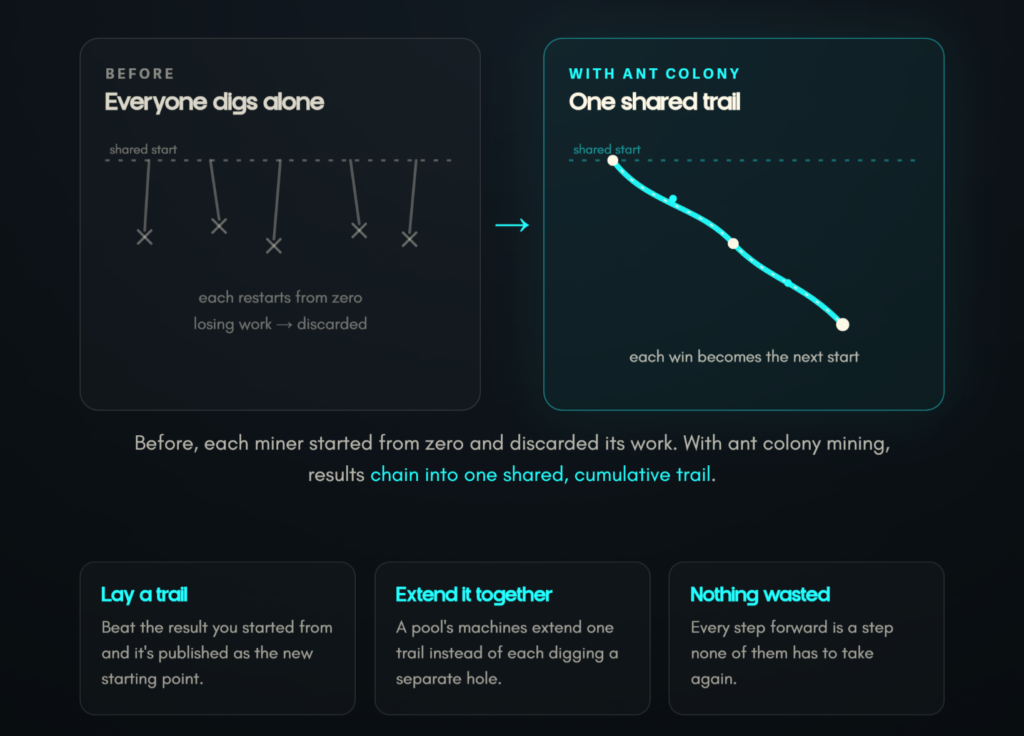
Ant colony mining went live at epoch 228, in the week beginning Wednesday 26 August 2026. The idea is borrowed from nature: an ant that finds food lays down a pheromone trail on its way home, and the ants behind it extend that trail instead of wandering off alone, so the colony gets better at finding food without any single ant being clever. Formalised as ant colony optimization, first proposed by Marco Dorigo in 1992, it is a well-established family of algorithms for finding good paths through enormous search spaces, and Qubic is the first network to put it underneath crypto mining.
Here is what it means in practice. Every epoch, the whole network starts from the same shared starting line. From there, each mining effort lays its own trail: when a miner beats the result it started from, that result is published and becomes the new starting point for the next miner working the same trail. A pool’s machines no longer each dig a separate hole; they extend one trail together, and every step forward is a step none of them has to take again. A failed search is still worth nothing, but a successful one now moves a trail forward for everyone working it. Work stops being deleted and starts being inherited.
The three rules that keep the trail moving forward
The first: you must improve on what you started from. You can pick any published result and try to beat it, but you can only publish your own if it genuinely scores better, not equal. A trail can only improve as it lengthens, never slip backwards.
The second: there is a bar for starting fresh. If you are not building on anyone else, you are building from the shared starting point every miner begins the round with, and your result has to clear a minimum quality bar before it counts. That keeps low-quality work out of the system at the root.
The third: only your best result counts. At the end of each weekly epoch, the network ranks every miner by their single best result and keeps the top 676, one for each Computor. There is no advantage to flooding the network with mediocre results, because depth beats volume.
Trust: the refundable deposit that keeps results honest
If everyone builds on published results, those results must be real. Qubic’s mechanism is economic. Every result published on-chain carries a refundable deposit of 1,000,000 QU, paid by the Computor publishing it rather than by the miner who found it. The network independently re-checks the score: if it holds up, the deposit comes straight back; if it does not, the deposit is gone and the result counts for nothing.
The incentive is simple. Nobody wants to lose a million QU, so Computors check results before publishing rather than after. An honest result costs nothing at all; a fake one is expensive. And because the network re-checks every score regardless, the deposit sits on top of verification as an extra filter, not as a replacement for it.
Why this matters beyond Qubic
Three consequences are worth drawing out. First, hashrate stops being a lottery ticket: on other chains, adding machines mainly triggers a difficulty increase and nothing else, whereas on Qubic adding machines means more trails and deeper ones, so more searching genuinely produces a better answer by the end of the week. Second, the network starts to behave like a single distributed AI training run, because progress along each trail carries forward instead of being discarded. Third, smaller miners get a real seat, because joining a trail someone has already pushed forward is far more achievable than winning a race that starts from nothing; you do not need to out-muscle the field, only to move your trail forward by one step.
For readers who want the full technical detail, the complete specification, including the submission flow, every acceptance rule, and the integration guide for pools, lives in the qubic/core repository on GitHub (doc/ant_colony_mining.md).
From AI miner to Computor: the progression path
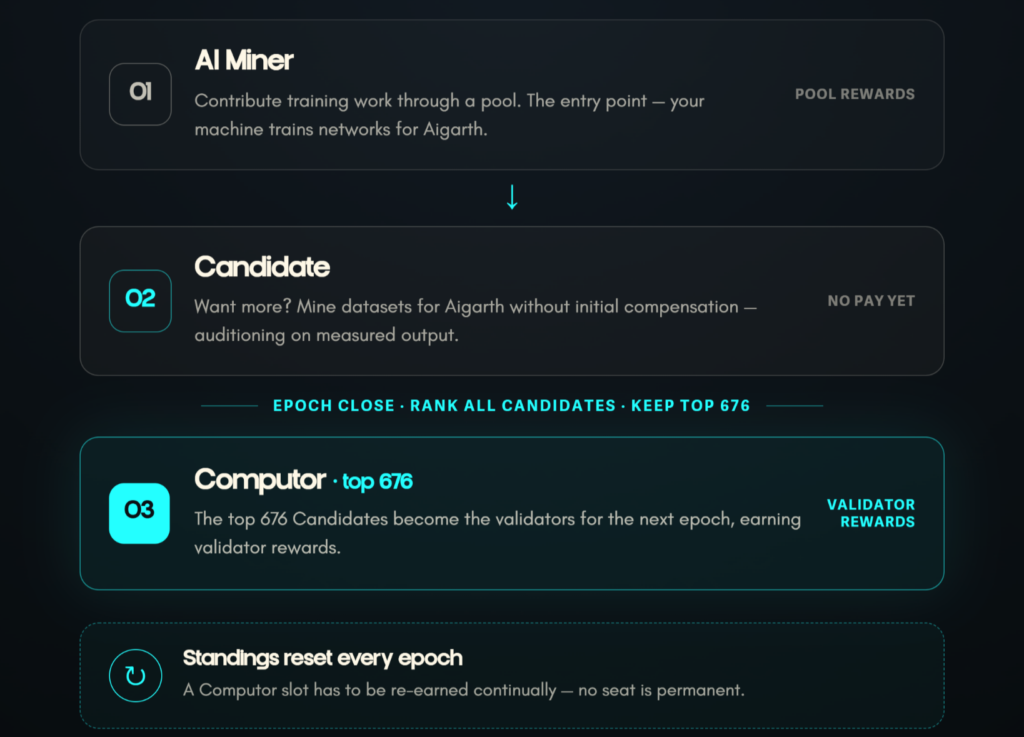
Qubic has a built-in ladder, and it is refreshed every week. You start as an AI miner, contributing research work through a pool. Miners who want more enter as Candidates, mining datasets for Aigarth without initial compensation. At the close of each epoch, the network ranks all Candidates and the top 676 become the Computors for the next epoch, earning validator rewards. There is no permission step and no committee; the only criterion is measured contribution, and the standings reset each epoch, so a Computor slot has to be re-earned continually. This is the mechanism that ties the whole system together: the same research work that feeds Aigarth is also the audition to become a validator.
Qubic mining pools compared
Qubic’s official channels and Academy list an official pool alongside several established community pools. The table gathers them with their profiles and payout modes. Fees are set by each operator and change over time; the figures circulating in the community are noted only as a starting point and must be verified on each pool’s own site before you commit.
| Pool | Payout modes | Fee (verify) |
|---|---|---|
| pool.qubic.li | PPS / SOLO | 7% |
| MinerLab | PPS (smooth) / SOLO | 7% |
| Jetski Pool | PPS/PPLNS / SOLO | 7% |
On payout modes: PPS, or pay-per-share, smooths your income into small, predictable payments and shifts variance onto the pool. PPLNS, or pay-per-last-N-shares, pays from actual results the pool lands, weighted by your recent contribution, so it can pay more when the pool does well and rewards staying with one pool. SOLO routes the full reward to you when your effort lands a top result, at the cost of long dry spells. Beginners usually start with PPS for predictability, then experiment once they understand their hardware.
Getting the most out of your machine
A handful of levers separate a well-run miner from a wasteful one. Tune your thread count rather than assuming more is better, because throughput often peaks just below the maximum number of threads, especially on a machine you also use for other things. If you mine on an NVIDIA GPU, keep its drivers current and watch its memory: because the workload is memory-heavy, a modest memory overclock often helps more than pushing the core clock, and a card short on VRAM will receive smaller tasks. A GPU running training work sits at full load for hours, so airflow and temperatures matter as much as they do on the CPU. Since the ant colony upgrade, where you build from matters as much as raw power: choosing which trail to extend is a real strategic decision, since a deep trail gives you a strong starting position but a thin margin left to improve, while a shallower one offers more room to gain but less of a head start. Protect your cooling, because sustained all-core load is the actual workload and airflow guards both performance and hardware lifespan. Prioritise uptime, since a machine mining steadily all week beats a faster one running only two evenings. And stay current, because outdated clients have been rejected since epoch 228.
Security: protect your seed, avoid the scams
Two rules prevent the large majority of losses. Your 55-character seed is everything: store it offline on paper, never in an email, a cloud note, or a screenshot, and remember that no legitimate pool or Qubic staff member will ever ask for it or message you first to offer help. And download miners only from official links, bookmarking them and ignoring search-ad lookalikes, because fake miner downloads are a well-documented route for wallet-stealing malware; verify a file’s checksum before running it.
One Qubic-specific risk deserves special emphasis, because it is easy to trigger and impossible to reverse. Qubic does not use standard public-key cryptography, and its wallet is tied to an epoch-based architecture, so importing your Qubic seed into a generic multi-chain wallet can be catastrophic. There is a documented case of a user losing 2.8 billion QUBIC after importing a seed into an incompatible multi-chain wallet, with the funds becoming unrecoverable once the epoch completed. The rule that follows is simple: manage QUBIC only in the official Qubic wallet, not in a general-purpose one.
Common mistakes to avoid
The recurring errors are avoidable once named: judging performance in the first hour instead of after a full epoch; running an outdated client, which has been rejected since epoch 228; maxing out every thread on a machine you also rely on for daily work; ignoring your electricity cost when calculating whether mining pays; and storing your seed digitally, which is the single most common route to permanent loss.
Glossary
Aigarth: the open-source AI layer Qubic is building; mining work contributes to its research.
AI miner: a participant contributing CPU (or GPU) work on Aigarth research tasks in exchange for QUBIC.
Ant colony mining: the framework, live since epoch 228, in which miners extend shared trails of results instead of starting from zero.
BPP-9000: the mining algorithm live since August 2026, running inside the ant colony framework.
Candidate: a miner competing for a Computor slot in the current epoch.
Computor: one of the 676 validators that run the network each epoch, selected by mining performance.
Epoch: the one-week cycle (Wednesday 12:00 UTC to Wednesday 12:00 UTC) that paces mining and rewards.
QU / QUBIC: the network’s native unit, used for rewards and for the on-chain result deposit.
Refundable deposit: 1,000,000 QU staked by a Computor when publishing a result, returned if the score is verified and forfeited if not.
Seed: your 55-character lowercase secret; whoever holds it controls the funds.
uPoW (Useful Proof of Work): Qubic’s consensus, in which mining performs useful AI research tasks instead of arbitrary hashing.
Ant colony mining shipped on schedule, one week after the halving, and it is live on the mainnet now. Because the framework and the algorithm are separate, BPP-9000 is not the ceiling: a new algorithm can slot into the same trails, deposits, and ranking without any of it being rebuilt. For anyone deciding whether to point a home CPU at the network, the thing to watch is not a token price target but whether this cumulative search bends Aigarth’s error curve toward zero, epoch after epoch. That is the measurable promise, and it is now testable in public.
It depends on your hardware, your electricity price, and the market price of QUBIC, and it can be negative if the coin you earn is worth less than the energy spent. Pools pay each epoch, so the honest approach is to do your own calculations after a full week. This is not investment advice.
Both, and they can run side by side. Which is faster depends on the current algorithm; at the time of writing, with BPP-9000, a CPU is slightly more efficient than a GPU. A multi-core processor with AVX-512 is the most accessible starting point, and GPU mining is supported on NVIDIA cards with CUDA, where VRAM is the key factor because AI training tasks are memory-intensive and their needs increase with algorithm updates. No ASICs are required or possible.
The mining algorithm has been in service since August 2026. It defines the AI training task and scoring, runs within the ant colony framework, and can be replaced by a future algorithm without rebuilding the framework.
The framework, in service since epoch 228, that allows miners to extend results already found by the network instead of starting from scratch, governed by three rules and a refundable on-chain deposit.
At the end of each epoch, every Wednesday at 12:00 UTC, on most pools, including your very first participation epoch.
Enter as a Candidate by mining datasets for Aigarth; if your best result ranks in the top 676 at epoch close, you become a Computor for the next epoch. The ranking resets every week.
Yes. Importing your seed into an incompatible multi-chain wallet can render funds irrecoverable after an epoch transition. Use only the official Qubic wallet.
Maximize your Cointribune experience with our "Read to Earn" program! For every article you read, earn points and access exclusive rewards. Sign up now and start earning benefits.

The views, thoughts, and opinions expressed in this article belong solely to the author, and should not be taken as investment advice. Do your own research before taking any investment decisions.