Fri 07 Feb 2025 ▪
3 min read
▪
by
Traders fear the impact of the US employment report on bitcoin. In this article, we explain why.
Traders fear the impact of the US employment report on bitcoin. In this article, we explain why.

While traditional end-of-reign predictions for Bitcoin were still circulating, the queen of cryptocurrencies responded with a stunning performance: a 125% explosion in options volumes in just one month. Behind this shocking figure, revealed by CCData, lies a deeper reality. Bitcoin is no longer just defying expectations – it is rewriting the investor's manual. Amid institutional plot twists and bold innovations, we dive into a month that shook Wall Street… and beyond.

Bitcoin has just experienced an unexpected hiccup: its mining difficulty has decreased for the first time in four months. A fragile breath in an ecosystem accustomed to constant escalation. However, behind this seemingly technical number lies a much more tumultuous story. Amid site closures, rapid updates, and survival strategies, the mining sector is navigating a silent storm. What if this decline were a symptom of a deeper transformation?

Holding bitcoin for three years and permanently avoiding capital gains tax? This once-unimaginable scenario is becoming a reality in the Czech Republic. Starting in 2025, cryptocurrency investors will benefit from a full exemption on their capital gains, provided they adhere to a holding period and certain specific rules. This initiative is shaking up the European tax landscape, stirring both the enthusiasm of investors and the questions of experts. What are the stakes of this bold reform? An analysis of a measure with significant implications.

Cryptocurrencies continue to divide the academic and financial world. While some see them as an inevitable monetary revolution, others persist in viewing them as a bubble destined to burst. Eugene Fama, a renowned economist and Nobel Prize winner, has thrown a stone into the pond by claiming that Bitcoin is doomed to become worthless. According to him, fundamental economic principles make its long-term survival impossible. A radical prediction that provokes numerous reactions, particularly in a context where BTC continues to be adopted by financial institutions and governments.

Bitcoin maintains its position around 98,000 dollars at the opening of Wall Street on February 6, as analysts closely scrutinize technical indicators to anticipate the next direction of the market.

The crypto landscape is undergoing a silent earthquake. As altcoins attempted to rise into the spotlight, a giant regained control: Bitcoin. By the end of 2024, the "altcoin season" had faded, yielding to an overwhelming dominance of BTC. According to Rekt Capital, a respected analyst, Bitcoin could reach a 71% market share before any altcoin revival. A scenario that resonates as a warning for overly optimistic investors. But how did we get here? And what does this dynamic reveal about the evolution of the market?

The American company MicroStrategy, known for its massive commitment to BTC, announced a major rebranding. From now on, it will simply be called "Strategy" and will adopt the orange color and the bitcoin logo, marking a new step in its evolution. This rebranding is accompanied by a massive investment in bitcoin, with a purchase of 20.5 billion dollars in BTC during the fourth quarter of 2024.

Traditional finance and bitcoin are continuing to draw closer. Following the resounding success of its Bitcoin ETF IBIT in the United States, BlackRock, the world's largest asset manager, is preparing to take a new step: the launch of a Bitcoin Exchange Traded Product (ETP) in Europe. This fund, which will be domiciled in Switzerland, reflects the growing desire of financial institutions to establish a lasting presence in the crypto market. While the United States has seen Bitcoin ETFs capture more than $57 billion in assets in just a few months, this new product could change the European landscape. Why Switzerland rather than another country? What will be the effects on investors and the institutional adoption of bitcoin in Europe? These are all questions that arise as BlackRock accelerates its international offensive.
The creation by Donald Trump of a sovereign fund overseen by Howard Lutnick is very promising for the bitcoin reserve.

Crypto traders are disoriented by a market that no longer reacts according to traditional patterns, despite an apparently favorable context with the pro-crypto initiatives of the U.S. government.
The growing adoption of inscriptions on Bitcoin could push the average block size to 4 megabytes (MB), according to a report published on February 4 by Mempool Research. This significant development occurs in a context where the debate over the use of the Bitcoin network echoes the old "block wars" that divided the community between 2015 and 2017.

The Bitcoin network continues to surprise. While analysts expected a slowdown in hashrate after the April 2024 halving, the computing power mobilized by mining companies has just reached a historic record of 833 exahashes per second (EH/s), an increase of 9% in just a few days. This surge in power is explained by the massive investments made by mining companies, which anticipated the reduction in block rewards by strengthening their infrastructure. However, a surprising contrast emerges: despite a price hovering around 100,000 dollars, transaction fees are at historically low levels, which undermines the profitability of mining companies and raises questions about the economic balance of the network.

The medical technology company Semler Scientific (NASDAQ: SMLR) continues its aggressive investment strategy in bitcoin with the acquisition of an additional 871 BTC, bringing its total portfolio to 3,192 BTC. This transaction comes as the giant MicroStrategy takes a pause in its acquisitions.

In the grand theater of power, Trump outlines a bold move: perhaps a crypto-friendly sovereign fund. Between a bluff and strategic genius, the suspense remains intact.

The price of bitcoin has fallen below the $100,000 mark following China's announcement of new tariffs on American imports. This decision, which comes amid increasing trade tensions between the two powers, has caused a shockwave in the markets. Analysts fear a period of heightened volatility if Sino-American negotiations do not progress.

MicroStrategy, known for its massive commitment to bitcoin, surprised the markets by temporarily halting its BTC purchases. According to an announcement from Michael Saylor on February 3, 2025, the company has not acquired any bitcoin for a week already. This pause raises questions... strategy or is BTC just not interesting at the moment?
The crypto market is going through a period of instability, and Solana (SOL) is on the front lines. Since February 1st, the drop of Bitcoin below $100,000 has caused a shockwave across altcoins. Solana, whose price moves in strong correlation with BTC, has seen its price fall below the critical threshold of $200. The impact has not been limited to price declines: investors have massively reduced their exposure, leading to a withdrawal of $367 million from spot markets in three days. This massive liquidation has reversed market sentiment, as evidenced by a long/short ratio dropping to 0.93, confirming seller dominance. While technical indicators signal sustained bearish pressure, a break of current support levels could send Solana to new lows, unless a sudden surge in demand comes to reverse the trend.

On February 3, 2025, Bitcoin reached a local low of $91,530 before rebounding to $95,306 later in the day. This decline comes after China, Canada, and Mexico promised severe retaliatory measures in response to tariffs imposed by the Trump administration. These measures have rekindled fears of a global trade war, prompting investors to shy away from risky assets, including cryptocurrencies.
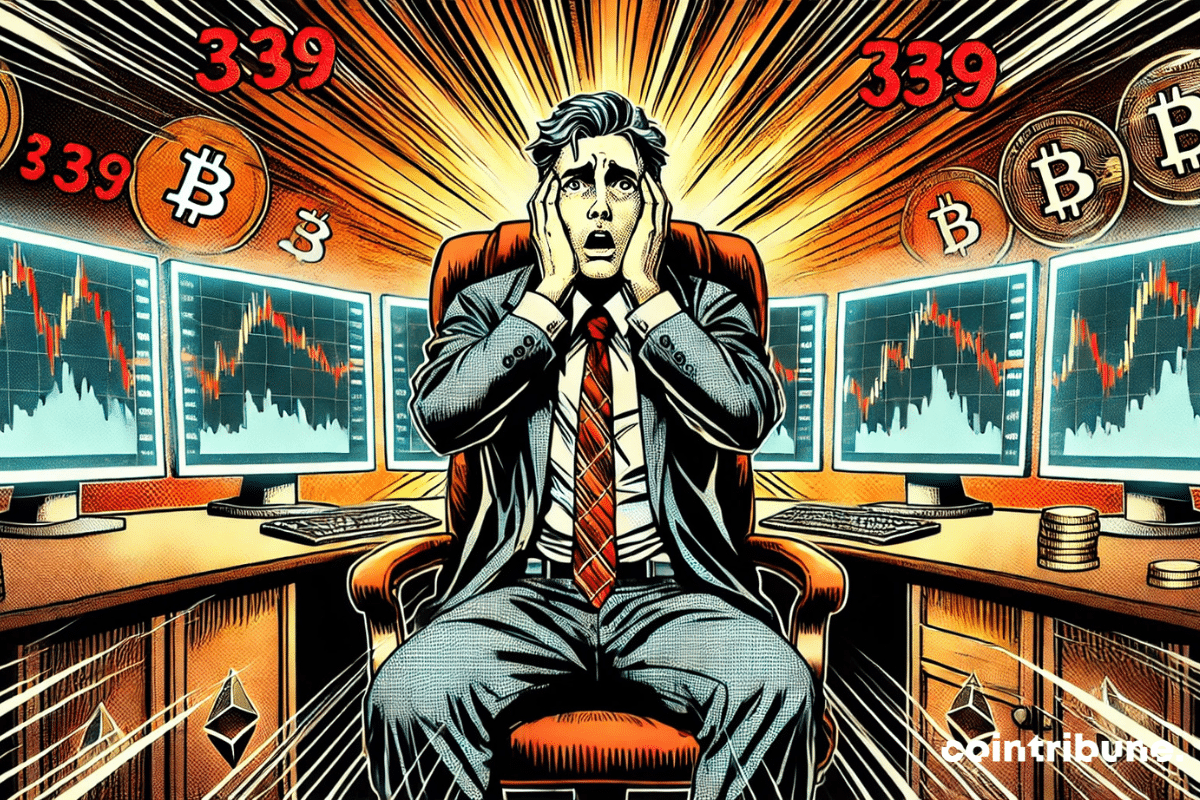
The Crypto Fear and Greed Index has just reached 39, signaling a significant period of uncertainty in the markets. This indicator, ranging from 0 (extreme fear) to 100 (extreme greed), is an essential barometer of market sentiment. A value of 39 suggests some anxiety, but is it a sign of imminent panic or a strategic investment opportunity?
Amid revolutionary announcements, technological developments, and regulatory turbulence, the crypto ecosystem continues to prove that it is both a territory of limitless innovations and a battleground of regulatory and economic struggles. Here is a summary of the most significant news from the past week surrounding Bitcoin, Ethereum, Binance, Solana, and Ripple.

Bitcoin asserts its dominant position against altcoins. The queen of cryptos sees its market share cross the symbolic threshold of 60% on February 2, while altcoins suffer significant losses following the new trade measures imposed by President Trump.

Bitcoin, freshly crowned with a peak of $102K, stumbles and dangerously flirts with $95K. A slight shiver or the beginning of a major downfall? Cryptocurrency trembles, and so do investors.

Financial markets sometimes hold paradoxes. While Bitcoin is experiencing a new surge, surpassing the symbolic threshold of 100,000 dollars, one surprising element stands out: the absence of individual investors. After the Federal Open Market Committee (FOMC) meeting, the Bitcoin futures market witnessed a rapid rise, with an increase of 1.2 billion dollars in just 24 hours. However, instead of widespread enthusiasm, the data reveals a significant retreat of small investors, whose activity has dropped by 50% since November 2024. This phenomenon highlights a profound transformation in the market, where financial institutions are taking over from individuals. Should we see this as a mere cyclical adjustment or a lasting change in the evolution of Bitcoin?

The crypto market is currently undergoing a decline, significantly impacting major assets such as Bitcoin, XRP, and Dogecoin. This downward trend has raised concerns among investors and traders, who are now adopting a more cautious approach in light of the increased market volatility. Here are the reasons behind this drop!

Court decisions regarding cryptocurrencies play a key role in the evolution of sector regulation. Indeed, when it comes to stolen funds, the issue becomes even more sensitive, as it pits the principle of confiscation against that of restitution to the victims. The case of the Bitfinex hack in 2016, one of the largest Bitcoin thefts in history, crystallizes these tensions. After the seizure of 94,643 BTC by US authorities, the courts are questioning the appropriateness of returning them to Bitfinex. Such a decision could create a major legal precedent, which would influence the future management of cryptocurrencies seized by the courts.

Bitcoin has experienced a significant drop, falling below the symbolic mark of 100,000 dollars for the first time since January 27. This decline comes amid heightened trade tensions, following Donald Trump's announcement of new tariffs targeting China, Canada, and Mexico, prompting immediate reactions from these countries.

The intense cold wave in the United States has caused the first negative adjustment in Bitcoin mining difficulty since September 2024, according to mining company Luxor. In January, a powerful explosion in the Arctic dropped temperatures in the USA, increasing the demand for electricity and driving up energy prices. This situation forced many BTC miners to slow down their operations, resulting in a decrease in mining difficulty.

January was a festival for XRP: 50% increase, regulatory green lights, and a crypto market in ecstasy. But at 4 dollars, does the party continue or will the wake-up call be brutal?

Small bitcoin investors are intensifying their sales on Binance at the beginning of 2025, with transfers reaching 6,000 BTC in January. This trend sharply contrasts with the behavior of large whales, who maintain a more conservative approach in their movements.