the crypto community is accompanied by airdrops and staking events on several major platforms.
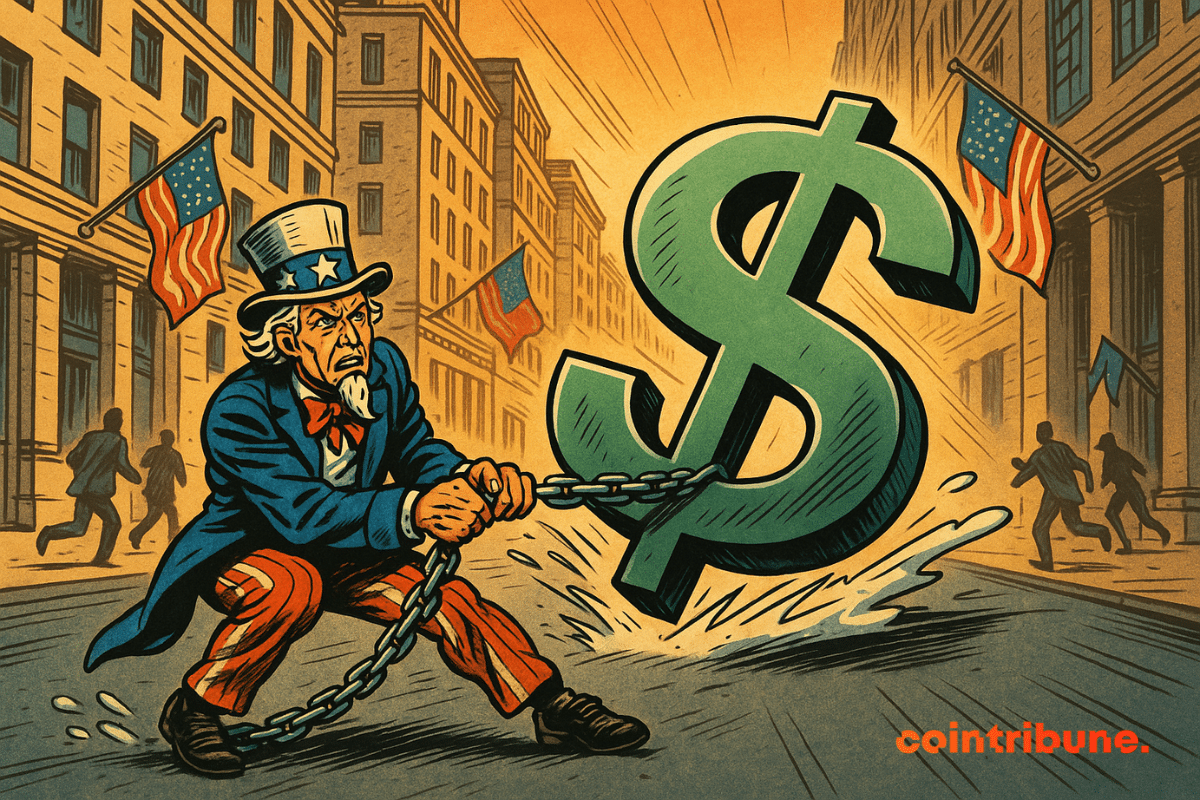
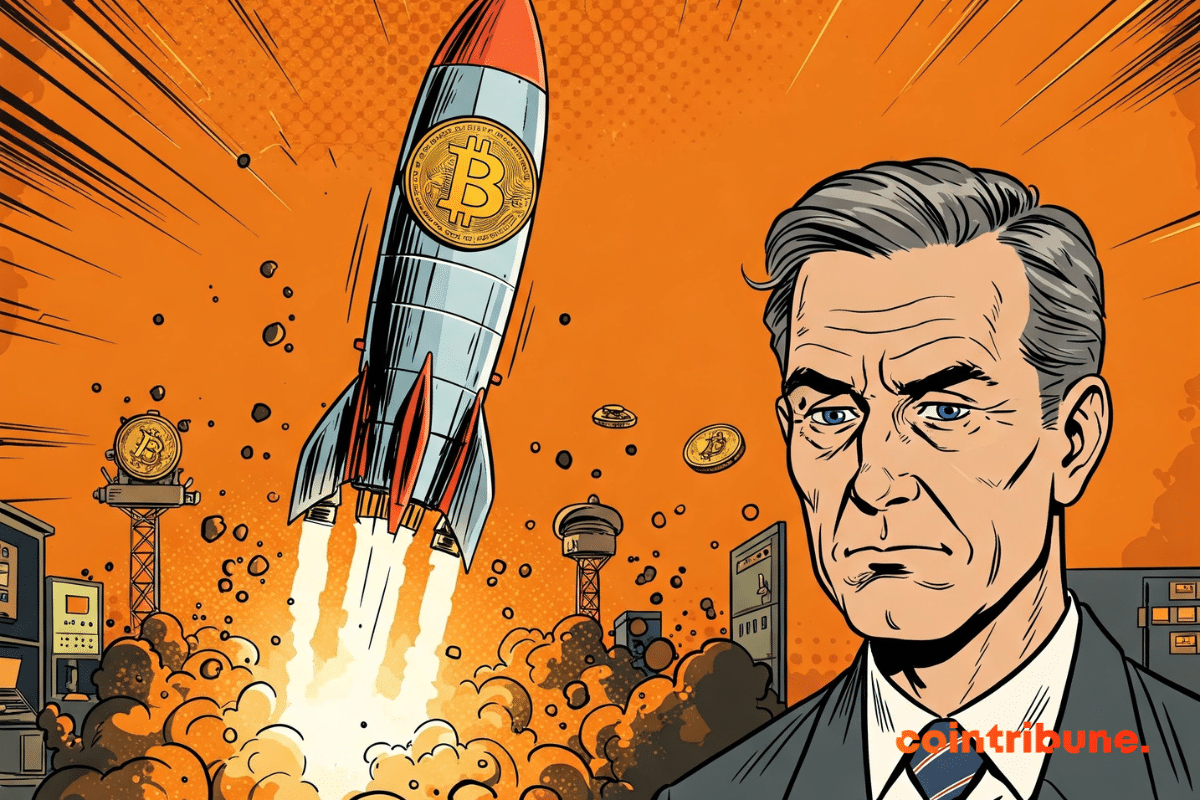
What if the dollar wavered under the weight of its own contradictions? Larry Fink, CEO of BlackRock, the global asset management giant, issues a striking warning: Bitcoin could supplant the American dollar as the world's benchmark currency. This prophecy, far from being isolated, is set against a backdrop of growing distrust towards the greenback. Between the explosive debt of the United States and the meteoric rise of cryptocurrencies, the global financial landscape is undergoing a transformation.
Bitcoin ruthlessly crushes the hopes of Ether. The ETH/BTC ratio has just hit its lowest level in five years, at 0.02193. A staggering drop of 39% in one year. For the first time since a halving, Ether is bending under the weight of its elder. What is behind this historic reversal? Between being a safe haven in the face of macroeconomic turbulence and the repositioning of investors, Bitcoin consolidates its status as a safe-haven asset. A deep dive into the mechanics of an unequal duel.
In light of the deadlock in the conflict in Ukraine, Donald Trump is changing his tone and threatening Moscow with an economic sledgehammer. The American president, who has so far been measured towards the Kremlin, is now brandishing the card of tariff sanctions on Russian oil. The stated objective is indeed to force Vladimir Putin to move towards a ceasefire. A shocking statement that fractures diplomatic balances and elicits reactions even in European capitals, at a time when the slightest tension can redefine the global geopolitical chessboard.
As Bitcoin wavers below $85,000, Michael Saylor, an iconoclastic figure in crypto, challenges the turbulence. His company, Strategy (formerly MicroStrategy), has just swallowed up $1.9 billion in the purchase of 22,000 BTC. A gamble? More like a show of strength. In a market shaken by Trump’s protectionist announcements and macroeconomic uncertainty, Saylor embodies an unshakeable conviction: Bitcoin remains the Holy Grail of digital assets.
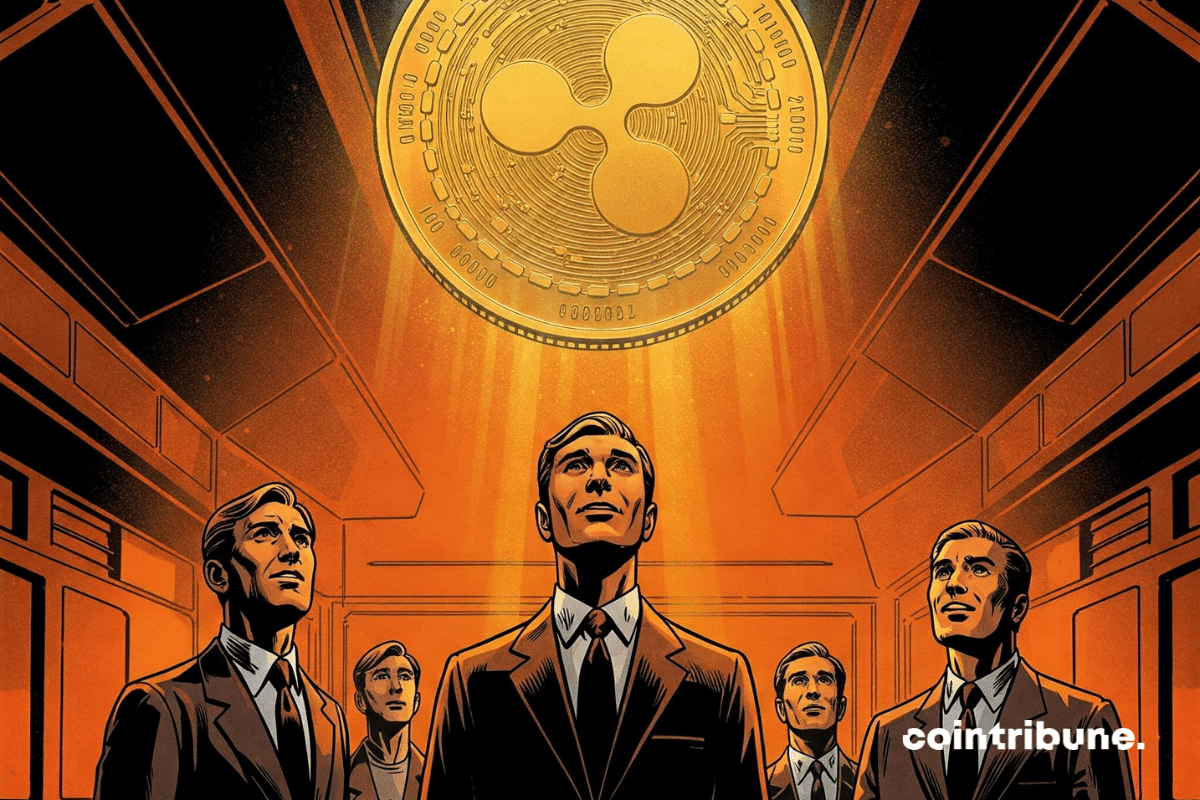
XRP's Drop: Ripple's Crypto Becomes the Weakest in the Top 10. A Comprehensive Analysis of a Descent into Hell that Worries Traders.
The numbers are falling, dry and relentless. In one month, developer activity on Ethereum, a cornerstone of the crypto ecosystem, has dropped by 11.8%. A decline that is not isolated: BNB Chain, Polygon, Arbitrum… All are seeing their metrics crumble. Worse, according to Santiment, some networks are losing up to 25% of their activity. This gradual desertion of coders, the nerve of blockchain innovation, is not a simple fluctuation. It is a critical signal for a sector that once dreamed of being unstoppable.
In just ten days of existence, PumpSwap has established itself as a major player in the decentralized exchange ecosystem. This platform, launched by Pump.fun, already shows impressive figures that testify to its rapid adoption by the crypto community.
Amid revolutionary announcements, technological evolutions, and regulatory turbulence, the crypto ecosystem continues to prove that it is both a territory of limitless innovations and a battleground of regulatory and economic conflicts. Here is a summary of the most significant news from the past week regarding Bitcoin, Ethereum, Binance, Solana, and Ripple.
The billionaire Elon Musk's favorite cryptocurrency wobbles after a statement that is as brief as it is devastating. In a few words, Musk has reignited doubts about the future of Dogecoin. A turning point that could signal the beginning of a downward spiral for the famous memecoin.
Binance merges two worlds that are opposed to each other. For the first time, users of a centralized exchange can interact with DEXs without leaving their interface. An innovation that radically simplifies access to DeFi, which has long been hindered by its technical complexity. By unifying these universes, Binance could well reshape the future of crypto exchanges.
As wealth inequalities worsen, another reality looms: Generation Z, often perceived as economically fragile, is set to become the richest in history by 2045. A study by Bank of America challenges preconceived notions by projecting an unprecedented shift of wealth towards this hyperconnected youth. Contrary to alarmist narratives, these forecasts reveal a generation on the rise, driven by economic, educational, and digital dynamics that are reshaping the contours of global financial power.
As Bitcoin hovers around $82,500, a breeze of optimism blows through the cryptosphere. Raoul Pal, a former Goldman Sachs executive and a key figure in macrofinance, throws a stone into the pond: according to him, Bitcoin is about to exit its correction phase and embark on a new ascent. His prediction? An explosion in prices, fueled by a little-known indicator to the general public: global liquidity. But behind these forecasts lie subtle mechanisms, where time, economic data, and market psychology intertwine.
A savvy crypto investor made a profit of 10 million dollars after investing only 2,000 dollars in the memecoin PEPE. His position reached a peak value of 43 million dollars before he decided to secure his gains.
A cold wind blows over crypto. The post-electoral momentum is fading. Bitcoin and Ethereum are wavering. The market looks elsewhere, uncertain, without a compass, waiting for the next breath.
American spot Bitcoin exchange-traded funds (ETFs) ended their remarkable streak of ten consecutive days of positive net inflows on Friday.
The Shiba Inu ecosystem is about to reach a historic milestone. The Shibarium blockchain, a layer 2 solution dedicated to this crypto universe, is nearing the billion transactions mark. At the time these lines are written, the counter shows more than 992 million transactions, with a daily rate exceeding 3.8 million. Just a few more days, and Shibarium will make history.
Announced as a strategic turning point, the integration of Pi Network into the Telegram wallet provided an unprecedented showcase for a project that already boasted a massive community. In an ecosystem where visibility can skyrocket an asset, PI seemed to be in a strong position. However, contrary to expectations, the token collapsed. The promise of accelerated adoption collided with the reality of the market. How can such a dissonance between the potential of an announcement and the brutality of a fall that raises questions about the project's solidity be explained?
The decision by American regulators to abandon "debanking" practices marks a decisive turning point for the cryptocurrency industry. David Sacks, crypto chief at the White House, describes this change as a "great victory" for the digital asset sector.
Solana is experiencing an unprecedented surge in activity: 11.12 million active addresses. In a crypto market where actual usage now takes precedence over promises, this figure marks the return of a network that some said was losing momentum, now propelled by visible, measurable, and concrete adoption. This dynamic, more than symbolic, repositions Solana as a structuring player in the ecosystem, with clear signals of resilience and traction.
After months of waiting, the main creditors of FTX finally see the light at the end of the tunnel. The bankrupt crypto platform announced that repayments will resume from May 30, 2025. This is an announcement highly anticipated by large investors, especially those hoping for a return on their frozen assets.
The price of Ethereum has fallen below 1,900 dollars, recording a decline of 6% over the last week. This drop jeopardizes several significant positions on MakerDAO with over 238 million dollars potentially at risk.
Ethereum is dead. For several venture capitalists, Ethereum has ceased to be a relevant investment asset. Layer-2 solutions, poorly controlled inflation, loss of revenue... Ethereum seems caught in a downward spiral that challenges its long-term financial viability. Analysis of a major strategic shift.
While several media outlets report that Bitcoin's dominance has reached a peak of 58.8% on March 28, 2025 – a record since April 2021 – a more nuanced reality emerges. According to our data, BTC hit a dominance peak of 61.2% two weeks earlier. This figure, overlooked or ignored, actually reveals a decline in Bitcoin's market share. Thus, is this the harbinger of an Altseason comeback?
The era of crypto interactions takes a new turn with ReachMe.io, the paid messaging platform launched by Binance and backed by BNB. This service allows users to communicate directly with opinion leaders for a crypto transaction fee. In 48 hours, the platform attracted 3,262 users and generated $24,000. An initiative that strengthens the utility of BNB and raises questions about the accessibility and monetization of exchanges in the Web3 ecosystem.
The storm is rumbling in the crypto market. This Saturday, the charts display an alarming red: bitcoin plunges below $84,000, Ethereum wavers around $1,880, and XRP crashes by 5%. A brutal correction, but not entirely unpredictable. Behind these numbers lie complex dynamics, where on-chain data and macroeconomic factors intertwine. Analysis.
Elon Musk announced on Friday evening the sale of his social network X to his own artificial intelligence company, xAI. This major transaction values X at $33 billion, slightly less than the initial purchase price of Twitter in 2022, but also includes $12 billion in debt.
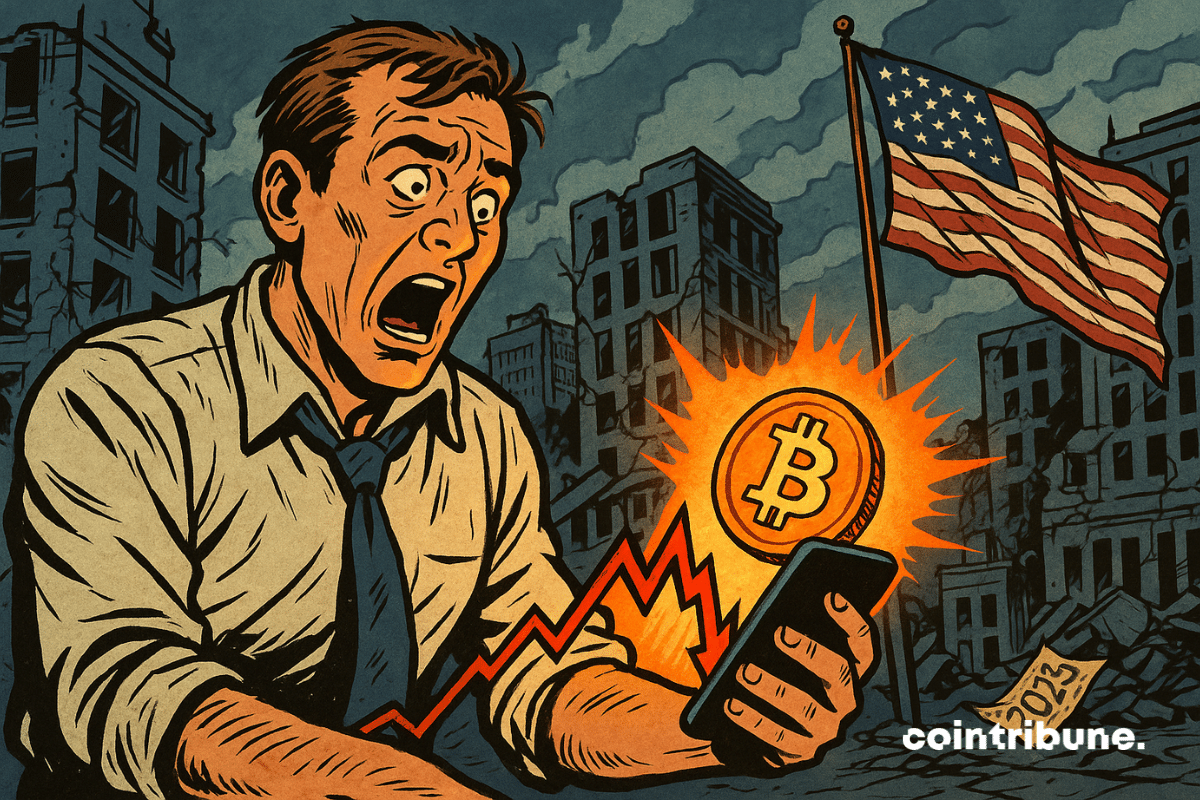
The volatility of Bitcoin is resurfacing. After a peak above $84,000, the cryptocurrency fell by 3.5% within a few hours. This decline fuels fears of a return to $72,000, a scenario that seemed unthinkable not long ago. The cause? Uncertain macroeconomic liquidity conditions, which undermine risky assets. Some analysts believe that the market could enter a critical phase, where the evolution of monetary policies and investors' appetite for risk will be decisive.
A global study reveals that real estate remains widely used for money laundering, with gaps identified in all the analyzed countries, including France, which nevertheless ranks among the good students.
This is a strong gesture that marks the first 100 days of Donald Trump's second term as president of the United States: the president has officially granted his presidential pardon to the three co-founders of the crypto exchange platform BitMEX - Arthur Hayes, Benjamin Delo, and Samuel Reed.