Tether Defends Its Reserves After Lowest Rating By S&P
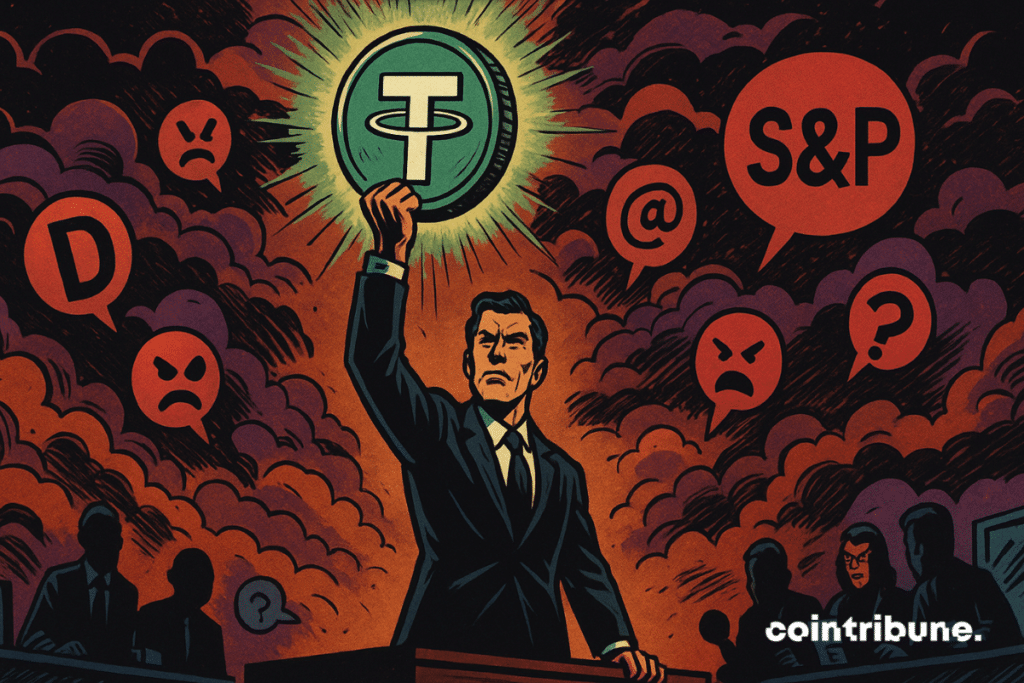
The stability of the market’s largest stablecoin is questioned. On November 29, the S&P agency downgraded USDT’s ability to maintain its peg to the dollar. Tether, through its CEO Paolo Ardoino, denounces a biased analysis and defends its figures. This confrontation between a central crypto player and a major financial institution reignites the debate on the solidity of reserves and trust in the ecosystem.
In Brief
- On November 29, S&P Global downgraded the stablecoin USDT’s ability to maintain its dollar peg.
- Tether, through its CEO Paolo Ardoino, denounces an incomplete analysis and defends the solidity of its reserves.
- Ardoino mentions 7 billion $ in excess equity and 500 million $ in monthly profits from Treasuries.
- This debate reignites questions on transparency, stablecoin resilience, and the crypto market’s dependence on USDT.
S&P downgrades USDT, Tether fights back with its figures
On November 29, S&P Global Ratings lowered the reliability rating of USDT, the stablecoin issued by Tether, to its lowest level.
The agency justifies this decision by Tether’s exposure to assets considered too volatile, notably bitcoin and gold, to guarantee absolute stability against the dollar. This rating immediately sparked a wave of criticism and doubts about the strength of the Tether model, already closely scrutinized by authorities and market players.
Tether’s CEO Paolo Ardoino responded quickly and fiercely. He firmly rejects S&P’s conclusions, stating that the agency’s analysis omits essential elements.
“S&P made the same mistake by not taking into account the group’s additional equity, nor the some 500 million dollars in monthly profits generated solely by returns on U.S. Treasury bonds“, he said.
He believes the rating is based on an incomplete view of Tether group’s consolidated accounts. Here are the main figures presented by Paolo Ardoino, based on the attestation report for the third quarter of this year :
- Total assets of the Tether group : approximately 215 billion dollars ;
- Stablecoin-related liabilities : approximately 184.5 billion dollars ;
- Excess equity : approximately 7 billion dollars ;
- Retained earnings included in equity : approximately 23 billion dollars ;
- Recurring monthly profits related to U.S. Treasury bonds: approximately 500 million dollars.
According to Ardoino, these figures show that Tether is largely over-collateralized, and the methodology used by S&P does not accurately reflect the consolidated financial reality of the group, notably its internal revenue and operating structure.
Analysts Divided : Should We Worry About Tether’s Strategy ?
Beyond the quarrel between Tether and S&P, this situation has sparked a strategic debate among sector analysts on the investment choices of the stablecoin issuer.
Arthur Hayes, founder of the BitMEX platform, has expressed concerns about the gold and bitcoin reserves held by Tether. According to him, these volatile assets could pose a risk in the event of a market downturn.
“A drop of about 30 % in the gold and BTC position would wipe out their equity, making USDT, in theory, insolvent“, he warned. Hayes assumes that the purchase of these assets serves to offset an anticipated drop in revenue from Treasury bonds, in anticipation of monetary easing by the U.S. Federal Reserve.
However, this view is far from unanimous. Joseph Ayoub, former senior crypto analyst at Citi, has rejected Hayes’ projections. He claims to have spent “hundreds of hours analyzing Tether” when he worked at Citi, and defends a very different position.
For him, Tether holds assets beyond what it publicly declares, operates an extremely profitable activity thanks to interest on Treasury bonds, while functioning with a lean structure of only 150 employees. He even states that Tether is “better collateralized than traditional banks“, and that its critics largely underestimate the strength of the model.
Tether targets a valuation of 500 billion dollars. However, the controversy with S&P highlights tensions between ambition and transparency. Between institutional distrust and meteoric growth, the stablecoin’s future will depend as much on its financial strength as its ability to convince beyond its adoption target.
Maximize your Cointribune experience with our "Read to Earn" program! For every article you read, earn points and access exclusive rewards. Sign up now and start earning benefits.

Diplômé de Sciences Po Toulouse et titulaire d'une certification consultant blockchain délivrée par Alyra, j'ai rejoint l'aventure Cointribune en 2019. Convaincu du potentiel de la blockchain pour transformer de nombreux secteurs de l'économie, j'ai pris l'engagement de sensibiliser et d'informer le grand public sur cet écosystème en constante évolution. Mon objectif est de permettre à chacun de mieux comprendre la blockchain et de saisir les opportunités qu'elle offre. Je m'efforce chaque jour de fournir une analyse objective de l'actualité, de décrypter les tendances du marché, de relayer les dernières innovations technologiques et de mettre en perspective les enjeux économiques et sociétaux de cette révolution en marche.
The views, thoughts, and opinions expressed in this article belong solely to the author, and should not be taken as investment advice. Do your own research before taking any investment decisions.