The Lowest Crypto Fees? OKX Beats the Competition
In the crypto ecosystem, transaction fees directly influence the profitability of a portfolio. This discreet but constant cost weighs heavily on active users, especially those who multiply orders or conversions. As the market matures, exchanges seek to distinguish themselves not only by their products but also by the transparency and efficiency of their pricing policy. OKX presents strong arguments in favor of its competitiveness, with a clear fee schedule, a progressive VIP system, and discounts via the OKB token. This article examines in detail the fees charged by OKX and compares them to those of Binance and Coinbase.
Understanding Fees Applied in the Crypto Ecosystem
Before evaluating exchanges’ pricing strategies, it’s important to clarify the different types of fees encountered in the cryptocurrency world. Each platform structures its costs around several categories, which follow different logics.
Trading, Withdrawal, and Network Fees
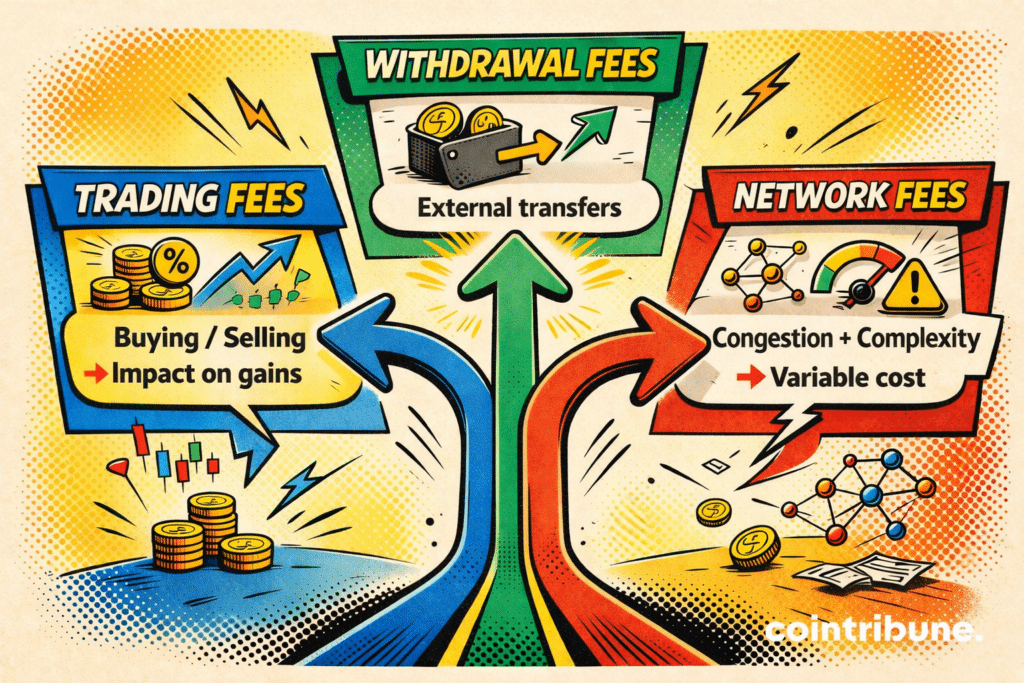
Trading fees correspond to a commission applied on each order executed on the platform. They are divided into two types: maker fees, when the user creates a pending order, and taker fees, when they execute an order already present in the order book. These fees are expressed as a percentage of the transaction amount.
Withdrawal fees occur when the user wants to transfer their assets to an external wallet. Unlike trading fees, these depend directly on the blockchain network on which the transaction takes place.
Finally, network fees, or gas fees, are paid to validators so that the transaction is processed on blockchains like Ethereum or BNB Smart Chain. These costs vary based on network load, transaction complexity, and desired priority.
Why Do These Fees Affect Wallet Profitability?
These various forms of fees have a direct impact on portfolio performance, even in the medium term. The accumulation of trading fees, especially for very active strategies like scalping, DCA, or arbitrage, can erode some potential gains.
Withdrawal fees must also be anticipated, particularly when the user regularly transfers funds between a centralized exchange, a wallet, and a DeFi protocol. Lastly, with gas fees, users must deal with fluctuations in the Gwei price, especially on Ethereum, where congestion periods abruptly increase the cost of even a simple operation.
OKX’s Fee Schedule in Detail
OKX offers a public fee structure that is clear and accessible from its interface. Unlike other exchanges that display variable conditions or limited promotions, OKX bets on long-term transparency.
Spot and Derivatives Trading Fees
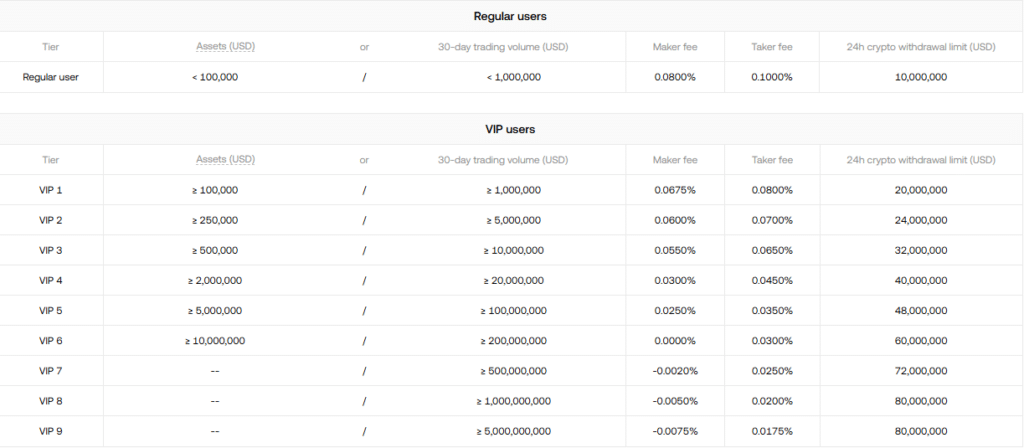
On the spot market, standard fees at OKX are 0.08% for maker orders and 0.1% for taker orders, from the first trade. These rates decrease quickly with the trading volume over 30 days. OKX’s VIP program includes eight levels. From a daily average volume of 1,000 USDT, the user already accesses a preferential level.
For derivatives trading, fees are even lower: 0.02% on the maker side and 0.05% on the taker side as a base. These rates compete directly with those of Binance Futures, while benefiting from a simplified display.
OKX also offers a discount of up to 40% through the use of its native token OKB. The more OKB the user holds, the greater the discount level, without manual intervention.
Crypto and Fiat Withdrawal Fees
OKX charges only the actual network cost during a crypto withdrawal. No additional fees are applied by the exchange itself. For example, an ETH withdrawal on the Ethereum network involves a direct payment of the gas fee calculated in Gwei, without markup. The user thus retains control over their exit fees.
For fiat withdrawals, OKX offers a solution via P2P Express, free of charge, on several payment methods. This service allows exchanging cryptos for euros, through verified sellers, without central commission or banking intermediary.
Fees Related to Additional Services
The OKX ecosystem includes several complementary products, accessible without additional cost. The Earn feature, dedicated to staking, charges no entry or exit commission. The integrated trading bots (DCA, Grid, etc.) operate without subscription. Only the usual trading fees apply.
Finally, copy trading incurs a commission only if the copied trade generates a profit, according to a predefined percentage. Thus, the user pays only in case of performance.
Comparison with Binance and Coinbase
OKX’s fee reputation is not based solely on its communication. A comparative analysis allows us to objectify the real gaps with its two main global competitors.
Comparison Table
| Criterion | OKX | Binance | Coinbase |
| Spot (maker / taker) | 0.08% / 0.1% | 0.1% / 0.1% | 0.5% to 1.49% |
| Derivatives | 0.02% / 0.05% | 0.02% / 0.04% | Not available |
| BTC Withdrawal | Gross network cost | Network cost + surcharge | Withdrawal + spread |
| Discount via token | OKB (up to -40%) | BNB (up to -25%) | No discount |
| P2P without fees | Yes (Express) | Yes (more complex) | No |
| Native bots / copy trading | Yes, without extra cost | Yes, complex navigation | No |
This table shows a clear advantage for OKX, notably on trading and withdrawal fees. Coinbase displays the highest rates, with little room for optimization for users. Binance remains competitive, but conditions related to BNB use and VIP status complicate real cost estimation.
Coinbase: Transparent but with Deterrent Fees
Coinbase mainly targets beginner and institutional users, with a strong emphasis on compliance. However, this rigor comes at a high cost. Direct card purchases sometimes reach 3% fees. The mobile app applies high commissions on each transaction. The lack of a discount mechanism makes the platform less suitable for active users.
Binance: Direct Competitor but with an Opaque Model
Binance remains OKX’s most serious competitor in terms of fees. However, its model is based on stacking discounts, via BNB staking, temporary campaigns, or VIP statuses. This complexity harms the clarity of actual costs. Additionally, some ancillary fees, such as fiat withdrawals or instant conversions, include spreads not visible in advance, which undermines the promise of low costs.
How to Reduce Your Fees on OKX: Tips and Strategies
OKX does not just display a competitive fee schedule. The platform provides several mechanisms allowing users to further reduce their fees. These strategies are aimed both at beginner traders and active or institutional investors.
Leveling Up in the VIP Program
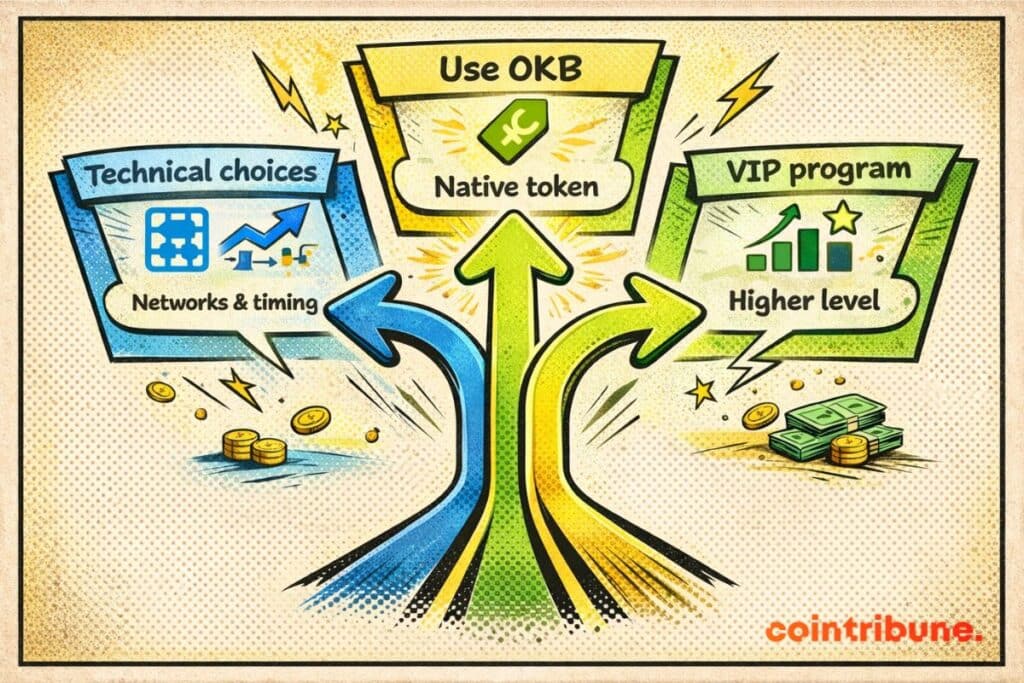
OKX rewards its users’ activity with a progressive VIP system. This program is based on the cumulative trading volume over 30 days, combining spot and derivatives transactions. As soon as a user reaches an average daily volume of 1,000 USDT, they gain access to VIP Level 1, which unlocks an initial discount on fees.
Benefits become significant from VIP Level 2, where fees drop to 0.06% for maker orders and 0.08% for taker orders. The higher the volume, the more levels progress, with fees going down to 0.02% for the most active clients. This system remains simple to understand and accessible to everyone, with no token holding obligation.
Using the OKB Token to Reduce Each Transaction
The native OKB token provides a second optimization lever. By maintaining a certain OKB balance in their account, the user automatically benefits from a discount on trading fees. The discount percentage varies according to the average amount of OKB held over the last seven days.
This mechanism requires no manual activation. The discount applies directly at the time of order execution. OKB can also be staked in the Earn section to generate passive income in parallel. Thus, the user combines fee reductions and returns on assets, without technical constraints.
Reducing Gas Fees with Smart Technical Choices
Network fees can represent a significant cost during withdrawals or transfers between wallets. To limit this expense, users have several simple strategies:
- Prefer alternative networks such as Tron, BNB Smart Chain, or Arbitrum instead of Ethereum;
- Consolidate withdrawals to avoid repeated fees;
- Avoid peak congestion times, especially during NFT events or DeFi spikes.
By combining these practices, it becomes possible to significantly reduce the total cost of each operation on OKX. In 2026, OKX stands out as one of the most competitive exchanges on the market in terms of fees. Its fee schedule remains clear, with no hidden surcharges, and its progressive VIP system adapts to all user profiles. The integration of the OKB token further optimizes each transaction. Compared to Binance, sometimes opaque, and Coinbase, too expensive, OKX offers a solid balance between performance, transparency, and accessibility. This advantageous positioning appeals to active traders, DeFi users, and those looking for an economical entry point into cryptos. A strategic choice to maximize results without compromising on experience quality.
The basic fee schedule is the same everywhere, but some fiat payment methods may involve specific fees depending on the country. P2P Express generally remains free of charge, regardless of the region.
Yes, OKX provides an integrated fee calculator in its interface. It allows precise estimation of costs based on order type, volume, and VIP level.
No, fees are deducted in crypto on the traded pair, but holding OKB automatically reduces applicable fees. No conversion is needed at the time of the order.
Maximize your Cointribune experience with our "Read to Earn" program! For every article you read, earn points and access exclusive rewards. Sign up now and start earning benefits.

Diplômé de Sciences Po Toulouse et titulaire d'une certification consultant blockchain délivrée par Alyra, j'ai rejoint l'aventure Cointribune en 2019. Convaincu du potentiel de la blockchain pour transformer de nombreux secteurs de l'économie, j'ai pris l'engagement de sensibiliser et d'informer le grand public sur cet écosystème en constante évolution. Mon objectif est de permettre à chacun de mieux comprendre la blockchain et de saisir les opportunités qu'elle offre. Je m'efforce chaque jour de fournir une analyse objective de l'actualité, de décrypter les tendances du marché, de relayer les dernières innovations technologiques et de mettre en perspective les enjeux économiques et sociétaux de cette révolution en marche.
The contents and products mentioned on this page are in no way approved by Cointribune and should not be interpreted as falling under its responsibility.
Cointribune strives to communicate all useful information to readers, but cannot guarantee its accuracy and completeness. We invite readers to do their research before taking any action related to the company and to take full responsibility for their decisions. This article should not be considered as investment advice, an offer, or an invitation to purchase any products or services.
Investment in digital financial assets carries risks.
Read more