The SEC Chairman Clarifies the Status of NFTs in the US Market
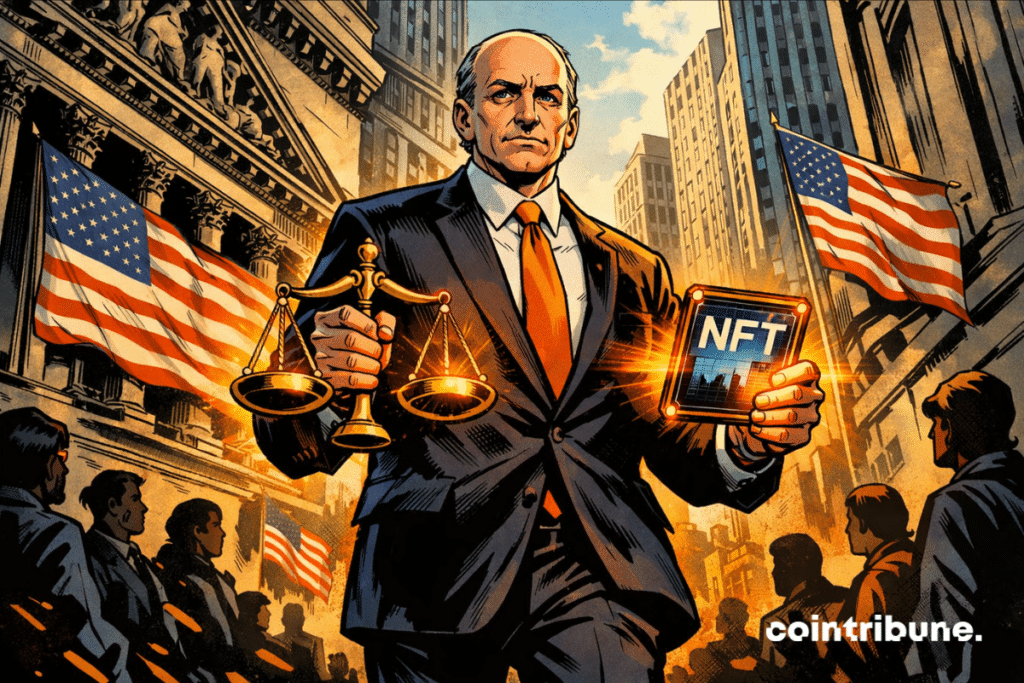
Crypto regulation is evolving in the United States with a major clarification on NFTs. Indeed, the chairman of the SEC, Paul Atkins, explained that these digital assets are generally considered collectibles. Thus, they do not fall under securities laws in most cases.
In Brief
- The SEC considers that NFTs are generally collectibles and not securities.
- Four types of digital assets are identified as outside the scope of securities laws.
- NFTs are still evaluated on a case-by-case basis according to their structure and actual use.
- Uncertainties persist despite these clarifications in a regulatory framework still evolving.
Four Types of Digital Assets Are Outside the Scope of Securities
After the United States Securities and Exchange Commission (SEC) published an interpretation establishing that most crypto assets are not securities, the regulatory framework has become clearer.
In an interview given Wednesday to CNBC, Paul Atkins confirmed this approach. He explained that the recent publication identifies four types of digital assets generally excluded from securities.
- digital commodities
- digital tools
- digital collectibles such as NFTs
- stablecoins
Thus, this distinction, according to Atkins, allows the market to be better structured. Besides, it helps companies and investors understand the applicable rules.
NFTs Are Considered Collectibles but Analyzed on a Case-by-Case Basis
Furthermore, he stated that NFTs (Non-Fungible Tokens) are similar to traditional collectibles. Indeed, users often buy them to keep, not to generate direct financial returns. Therefore, these digital assets do not meet, in the majority of cases, the definition of an investment contract. This distinction remains essential in regulatory analysis.
This approach likens NFTs to physical objects such as baseball cards, they are goods that users buy and keep, rather than assets intended to be traded. Their primary use thus plays a determining role in their classification.
However, regulation does not rely on a single rule. According to Atkins, each NFT is evaluated according to its own characteristics. Authorities notably examine the sales conditions, associated promises, and the issuer’s role.
Thus, some projects can be requalified as securities based on their structure. However, the majority of NFTs remain outside this framework. This case-by-case approach helps avoid an overly rigid classification of the market according to the SEC Chairman.
A Regulatory Clarification That Still Leaves Uncertainties About NFTs
These clarifications come after the US financial regulator mentioned, in another context, the establishment of a safe zone for crypto companies. This measure offers a more flexible framework during the initial development phases.
However, these elements do not clear all uncertainties. The design and use of NFTs still determine their qualification. Consequently, some situations may still generate different interpretations.
Moreover, this approach takes place in an evolving regulatory environment. Rules remain variable according to jurisdictions, complicating their application on an international scale. Thus, the regulatory trajectory remains open. Between progressive clarification and adaptation to uses, authorities will have to adjust their position facing a crypto market in constant evolution.
Maximize your Cointribune experience with our "Read to Earn" program! For every article you read, earn points and access exclusive rewards. Sign up now and start earning benefits.

Journaliste et rédacteur web passionné par l’univers des cryptomonnaies et des technologies Web3. J’y traite les dernières tendances et actualités afin de proposer un contenu de haute qualité à un large public du secteur.
The views, thoughts, and opinions expressed in this article belong solely to the author, and should not be taken as investment advice. Do your own research before taking any investment decisions.