Tokenization Of Stocks Could Divide Markets According To TD Securities
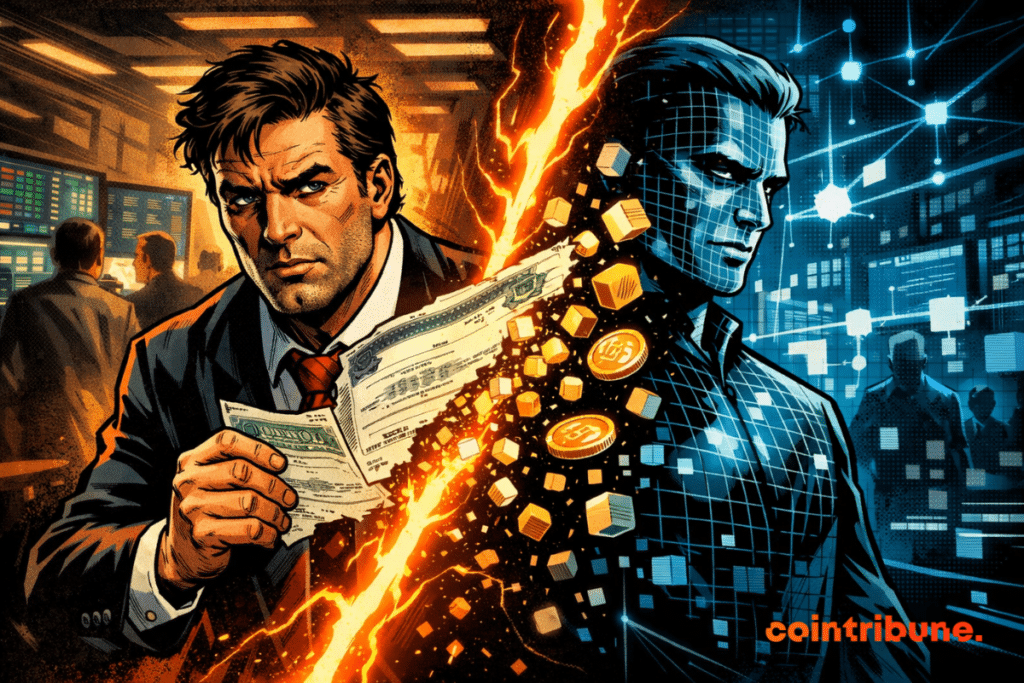
The tokenization of financial assets is gaining ground within institutions. Between technological innovation and market transformation, this development raises a strategic question: will it unify finance or fragment it? The Nasdaq initiative with TD Securities reignites the debate.
In brief
- The tokenization of stocks modernizes markets with increased accessibility and global continuous trading.
- This innovation could fragment liquidity and create several interconnected but less homogeneous markets.
A transformation driven by the tokenization of stocks
The Nasdaq is studying the tokenization of stocks in partnership with TD Securities. This approach aims to transform traditional securities into digital assets operable on blockchain.
This evolution paves the way for several structural changes:
- Splitting of shares, making investment more accessible
- Continuous trading, without time constraints
- Reduction of intermediaries, with faster transactions
The goal is thus a modernization of financial markets, often compared to aging infrastructures facing the capacities offered by blockchain.
An innovation that could fragment markets
TD Securities highlights a major risk: tokenization could divide liquidity among several platforms. Instead of a centralized market, several environments would then coexist.
This fragmentation introduces new challenges:
- Multiplication of liquidity pools
- Arbitrage between traditional and tokenized markets
- Increased complexity for institutional investors
In a simple analogy, the current market functions like a large single stock exchange. Tokenization could thus transform it into a constellation of interconnected but less homogeneous markets.
RWAs at the heart of financial transformation
The dynamic goes beyond listed stocks. The tokenization of real-world assets (RWA) is now a key lever for convergence between traditional finance and crypto. Data indeed indicates a significant increase in recent months.
Its main advantages:
- Global accessibility for investors
- Increased liquidity on historically illiquid assets
- Operational efficiency thanks to blockchain
Players like Securitize develop compliant infrastructures to integrate these assets within a regulated framework. This facilitates institutional entry.
A transition towards hybrid finance?
Tokenization does not immediately replace existing markets. It rather introduces an additional layer, comparable to the arrival of electronic trading compared to physical trades.
Today, two visions therefore oppose each other:
- A unified and more accessible finance
- A fragmented system composed of multiple infrastructures
The outcome will thus depend on the ability of actors to harmonize these new markets. One thing is certain, this transformation is already redefining the rules of the game, between technological innovation and financial balance.
In any case, tokenization is already reshaping financial markets. According to some analyses, it could reach 11 trillion dollars by 2030. One major unknown remains: will this revolution unify the markets or accelerate their fragmentation?
Maximize your Cointribune experience with our "Read to Earn" program! For every article you read, earn points and access exclusive rewards. Sign up now and start earning benefits.

My name is Ariela, and I am 31 years old. I have been working in the field of web writing for 7 years now. I only discovered trading and cryptocurrency a few years ago, but it is a universe that greatly interests me. The topics covered on the platform allow me to learn more. A singer in my spare time, I also cultivate a great passion for music and reading (and animals!)
The views, thoughts, and opinions expressed in this article belong solely to the author, and should not be taken as investment advice. Do your own research before taking any investment decisions.