Why Despite Record Performances, Ethereum, Solana, and Avalanche Fail
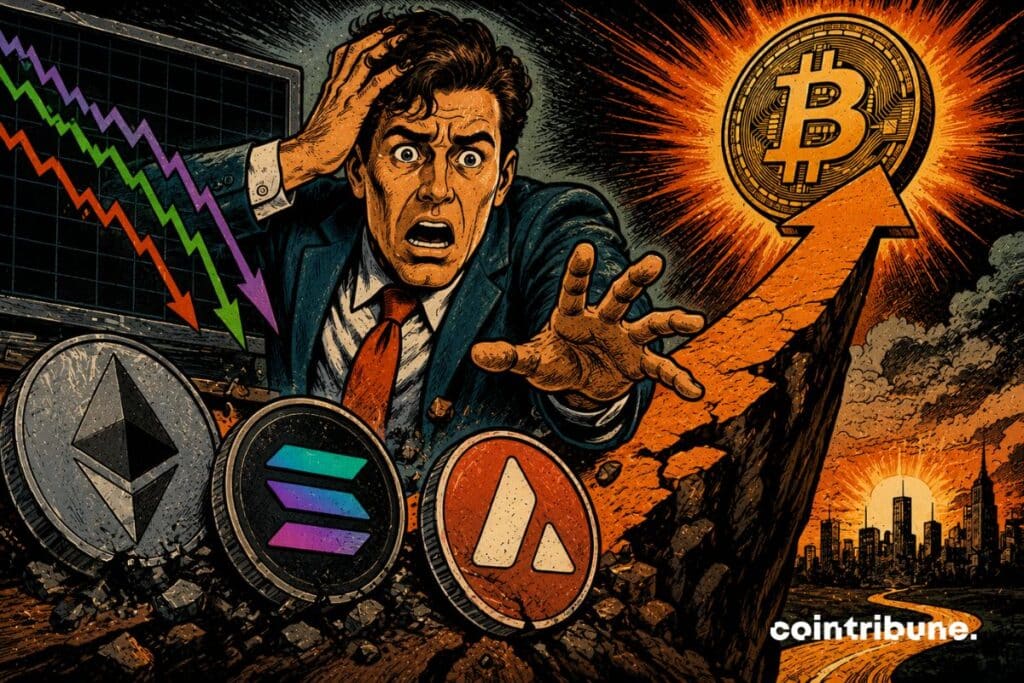
The Ethereum, Solana and Avalanche networks have never been more active with increasing transactions and plummeting costs. Yet, their tokens are collapsing. A troubling divergence that raises questions… is adoption enough to save prices?
In brief
- Transactions and efficiency explode on Ethereum, Solana and Avalanche, with costs divided by 3 to 10.
- Despite their growth, ETH, SOL and AVAX lose more than 50% of their value in one year.
- Token inflation, dilution of staking rewards and Layer 2 competition weigh on their prices.
Crypto: Ethereum, Solana and Avalanche Break Records!
In 2026, the blockchains Ethereum, Solana and Avalanche are running at full capacity and the numbers speak for themselves. Ethereum saw its transactions leap 68% in one year, rising from 121.1 million to 203.9 million in the second quarter of 2026. Solana and Avalanche follow the same trend, with transaction volumes doubling, even multiplying by ten, depending on the periods. Moreover, transaction fees have collapsed. On Solana, the average cost dropped to $0.005, compared to $0.030 a year earlier. Ethereum cut its fees by three, going from $1.08 to $0.31.
This performance is explained by major protocol improvements:
- On Ethereum, the Dencun upgrade reduced Layer 2 costs by optimizing data storage;
- Solana benefited from Firedancer, a high-performance client that boosted its transaction processing capacity;
- Avalanche has, for its part, bet on subnets to scale its ecosystem.
However, these technical advances have a hidden cost: validator revenues are collapsing. Indeed, with falling fees, rewards in native tokens (ETH, SOL, AVAX) melt away like snow in the sun. As a result, validators earn less, and crypto investors are questioning.
Why ETH, SOL and AVAX Collapse Despite Their Performances?
Here lies the heart of the problem. Record activity does not translate into price increases. On the contrary, Ethereum (ETH) has lost over 50% of its value since July 2025, while Solana (SOL) and Avalanche (AVAX) have dropped 53% and 58% respectively. This dichotomy is explained by several factors:
Token Inflation:
Staking rewards are mostly funded by the issuance of new tokens (93% for Ethereum, over 90% for Solana). As a result, a massive dilution of the value of existing tokens, especially if demand does not keep up.
The Law of Supply and Demand:
This law works against these blockchains. Indeed, with an increasing supply of blockspace and stagnant demand, prices collapse. As Kam Benbrik, head of on-chain research at Bitwise, summarizes:
Networks are operating at full capacity… but no one wants to pay for the fuel.
Staking Becomes a Double-Edged Trap:
With 40.2 million ETH (one-third of the total supply) currently staked, rewards are shared among an increasing number of participants, reducing individual returns. Bitmine, the largest Ethereum holder, stakes 4.9 million of the 5.8 million ETH it owns, illustrating this trend well.
Competition from Layer 2:
Indeed, competition from Layer 2s like Arbitrum, Optimism or Base (Coinbase) captures an increasing share of transactions, depriving Layer 1s of potential revenue.
In the crypto ecosystem, record activity is no longer enough. Without strong demand, ethereum, solana and avalanche tokens are collapsing. In your opinion, should you bet on long-term adoption or fear a lasting crash? Do you think this divergence between adoption and price is a buying opportunity… or a sign of a structurally troubled market?
Maximize your Cointribune experience with our "Read to Earn" program! For every article you read, earn points and access exclusive rewards. Sign up now and start earning benefits.

The world is evolving and adaptation is the best weapon to survive in this undulating universe. Originally a crypto community manager, I am interested in anything that is directly or indirectly related to blockchain and its derivatives. To share my experience and promote a field that I am passionate about, nothing is better than writing informative and relaxed articles.
The views, thoughts, and opinions expressed in this article belong solely to the author, and should not be taken as investment advice. Do your own research before taking any investment decisions.