77% of Americans See Crypto as Risky for Retirement
On August 26, 2026, the National Institute on Retirement Security (NIRS) publishes a study that reignites the debate within the crypto community. The survey, conducted between October 24 and November 15, 2025, was carried out by Greenwald Research among 1,203 Americans aged 25 and over. The result? 77% of Americans see cryptocurrencies as a risky investment in company retirement plans. 46% even consider them very risky. That’s not all! The survey also indicates that 53% of respondents do not want employers to offer crypto as an investment option in 401(k) plans.

In Brief
- 77% of Americans consider crypto risky for their retirement.
- Among them, 46% consider it very risky.
- 53% reject a crypto option offered by their employer.
- Washington facilitates its access to 401(k) plans without making it mandatory.
The Debate on Crypto in 401(k)s Intensifies Further in 2026
The figures published by NIRS highlight two distinct facts:
- 46% of Americans surveyed consider the presence of crypto-assets (notably bitcoin) in a retirement savings plan “very risky”;
- 31% consider it “somewhat risky”.
In total, 77% of Americans surveyed therefore associate cryptocurrency with a risk in professional retirement savings.
Conversely, 10% consider this choice to be low risk and 2% assign no risk to it. The remaining 10% state they are unaware of possible discrepancies in totals from rounding applied by the institute.
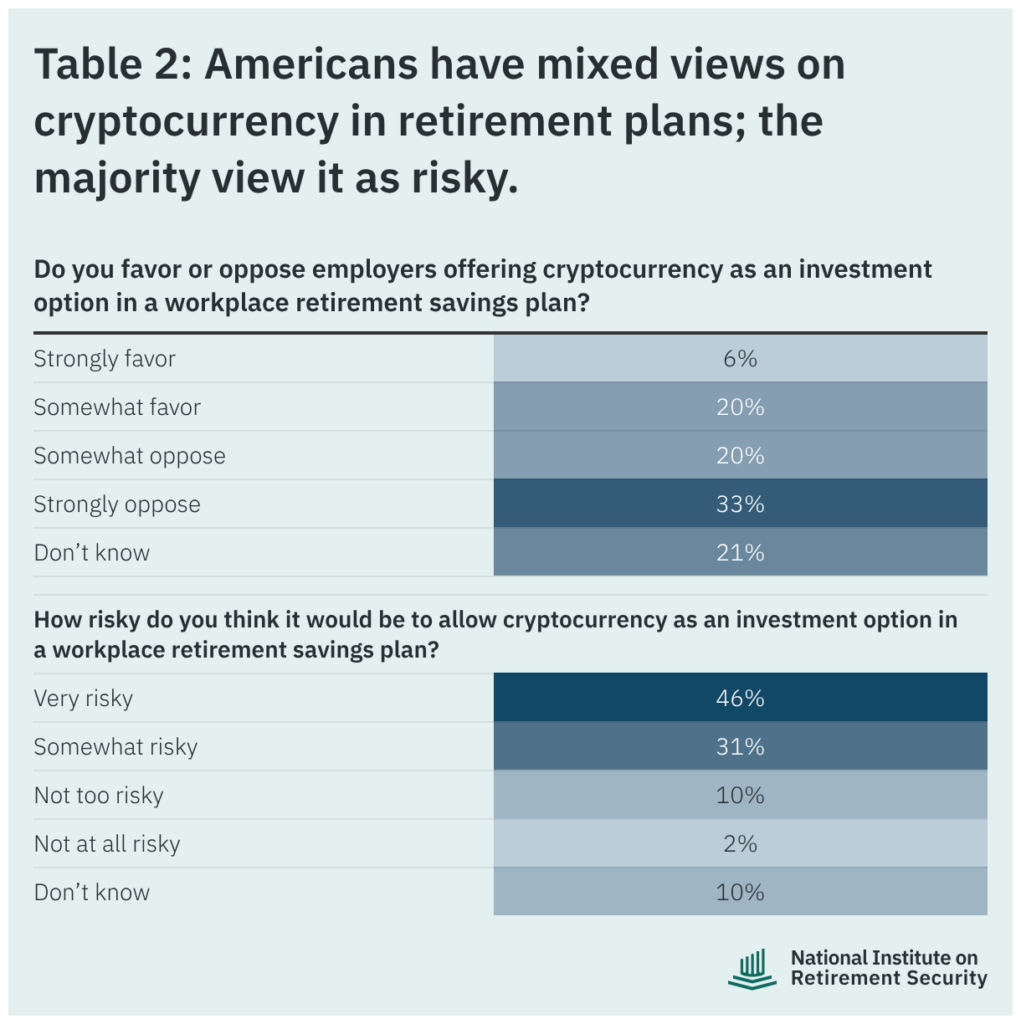
However, NIRS emphasizes an important point: perception of risk does not automatically mean rejection. The survey indeed shows that 53% of participants oppose their employer offering a crypto option. Among them, 33% strongly oppose it. Conversely, 26% support this option and 21% did not express an opinion.
Why Do 77% of Americans Consider Crypto Risky?
According to the results of the study published by NIRS, the gap of 24 points between perceived risk and declared opposition is particularly significant. It indeed suggests that some Americans might accept the existence of a crypto option. They consider it risky without necessarily using it themselves.
The main cause of this reluctance: limited knowledge of digital assets. According to NIRS, 47% of respondents have heard of crypto without really knowing it. 4% have never heard of it. Upstream, only 9% already report holding this type of investment and 15% say they are very familiar with the crypto universe.
Dan Doonan, Executive Director of the National Institute on Retirement Security, also links this caution to pressures already weighing on households. On August 26, he stated:
Americans tell us that retirement security is becoming increasingly difficult to achieve as they struggle with the affordability of daily life. Housing, healthcare, debt, and other expenses compete with the need to save for retirement. At the same time, Americans face new questions about artificial intelligence and cryptocurrency as the retirement landscape becomes increasingly complex.
That’s not all! This distrust of crypto assets is part of a broader financial concern. The report establishes that 80% of Americans see a national retirement crisis, compared to 67% in 2020. 61% even fear not achieving financial security once retired.
Another important detail: inflation fuels the concerns of 73% of respondents and market volatility those of 62%.
Crypto in 401(k): Washington Accelerates Despite 53% Opposition
On May 28, 2025, the U.S. Department of Labor withdraws a 2022 recommendation that urged 401(k) plan managers to exercise “extreme caution” before adding a crypto option. The administration then restored a neutral approach between asset categories without mandating their inclusion.
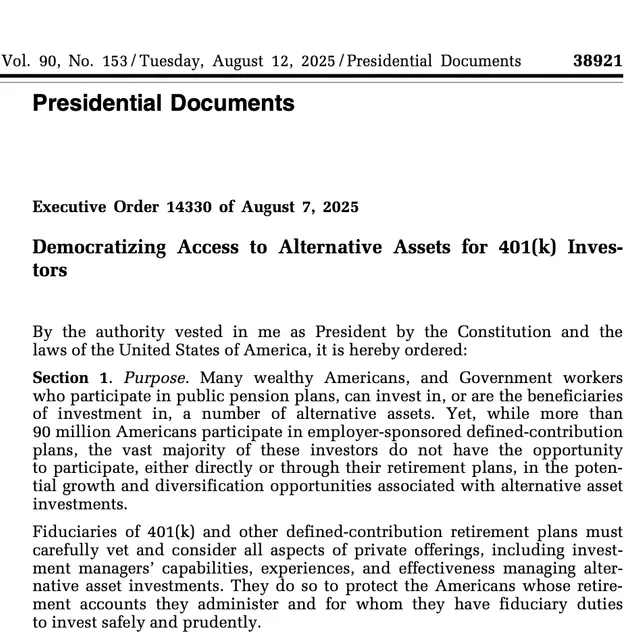
On August 7, 2025, Donald Trump signs decree 14330 to expand access to alternative assets for defined contribution plans. The Department of Labor then published on March 31, 2026, a draft rule creating a legal protection mechanism based on the selection method. Managers should evaluate six criteria:
- performance;
- fees;
- liquidity;
- valuation;
- benchmark index;
- complexity.
At the date of NIRS’s report publication, this text remains a proposal. It does not make crypto mandatory in 401(k) plans.
In the short term, the regulatory easing thus neither guarantees adoption nor massive flows towards digital assets. The NIRS survey also shows that the decisive battle will focus on trust, information, and risk management.
In any case, this study raises questions about the place of cryptocurrencies in the American financial architecture. If crypto regulation continues to ease under the White House’s impetus, the gap between growing institutional offerings and persistent savers’ distrust could become one of the major economic and political debates in the United States in the coming years.
Maximize your Cointribune experience with our "Read to Earn" program! For every article you read, earn points and access exclusive rewards. Sign up now and start earning benefits.

My name is Ariela, and I am 31 years old. I have been working in the field of web writing for 7 years now. I only discovered trading and cryptocurrency a few years ago, but it is a universe that greatly interests me. The topics covered on the platform allow me to learn more. A singer in my spare time, I also cultivate a great passion for music and reading (and animals!)
The views, thoughts, and opinions expressed in this article belong solely to the author, and should not be taken as investment advice. Do your own research before taking any investment decisions.