Anonymous voting on Ethereum: Vitalik Buterin's secret dream
Crypto has its legendary pioneers who have marked the history of blockchain. Satoshi Nakamoto laid the foundations of Bitcoin, CZ built an empire on Binance. Charles Hoskinson shaped Cardano, and Vitalik Buterin created Ethereum with a unique vision. We all know Vitalik Buterin for his endless proposals to technically improve the ecosystem. Once again, he surprises by unveiling a bold approach to protect votes in the crypto universe. This news generates as much hope as legitimate questions.
In brief
- Vitalik Buterin proposes indistinguishable obfuscation for private and unbreakable on-chain votes.
- This technology could eliminate threshold committees and make governance harder to manipulate.
- But execution times are galactic, far too slow for practical use today.
- Buterin has allocated 16,384 ETH to privacy initiatives on Ethereum.
Vitalik Buterin unveils the “final boss” of cryptography
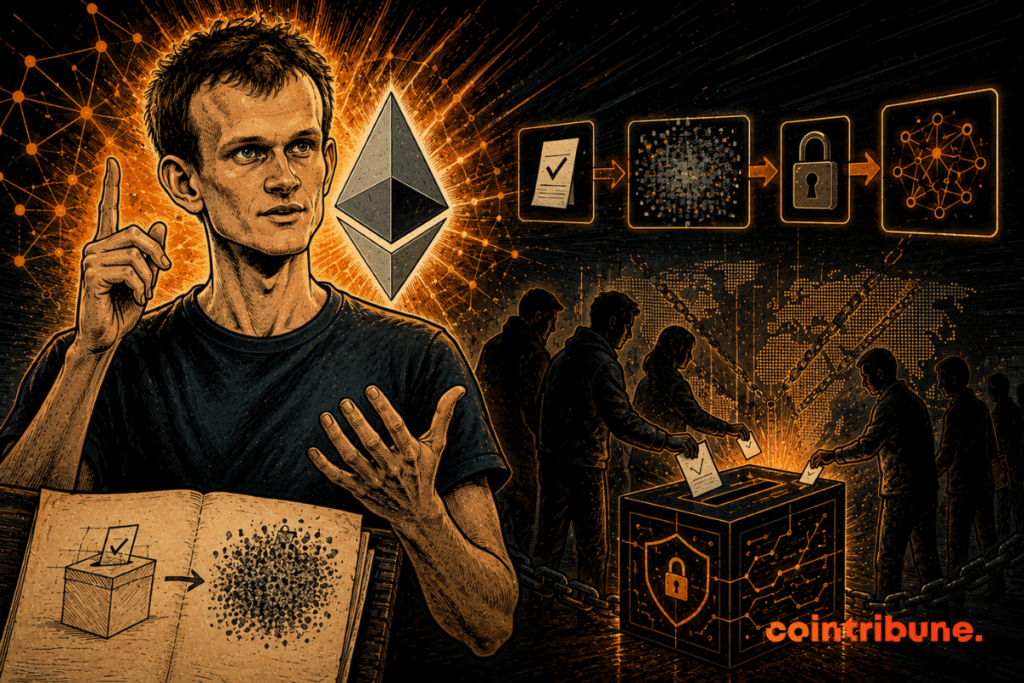
Vitalik Buterin, the man who fears AI agents, published a technical essay detailing how indistinguishable obfuscation (iO) could enable private on-chain voting. “The most powerful primitive ever designed in cryptography is obfuscation“, he specifies.
Obfuscation could simulate a trusted third party without any real trust, a fascinating feat. Combined with a blockchain, iO would eliminate the need for threshold committees. These potentially corruptible groups of operators would become obsolete.
The paradox is striking: Vitalik Buterin imagines a system where trust is no longer necessary. Decentralized governance would be more difficult to manipulate for malicious actors.
The ethics of this approach raises questions about the limits of total decentralization.
A fascinating vision, but a galactic execution
If obfuscation is the most powerful primitive, its computational cost is literally “galactic.” The most rigorous constructions require execution times longer than the lifespan of the universe.
The execution time is literally galactic.
Source: Vitalik Buterin, blog post, June 29, 2026.
Vitalik Buterin himself acknowledges that the technology remains “impractical.” It is a “long-term research direction“, not a deployable solution.
The antithesis is disconcerting: the potential is immense, the reality very distant. Is Vitalik Buterin’s will a proof of genius or naivety?
The debate is wide open within the crypto community. Some see it as an exaggerated and unrealistic ambition. Others praise the consistency of a visionary pushing the limits of technology.
An odyssey to preserve privacy on Ethereum
Vitalik Buterin does not just theorize about obfuscation in his technical writings. He has allocated 16,384 ETH (about 45 million dollars) to privacy-focused initiatives. He has proposed a roadmap to integrate privacy tools into Ethereum wallets.
This quest is part of a larger strategy: to make Ethereum a truly private and sovereign ecosystem. Privacy has become a central issue for the crypto industry.
Obfuscation could one day protect votes, transactions, and identities. But the path to achieve this is still very long. Vitalik Buterin continues to explore all possible avenues.
The key figures from Vitalik Buterin’s essay
- 16,384 ETH allocated to privacy;
- 45 million dollars invested in infrastructure;
- 1,567 dollars: ETH price at the time of writing;
- June 29, 2026: date of essay publication;
- “Galactic” execution time for obfuscation.
Vitalik Buterin explores all angles of tech, from AI to quantum computing. He sees artificial intelligence as a means to improve DAOs. Obfuscation remains a distant goal, but his quest for total decentralization does not weaken.
Maximize your Cointribune experience with our "Read to Earn" program! For every article you read, earn points and access exclusive rewards. Sign up now and start earning benefits.
La révolution blockchain et crypto est en marche ! Et le jour où les impacts se feront ressentir sur l’économie la plus vulnérable de ce Monde, contre toute espérance, je dirai que j’y étais pour quelque chose
The views, thoughts, and opinions expressed in this article belong solely to the author, and should not be taken as investment advice. Do your own research before taking any investment decisions.