Crypto: USDT Overtakes Ethereum at the Top of the Market
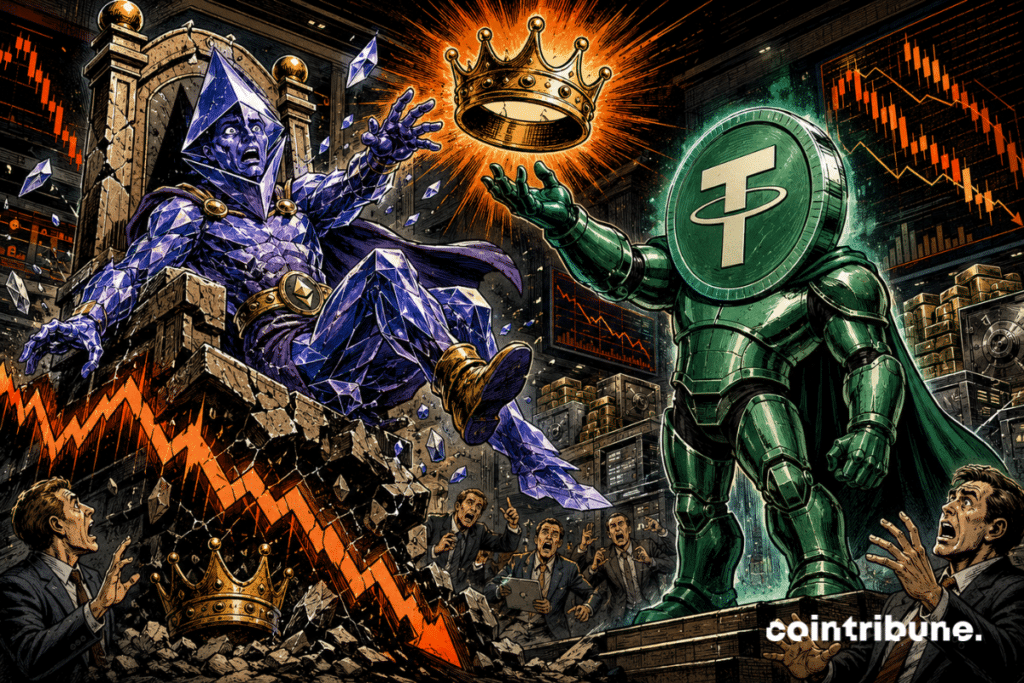
The crypto ranking experienced a rare shift on June 26. Tether’s USDT briefly surpassed Ether in market capitalization, becoming the second cryptocurrency in the market behind Bitcoin. This reversal did not come from an increase in the USDT price, but from Ethereum’s sharp drop to its lowest level in 2026.
In brief
- USDT briefly surpassed Ether with over 186 billion dollars in capitalization.
- Ethereum fell near 1,510 dollars, its lowest level in 2026.
- The growth of stablecoins reveals a crypto market that has become more defensive.
USDT briefly surpasses Ethereum crypto
USDT reached a capitalization close to 186.06 billion dollars. At the same time, Ether’s capitalization fell to around 185.66 billion. Tether’s stablecoin thus temporarily occupied the second place in the crypto ranking. A scenario that some observers had already considered when Ethereum’s position began to seem less solid.
The crossover remained narrow. By June 27, Ether had recovered a capitalization close to 190 billion dollars thanks to a rebound in its price. USDT remained around 186 billion, with no major variation in its unit value.
This difference highlights a key particularity. Ethereum’s capitalization depends directly on the price of ETH. USDT’s capitalization evolves mainly according to the number of tokens in circulation, as each unit aims to maintain a value close to one dollar.
The surpassing therefore does not mean that investors have suddenly valued Tether as a blockchain technology superior to Ethereum. It rather shows that digital dollars are gaining ground while volatile crypto assets retreat.
Ethereum falls to its lowest level in 2026
Ether fell near 1,510 dollars on Coinbase, its lowest level of the year. The drop reached about 5.2% over twenty-four hours and nearly 9% over a week. It was enough to push its capitalization below that of USDT.
The correction becomes even more striking when compared to the August 2025 peak. At that time, ETH traded around 4,946 dollars. The decline now exceeds 68%, bringing the price back to levels seen in 2023 and April 2025.
Ethereum nevertheless retains significant activity in decentralized finance, stablecoins, and tokenization. But the crypto market does not automatically reward the use of a network. Demand for its token also depends on the economic context, speculation, and investor confidence.
This weakness does not only affect Ether. It weighs on all altcoins, often more sensitive to capital outflows than Bitcoin. When risk increases, investors often favor liquidity or assets considered more defensive.
Stablecoins rise in the crypto rankings
USDT is not the only stablecoin to have benefited from the decline. Circle’s USDC also surpassed XRP in capitalization. USDC was nearly 74 billion dollars, against about 65 billion for XRP after its fall to one dollar.
Again, stablecoins did not experience a spectacular price increase. Their value remained close to one dollar. It is the competing crypto assets that declined, allowing stable digital currencies to gain ground.
This growth also reflects a real increase in their supply. The stablecoin market reached new records in 2026, even as several major cryptocurrencies lost value. USDT retains first place, while USDC gains ground in payments and on-chain transactions.
Stablecoins now represent a significant share of the total crypto capitalization. They serve as a temporary reserve for traders, a means of settlement in DeFi, and a tool for international transfers. Their demand no longer depends solely on periods of speculative euphoria.
For Ethereum, the challenge now is to turn its technical activity into a sustainable demand for ETH. For Tether, the issue will be to maintain confidence around its reserves and its dollar peg. In both cases, this episode confirms that stablecoins are no longer just secondary tools. They now occupy the center of the crypto market.
Maximize your Cointribune experience with our "Read to Earn" program! For every article you read, earn points and access exclusive rewards. Sign up now and start earning benefits.

Enseignante et ingénieure IT, Lydie découvre le Bitcoin en 2022 et plonge dans l’univers des cryptomonnaies. Elle vulgarise des sujets complexes, décrypte les enjeux du Web3 et défend une vision d’un futur numérique ouvert, inclusif et décentralisé.
The views, thoughts, and opinions expressed in this article belong solely to the author, and should not be taken as investment advice. Do your own research before taking any investment decisions.