Project Eleven Awards 1 BTC Q-Day Prize for Largest Quantum Attack on Elliptic Curve Cryptography to Date
— Project Eleven (@projecteleven) April 24, 2026
Researcher breaks 15-bit ECC key on publicly accessible quantum hardware in a 512x jump from the previous public demonstration.
Project Eleven today awarded the Q-Day…
A
A
A researcher manages to break a crypto key with a publicly accessible quantum computer
Sat 25 Apr 2026 ▪
3
min read ▪ by
Getting informed
▪
Crypto regulation
Summarize this article with:
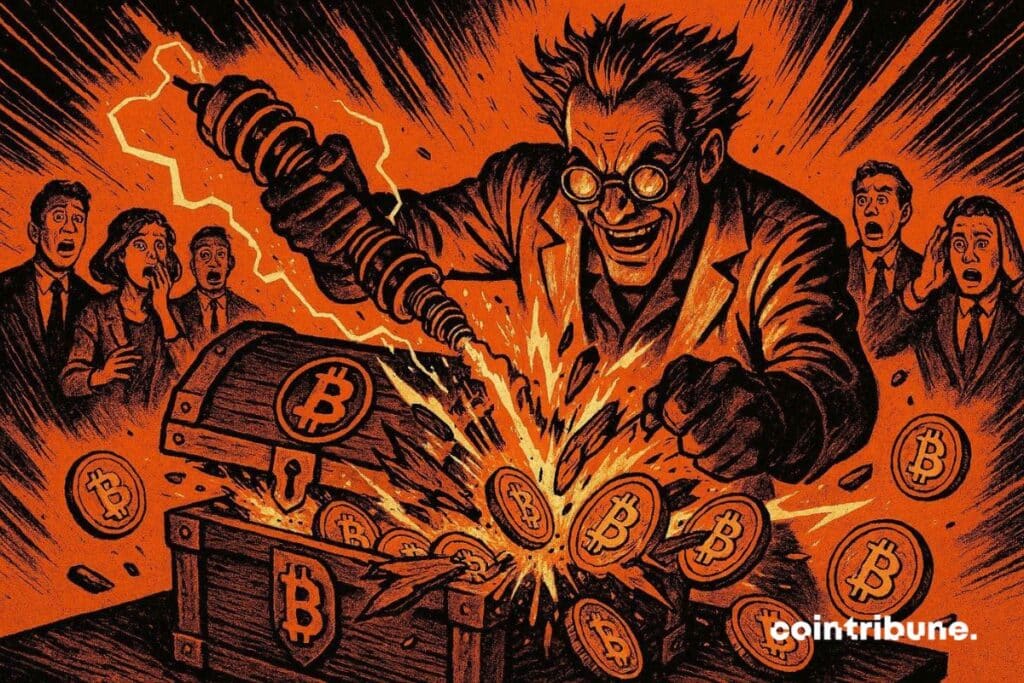
An independent researcher has managed to break a 15-bit elliptic crypto key on a publicly accessible quantum computer, winning a prize of 1 Bitcoin. This breakthrough, 512 times more powerful than the previous one, raises an urgent question: are blockchains truly ready for the quantum era?
In brief
- An independent researcher broke a 15-bit elliptic key on cloud-accessible quantum hardware.
- This breakthrough, 512 times more powerful than the previous record, lowers estimates to break 256-bit keys to under 500,000 qubits.
- 6.9 million bitcoins (1/3 of supply) are vulnerable if blockchains do not quickly migrate to post-quantum algorithms.
A researcher breaks a crypto key with a quantum computer
According to Vitalik Buterin, crypto has until 2028 to avoid quantum collapse. However, Giancarlo Lelli, an independent researcher, has just made history by breaking a 15-bit elliptic crypto key on quantum hardware accessible via the cloud! Proving that quantum attacks are no longer reserved for ultra-specialized labs. This demonstration, rewarded by the Q-Day Prize (1 Bitcoin), surpasses the previous record from September 2025 by 512 times. Indeed, Lelli exploited a variant of Shor’s algorithm targeting the discrete logarithm problem on elliptic curves (ECDLP), the basis of the digital signatures securing Bitcoin and Ethereum.
Unlike theoretical attacks, this breakthrough shows that the quantum threat is becoming tangible, even with limited resources. This success underlines a worrying trend. Namely, the collapse of costs and technical barriers to break crypto keys. A Google study published in April 2026 now estimates that an attack on a 256-bit key (current standard) would require less than 500,000 qubits, compared to millions previously.
Is Bitcoin in danger from the quantum computer?
Although Bitcoin uses 256-bit keys, this breakthrough revives fears about the long-term security of blockchains. About 6.9 million bitcoins (one third of the total supply) are stored in crypto addresses whose public keys are visible on the chain, making them vulnerable to a future quantum attack. For experts, the immediate risk remains limited, but the exponential progress of quantum capabilities calls for a rapid response.
To this end, solutions like BIP-360 (Bitcoin) or Ethereum’s migration plans towards post-quantum algorithms are underway. These proposals aim to replace ECC signatures with resistant alternatives, such as signatures based on Euclidean lattices. For Alex Pruden, CEO of Project Eleven, the window to act is closing. Blockchains must speed up their transition, or risk exposing billions of dollars in funds to quantum attacks in the coming years.
Lelli’s breakthrough proves that the quantum threat is no longer theoretical. Although Bitcoin has already anticipated the quantum threat, blockchains must innovate rapidly to avoid a crisis of confidence. This discovery raises crucial questions… Can blockchains migrate in time to post-quantum algorithms? Are crypto users ready to adopt more complex solutions?
Maximize your Cointribune experience with our "Read to Earn" program! For every article you read, earn points and access exclusive rewards. Sign up now and start earning benefits.
A
A

The world is evolving and adaptation is the best weapon to survive in this undulating universe. Originally a crypto community manager, I am interested in anything that is directly or indirectly related to blockchain and its derivatives. To share my experience and promote a field that I am passionate about, nothing is better than writing informative and relaxed articles.
DISCLAIMER
The views, thoughts, and opinions expressed in this article belong solely to the author, and should not be taken as investment advice. Do your own research before taking any investment decisions.