AI Faces Energy Backlash as It Repeats the Mistakes of Crypto Mining
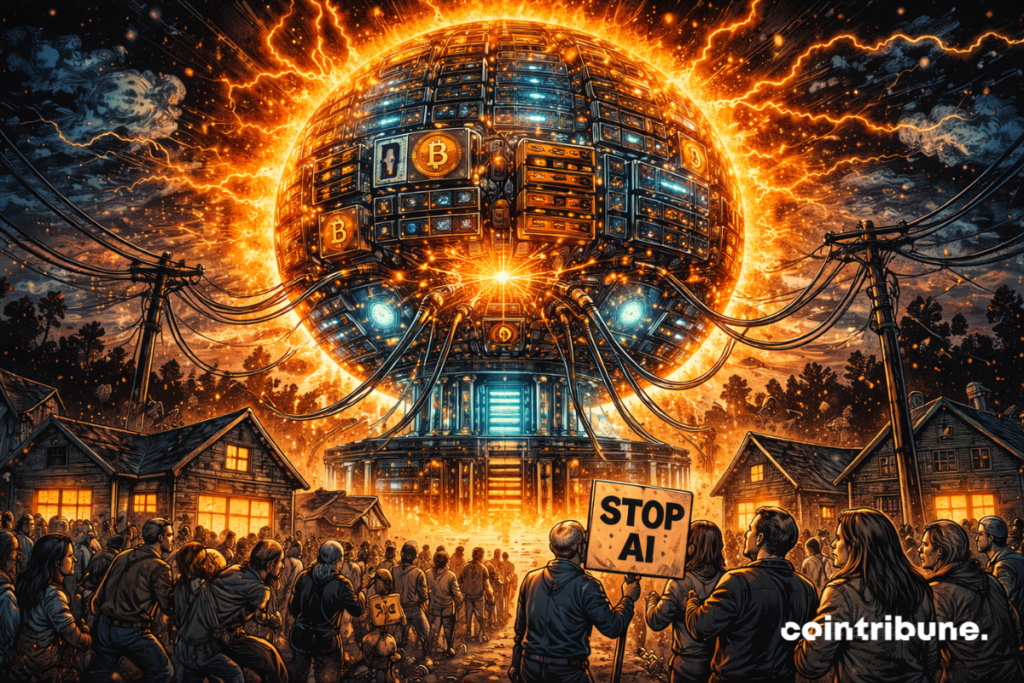
We love artificial intelligence because it makes our lives simpler. In every app, from photo editing to the voice assistant, AI quietly sneaks in. It guides us, entertains us, and promises to revolutionize entire industries. But behind the screen, the reality is less glamorous: AI demands considerable energy. And just like before with Bitcoin, this quest for computing power today hits social, environmental, and energy limits.
In brief
- $64 billion worth of AI data center projects blocked by local resistance.
- Citizens denounce the energy pressure of AI infrastructures, compared to bitcoin mining.
- Fermi America plans a nuclear campus in Texas to power future AI servers.
- OpenAI promises to cover its energy costs amid growing criticism on environmental impact.
AI & territories: when the 4th revolution hits the ground
Artificial intelligence doesn’t only circulate in data: it also lives in gigantic data centers. These computing factories, scattered across the United States, require gigawatts of electricity, robust networks, and massive infrastructure.
Yet, in Oregon, Virginia, Texas, or Georgia, citizens and local officials are starting to say stop.

These new resistances are reminiscent of a well-known episode among bitcoin enthusiasts: tensions that arose when BTC miners clashed with local communities concerned about noise pollution and soaring electricity bills. At the time, promises of jobs and tax revenues were not enough to soothe residents.
Today, it is AI data centers that are experiencing this shift in public opinion. According to the Data Center Watch report, projects totaling $64 billion have been blocked or delayed by citizen groups, municipal votes, and legal challenges.
In response to these tensions, companies try to adapt their approaches. Some claim they want to engage in better dialogue, others promise to cover energy costs.
However, residents remain on guard. They believe the “AI revolution” should not sacrifice their living environment, local taxes, or the sustainability of their electrical networks.
AI follows the same path as bitcoin: energy first, social acceptance after
The story repeats itself. As computing demand rises, AI appears as a new source of energy pressure. And this pressure is not abstract: it directly affects regions that, a few years earlier, had already seen BTC mining farms flourish.
These same regions are now being solicited by hyperscalers, gigantic tech companies building data centers for AI.
Critics highlight fears of impacts on local networks, electrical grids, groundwater, and even energy prices. What was once a discreet, almost invisible activity is now becoming a local electoral issue.
And it’s no longer just a matter for engineers or crypto traders; it has become a public debate.
The situation illustrates a paradox: AI, which should improve our daily lives, is perceived as a threat when it demands too much electricity or too many resources. This is precisely the same energy model that bitcoin had already highlighted.
The nuclear bet and AI: a headlong rush or a real energy future?
Facing what could become a dead end, some players are exploring bold strategies. This is the case in Texas, where Fermi America plans to build a mega AI campus powered by nuclear energy.
The Project Matador combines AP1000 reactors and very high-density data centers, a fiscal and political gift supported by Washington. This energy model aims to meet the explosive demand of AI without relying on local grid constraints.
But this solution carries its own risks. Local communities fear not only the environmental impact of heavy infrastructure, but also an unequal redistribution of benefits.
The specter of a new “digital extractivism” looms: technologies benefiting major players, costs borne by local communities.
And beyond the planet, others already dream of data centers out of this world. In more futuristic proposals, engineers suggest placing servers in Earth orbit, powered by space solar energy, to bypass network limits.
But these ideas remain experimental, costly, and far from the current political realities.
The energy choice the world makes for AI is not neutral. It will indicate if we want innovative, sustainable, and shared growth or just a simple repetition of past mistakes.
Key Figures: Energy, AI, Bitcoin, and Data Centers
- $64 billion: data center projects blocked or delayed in the United States;
- 142: active citizen groups against these projects;
- 12%: projected share of global electricity consumed by AI by 2028 (industry estimate);
- 18 million m²: planned area of the nuclear AI campus Fermi America;
- $89,527: bitcoin (BTC) price at the time of writing.
Automation and artificial intelligence are transforming not only energy but also work. Some already warn that the speed of AI could destroy traditional jobs. As CZ pointed out, technological progress endangers entire professions. In this landscape, crypto, notably bitcoin, could be seen as a financial safe haven for displaced workers.
Maximize your Cointribune experience with our "Read to Earn" program! For every article you read, earn points and access exclusive rewards. Sign up now and start earning benefits.

La révolution blockchain et crypto est en marche ! Et le jour où les impacts se feront ressentir sur l’économie la plus vulnérable de ce Monde, contre toute espérance, je dirai que j’y étais pour quelque chose
The views, thoughts, and opinions expressed in this article belong solely to the author, and should not be taken as investment advice. Do your own research before taking any investment decisions.