AI: ECB Economists Warn Tech Stocks May Be Due for a Pullback
Five economists from the European Central Bank (ECB) have just rung a rarely heard alarm with such clarity. In a post published on August 17, 2026, they state that a correction in stock market valuations driven by AI is likely whether current prices reflect economic reality or not. For crypto investors, who are used to watching tech stocks as a barometer of risk, this warning deserves special attention.
In Brief
- A correction could occur despite earnings and productivity supported by AI.
- The CAPE ratio places US valuations near their historical peak.
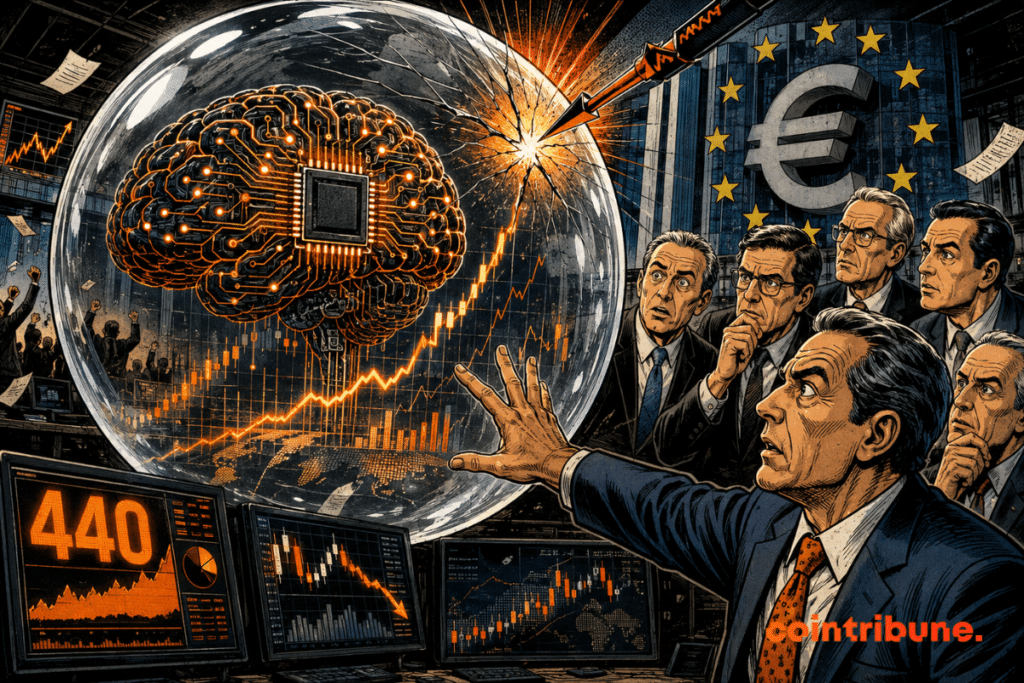
- Euro area households accumulate about €440 billion in exposure to US tech stocks.
An AI Correction Remains Likely, Even in Case of Success
In a post published on August 17, 2026, Malin Andersson, Johannes Breckenfelder, Stefano Corradin, Kalin Nikolov, and Maria Antonietta Viola compare the AI boom to the revolutions of railroads, electricity, and the Internet. All transformed the economy before a correction of their first stock market winners.
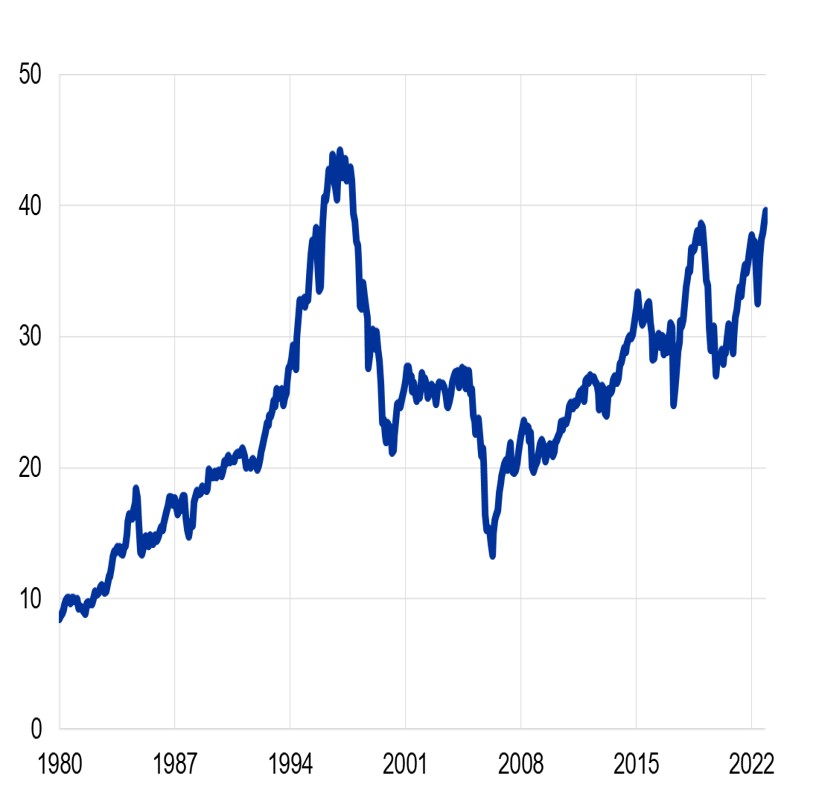
Their initial observation is based on the CAPE ratio. It measures the valuation of the US market by comparing prices to inflation-adjusted earnings over ten years. It is now near its historic peak. In the euro area, valuations have also increased, but to a much lesser extent.
Specifically, the five ECB economists rely on two complementary explanations. The first is called “rational.” It is based on seminal academic work on past technological revolutions. According to this AI crash theory, extreme uncertainty about the potential of a nascent technology justifies very high valuations.
Decoding: the investor only loses their stake, but the potential gain is hard to limit. According to the economists, this logic would explain the spectacular rise of Nvidia since 2022.
But the same logic also contains the seeds of a turnaround. As long as AI remains confined to a few companies, the potential failure of the technology remains an isolated risk, absorbable by the rest of the economy. As artificial intelligence adoption spreads, this risk becomes systemic and can no longer be diluted. Investors then demand a higher risk premium. This weighs on prices even if earnings continue to rise.
The second explanation is more intuitive: overconfident investors push prices beyond what fundamentals justify. When that confidence erodes, the drop can be more brutal than in the rational scenario.
In both cases, the outcome remains the same: an AI market correction is to be expected. Only the exact timing remains unpredictable.
Why Does €440 Billion Put Europe on the Frontline?
Based on third-quarter 2025 data, the authors of the blog post estimate €440 billion as the exposure of euro area households to US tech stocks. This mainly happens through global funds and ETFs dominated by the Magnificent Seven:
- Alphabet;
- Amazon;
- Apple;
- Meta;
- Microsoft;
- Nvidia;
- Tesla.
Insurers and pension funds are also very exposed.
This structure could amplify a shock. A sharp drop in the AI market would trigger redemption requests. This would force funds to first sell their liquid assets, then more fragile positions. These sales would deepen the price declines and could provoke further withdrawals. The risk would then shift from a US sectoral correction to a European financial stability problem.
Another important point: European stocks appear cheaper and more tied to the old economy. But in reality, markets on both continents remain strongly correlated. Above all, interest rates and public budgets offer less room than in 2000 to soften a crisis. Financial uncertainty thus remains high. Reuters, citing Goldman Sachs, notes that 11% of S&P 500 companies have quantified specific AI use cases and only 2% an effect on their earnings.
What This Changes for the Crypto Market
For a crypto investor, this AI market diagnosis resonates particularly. The fact is that bitcoin and large cap digital assets have evolved for several years in close correlation with US tech indices (notably during risk compression phases). A Nasdaq correction triggered by a deflation of AI valuations would likely spread via institutional flows and leveraged positions to the crypto market.
The ECB also highlights a rarely emphasized point: unlike the bursting of the Internet bubble in 2000, the euro area today has significantly less monetary and fiscal headroom to absorb an economic shock of this magnitude. This observation also applies to US authorities. This limits the collective capacity to contain the effects of an AI correction should it coincide with broader financial instability.
AI Crash? Scenarios to Watch
The ECB economists do not favor the scenario of a collapse of the artificial intelligence thesis in any way. If the technology confirms its transformative potential, nothing excludes valuations from reaching levels higher than today after correction. The identified risk mainly concerns the timing and scale of an intermediate adjustment, not the long-term viability of the AI sector.
Conversely, a more worrying scenario would combine:
- a US technology correction;
- contagion to other asset classes (including cryptocurrency).
This is possible in a context where central banks have few levers to intervene.
The authors remind that these boom and correction cycles can only be identified retrospectively. This makes any precise anticipation of the trigger or timing hazardous.
In any case, the ECB economists’ warning deserves close monitoring. A correction would not prove that AI has failed. It could simply reflect the transition from a sector promise to a generalized economic risk. Moreover, this blog post does not necessarily reflect the official position of the ECB or the Eurosystem.
Maximize your Cointribune experience with our "Read to Earn" program! For every article you read, earn points and access exclusive rewards. Sign up now and start earning benefits.

My name is Ariela, and I am 31 years old. I have been working in the field of web writing for 7 years now. I only discovered trading and cryptocurrency a few years ago, but it is a universe that greatly interests me. The topics covered on the platform allow me to learn more. A singer in my spare time, I also cultivate a great passion for music and reading (and animals!)
The views, thoughts, and opinions expressed in this article belong solely to the author, and should not be taken as investment advice. Do your own research before taking any investment decisions.