American crypto law: Proposals multiply amid Senate deadlock
The long-awaited adoption of a legal framework for digital assets in the United States has come to a serious halt. While the ambition for a coherent crypto regulation is consensual, the parliamentary reality is much more chaotic. Between conflicting interests and political power struggles, negotiations are bogged down in the Senate. Discussions do not reach an agreement despite notable efforts. Meanwhile, crypto industry players are trying to save the bill by multiplying compromises. But the equation remains complex, and the deadlock, persistent.
In brief
- The crypto text is progressing slowly, stuck between banking lobby and rising regulatory pressure.
- Concessions have been proposed, notably by involving local banks with stablecoins.
- The White House convened a meeting with no clear outcome between crypto firms and financial institutions.
- The chairman of the banking committee hopes for an agreement to make the United States a sector leader.
Giving assurances to banks to save crypto regulation
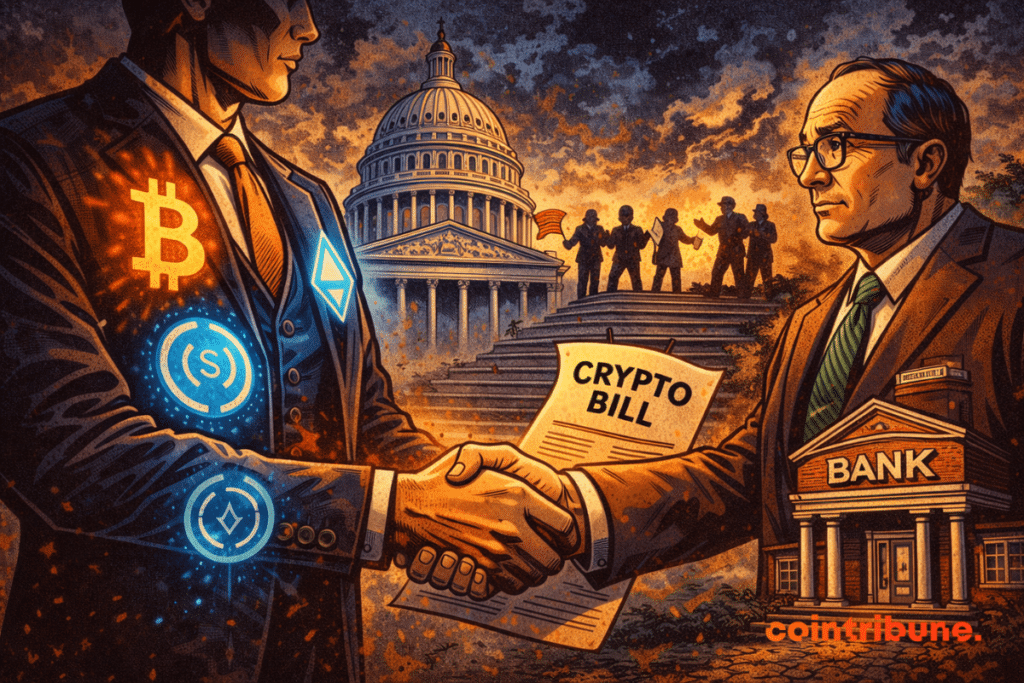
Giants of the crypto industry want to prevent the bill from dying in the Senate. To do this, they today propose concrete compromises. The flagship idea: to involve community banks more, which are very influential in certain states. These could hold the reserves of stablecoins, or even issue their own tokens through partnerships with platforms like Circle or Paxos. A subtle way to make the regulation more “bank-friendly”.
The major point of friction remains the remuneration of stablecoins. Banks believe this would divert deposits from their savings accounts. On the other side, crypto firms see this yield as essential to attract users. A stubborn disagreement despite promises of regulation.
A summit between crypto and banks at the White House in early February ended in failure. No convergence. Yet discussions continue. As Senator Tim Scott declared:
The good news is that both sides remain at the negotiating table […] we will overcome these obstacles and ensure America becomes the global capital of crypto.
Faced with the impasse, crypto companies are redoubling initiatives. They know this bill could determine the regulatory future of the sector in the United States.
In the United States, crypto still rhymes with political power struggle
The crypto bill illustrates a deep political divide within the Senate. The text passed the House stage in 2025, but senators struggle to agree. Two versions circulate: one Republican, from the Agriculture committee; the other, stricter, from the banking committee. They will need to be merged and at least seven Democrats convinced to move the process forward.
The main block? The fear of a “bank run” orchestrated by platforms capable of remunerating savings better than banks. An argument often put forward by traditional institutions, which fear capital flight. Yet the chairman of the banking commission minimized this risk, assuring that no deposit flight was expected.
But this statement was not enough to soften positions.
Behind the scenes, one fact is clear: the future of crypto regulation in the USA could well be played out in informal negotiations, away from the spotlight. And in this influence struggle, community banks become the ideal lever. Less powerful but close to the field, they could link technological innovation and financial security.
What to remember in 5 points
- The United States is trying to adopt a law structuring the crypto market, but the Senate remains divided;
- The role of community banks is central in the new compromises proposed by the crypto industry;
- The remuneration of stablecoins remains the core disagreement between banks and crypto platforms;
- Two versions of the bill oppose: Agriculture vs. Banking, with a difficult merging ahead;
- The text needs the support of 7 Democrats to hope to pass before the end of the current mandate.
While the crypto debate shakes the Senate, another event rattles American markets: the appointment of Kevin Warsh to the head of the Federal Reserve. Chosen by Trump, this conservative profile reassures some… but worries Wall Street. In an already tense climate, this new development could heavily weigh on upcoming economic and financial decisions.
Maximize your Cointribune experience with our "Read to Earn" program! For every article you read, earn points and access exclusive rewards. Sign up now and start earning benefits.

La révolution blockchain et crypto est en marche ! Et le jour où les impacts se feront ressentir sur l’économie la plus vulnérable de ce Monde, contre toute espérance, je dirai que j’y étais pour quelque chose
The views, thoughts, and opinions expressed in this article belong solely to the author, and should not be taken as investment advice. Do your own research before taking any investment decisions.