Billionaire Jeremy Grantham Predicts A Major Tech Market Correction
Global financial markets are undergoing an unprecedented transformation, where technological euphoria revives the specters of past systemic crises. In this period of extreme tension, the analysis of economic cycles by historical figures of traditional finance provides an essential framework for anticipating capital allocations. Jeremy Grantham, famous billionaire and co-founder of the institutional management firm GMO, has just issued a blunt diagnosis of the current state of technological valuations linked to AI and cryptos. In a lengthy interview with Steven Bartlett for the YouTube series “The Diary of a CEO”, Grantham delivered alarmist macroeconomic forecasts, specifying that his statements represent his sole responsibility and not that of his management company, which manages 85 billion dollars in assets.
In brief
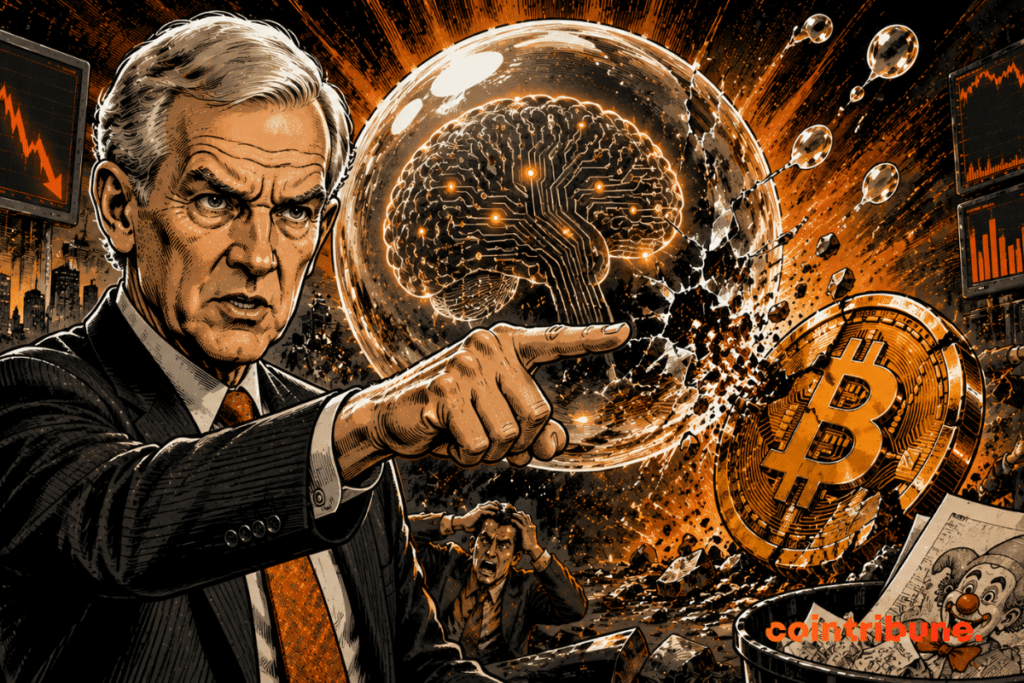
- Jeremy Grantham believes that the artificial intelligence revolution fuels the largest financial bubble in U.S. history.
- The investor compares the current enthusiasm for AI to the great speculative bubbles of the past and fears a correction that could reach 70% on certain technology stocks.
- The billionaire categorically rejects Bitcoin, which he considers a purely speculative asset lacking sustainable economic utility.
- Facing the risk of a crash, Grantham recommends avoiding U.S. stocks in favor of international markets, bonds, and precious metals.
A meteoric rise of AI
Jeremy Grantham places the current rise of AI, thanks to capital inflows, at the same level as the great infrastructural revolutions of the last two centuries, while warning against the inherent danger of such enthusiasm.
His analysis shows that major technological upheavals always cause, in the short term, massive overinvestment and destructive value loss. To support this thesis of widespread speculation excess, the GMO co-founder relies on several factual indicators:
- The historical example of Amazon which, during the 1999 tech bubble, saw its stock multiplied by six or seven before collapsing by 92% during the stock market crash;
- Overvalued U.S. stock markets trading today between 35 and 40 times earnings, a level well above the historical norms of previous cycles;
- The emblematic case of SpaceX’s prospectus, which defines its potential addressable market as representing a quarter of global GDP and mentions asteroid mining.
Faced with these AI-related forecasts, the billionaire draws a direct parallel with one of the most famous bankruptcies in modern finance. He indicates that “within 50 years, people will look back and tell stories about SpaceX and its brochure, just as they tell stories about the South Sea Bubble”. Grantham states factually: “if you look at the data, this could well correspond to the story where the peak is very near”.
This warning comes as the presence of retail investors in U.S. stock markets has never been stronger since the beginning of the modern era, thereby exposing an unprecedented share of public savings to a major correction risk that Grantham estimates at 70% for technology stocks linked to AI. His conclusion about this dynamic leaves no doubt: “this is, in my opinion, the biggest financial bubble in U.S. history”.
The absolute condemnation of bitcoin’s long-term viability
Jeremy Grantham’s skepticism about market dynamics extends even more radically to cryptos, an area where he applies a purely utilitarian reading grid. The investor clarified his personal position by stating that he holds no crypto, has never held any, and has no plans to acquire any in the future. His critique of bitcoin is based on the total absence of traditional economic fundamentals and its lack of practical utility in the real economy.
Grantham rejected the idea that bitcoin could substitute for a traditional currency or a safe haven asset. He states: “I think it’s useless nonsense. It doesn’t facilitate anything except for criminals who move money offshore to avoid being seen. It’s not a store of value since it bounces everywhere, it fell from $120,000 to $60,000 just because it wanted to. So it’s not stable. It’s volatile as hell”.
The GMO co-founder questions the protocol’s efficiency as a daily exchange instrument, not just its price volatility. He argues that its difficulty of use and lack of structural integration prevent bitcoin from competing with fiat currencies: “It doesn’t serve conveniently as a means of exchange. You can’t easily go into a store and use it. It does one thing very well. It’s a magnificent way to speculate”.
When directly asked about the long-term objective of this purely speculative asset, the analyst expressed no reservations about its eventual disappearance, though linking its fate to a broader financial entropy law: “well, in the distant future, yes, it will certainly go to zero, but that could take a long time. And you know, in the distant future, everything goes back to zero”.
A capital preservation strategy amid Wall Street’s major tightening
To face this collapse he considers inevitable, Jeremy Grantham advocates a radical defensive portfolio reallocation completely independent of traditional U.S. indices. His main recommendation for the average investor is a simple and immediately actionable directive: “do not hold U.S. stocks. It’s a simple strategy you can act on”.
He instead proposes allocating 60% of capital into an international stock index excluding the U.S., mentioning Europe, Japan, Canada, Australia, and emerging markets. He believes the rest of the portfolio should be oriented towards proven safe havens like short-term government bonds, real estate, and precious metals such as gold and silver.
These rather antagonistic statements require a nuanced analysis of the forces at play today between traditional finance and the crypto ecosystem. Grantham relies on decades of proven economic cycles where liquidity excesses always end up being absorbed. However, his perception of bitcoin omits the concepts of programmed scarcity and decentralization that underpin the asset’s value for its supporters.
Maximize your Cointribune experience with our "Read to Earn" program! For every article you read, earn points and access exclusive rewards. Sign up now and start earning benefits.

Diplômé de Sciences Po Toulouse et titulaire d'une certification consultant blockchain délivrée par Alyra, j'ai rejoint l'aventure Cointribune en 2019. Convaincu du potentiel de la blockchain pour transformer de nombreux secteurs de l'économie, j'ai pris l'engagement de sensibiliser et d'informer le grand public sur cet écosystème en constante évolution. Mon objectif est de permettre à chacun de mieux comprendre la blockchain et de saisir les opportunités qu'elle offre. Je m'efforce chaque jour de fournir une analyse objective de l'actualité, de décrypter les tendances du marché, de relayer les dernières innovations technologiques et de mettre en perspective les enjeux économiques et sociétaux de cette révolution en marche.
The views, thoughts, and opinions expressed in this article belong solely to the author, and should not be taken as investment advice. Do your own research before taking any investment decisions.