Bitcoin Core Advances Strongly in 2025 Amid Rising Network Activity
Bitcoin Core gained traction in 2025, recording a notable increase in development activity. The software, which runs around 78% of Bitcoin full nodes, saw more people actively involved in the project over the year, according to Jameson Lopp, Casa’s Chief Security Officer, who noted the increase in community participation.

In brief
- Bitcoin Core saw a notable rise in participation in 2025 with 135 contributors, up from 112 in 2024.
- Activity on the Bitcoin Development Mailing List picked up in 2025, rising 60% after a 25% decline the previous year.
- Quarkslab’s audit reported two minor issues and 13 informational suggestions without any security risk.
Bitcoin Core Sees Increased Contributions
Activity on the Bitcoin Development Mailing List rose by 60% in 2025 compared to the previous year, fueled by higher email volume. The list, a central platform for proposing updates and coordinating protocol improvements, rebounded from a 25% decline in 2024, reflecting renewed community participation.
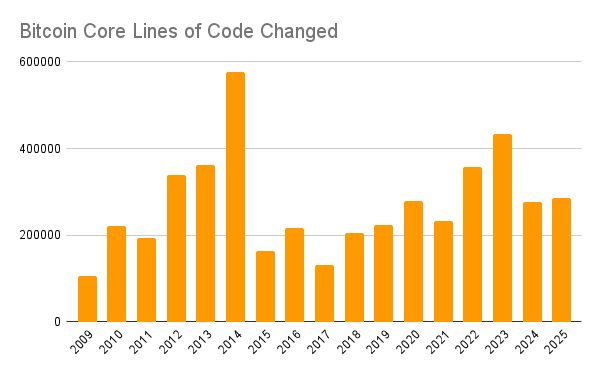
Code activity remained steady, with around 285,000 lines of code added or removed over the year, slightly above 2024’s 276,000. Participation also rose, with 135 contributors submitting code to the Bitcoin Core repository, up from 112 in 2024. Code commits edged up 1% to 2,541, reflecting a consistent and sustainable pace of development.
Bitcoin Core Security Review and Ongoing Support
The rise in contributions paralleled meaningful technical milestones. Bitcoin Core underwent its first publicly disclosed independent security assessment, led by cybersecurity firm Quarkslab with backing from the nonprofit Brink. The audit, designed to identify vulnerabilities, found two minor issues along with 13 recommendations for informational purposes. None posed actual security risks according to Bitcoin Core’s classification system.
The 100-day review followed a structured and methodical approach that covered key aspects of the codebase:
- It started with a careful manual inspection of critical components, giving particular attention to thread management and transaction validation
- The process then moved into dynamic testing, making use of tools already integrated into Bitcoin’s workflows to simulate real-world conditions
- Finally, advanced fuzz testing was applied to explore less conventional areas of the codebase and identify potential weaknesses
Funding for Bitcoin Core development has remained steady, with organizations continuing to provide financial support. In January 2025, VanEck reaffirmed its commitment to allocate 5% of profits from its spot Bitcoin ETF to Brink, ensuring ongoing resources for developer initiatives.
On-Chain Activity Reflects Network Strength
Meanwhile, Bitcoin’s blockchain activity remained robust in 2025. Estimates from CoinMetrics, which adjust for likely change outputs, show that roughly $4.5 trillion moved across the network, averaging $144,000 per second.
The network’s computational power also increased, with the hashrate rising 32% from 802 to 1,060 exahashes per second, reflecting both growing adoption and the network’s sustained security.
Maximize your Cointribune experience with our "Read to Earn" program! For every article you read, earn points and access exclusive rewards. Sign up now and start earning benefits.

Ifeoluwa specializes in Web3 writing and marketing, with over 5 years of experience creating insightful and strategic content. Beyond this, he trades crypto and is skilled at conducting technical, fundamental, and on-chain analyses.
The views, thoughts, and opinions expressed in this article belong solely to the author, and should not be taken as investment advice. Do your own research before taking any investment decisions.