Bitcoin: Early Release of Hacker Ilya Lichtenstein
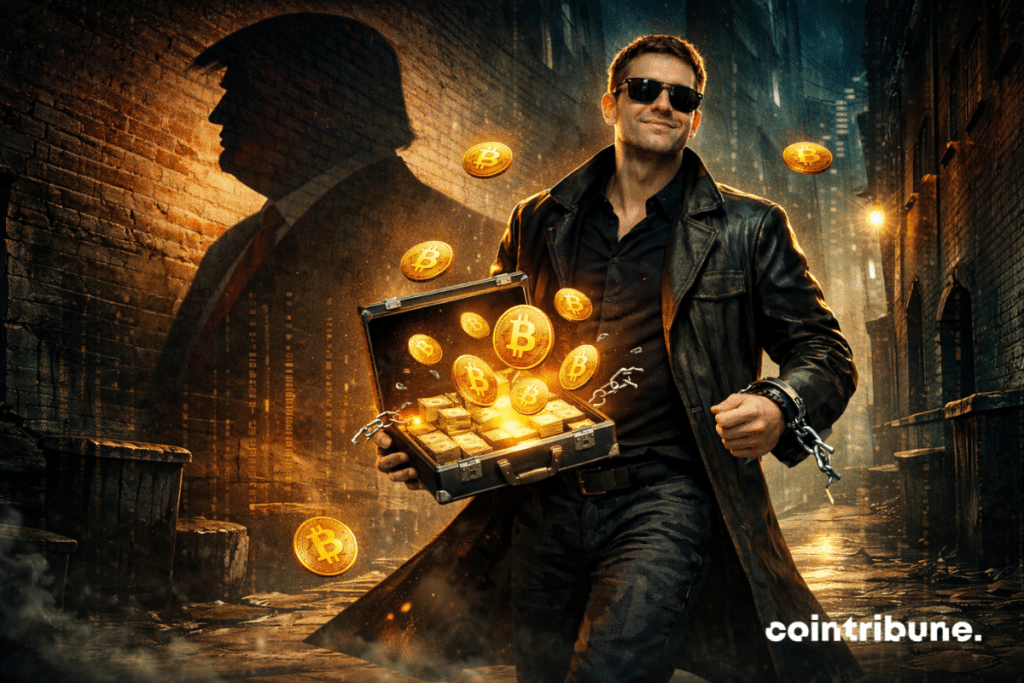
Ilya Lichtenstein, involved in the theft of approximately 119,756 BTC on Bitfinex, says he was released from prison earlier than expected thanks to the First Step Act, a law passed under Donald Trump. He spent just over a year behind bars, although he had been sentenced to five years.
In brief
- Ilya Lichtenstein, involved in the BTC theft on Bitfinex in 2016, has announced his early release.
- He claims to have benefited from the First Step Act, a law signed under Donald Trump allowing sentence reductions
A swift exit, a law that was already lingering in the background
Ilya Lichtenstein, a central figure in the bitcoin hack on Bitfinex in 2016, says he was released early thanks to the First Step Act. This is a law signed under Donald Trump. Sentenced to five years, he spent just over a year behind bars before announcing his release on X.
In this tweet, he explicitly thanked the First Step Act. In the same message, he claims to want to have a positive impact in cybersecurity. It is a common phrase. But it also indicates he is preparing the next steps.
The First Step Act, passed in 2018, expanded access to sentence reductions through time credits and reintegration programs. In short, this case related to bitcoin is not about a presidential pardon. It’s rather a mechanism that can shorten a sentence if certain criteria are met.
According to a statement relayed by the press, Lichtenstein is not free in the Hollywood sense of the term. However, he would be placed under home confinement under Bureau of Prisons rules.
Bitfinex and Bitcoin, the heist that almost never closes
The case dates back to August 2016, when Bitfinex was drained of nearly 120,000 bitcoins. At the time, it was already huge. With the bitcoin surge over the years, the amount has taken on an almost mythological dimension, as if the theft grew retroactively.
In legal documents, the picture is more technical and less romantic. The U.S. Department of Justice describes more than 2,000 fraudulent transactions followed by a methodical attempt to erase traces on the exchange’s network. It’s meticulous work, but digital burglary style.
Then comes the most “crypto” part of the case, the one that looks like a mixer user manual. “Chain hopping”, fake accounts, mixing services, conversions into other assets… The DOJ even mentions BTC exchanges into gold coins. As if the plan was to scramble the story until it became unreadable.
Razzlekhan, Netflix, and the transformation of a criminal case into a public saga
In this story, there is also Heather Morgan, aka “Razzlekhan.” She was sentenced to 18 months and also mentioned early release. On social media, the couple quickly resumed the pose of returning to life, with staging that contrasts with the tone of a federal case.
Lichtenstein’s early release comes in a political climate where bitcoin is watched as an influence issue. Trump, having become president again, has stood out with very visible decisions. He granted a full and unconditional pardon to Ross Ulbricht, the founder of Silk Road, on January 21, 2025.
He also pardoned Changpeng Zhao, the founder of Binance, on October 23, 2025, according to the White House and Reuters. The gesture is symbolically heavy because it touches a central figure of the industry. Similarly, Trump declared he would look into the case of Keonne Rodriguez, co-founder of Samourai Wallet, leaving the idea of possible clemency hanging. Even without a decision, just talking about it acts as a signal. In crypto, signals sometimes matter as much as texts.
Maximize your Cointribune experience with our "Read to Earn" program! For every article you read, earn points and access exclusive rewards. Sign up now and start earning benefits.

Enseignante et ingénieure IT, Lydie découvre le Bitcoin en 2022 et plonge dans l’univers des cryptomonnaies. Elle vulgarise des sujets complexes, décrypte les enjeux du Web3 et défend une vision d’un futur numérique ouvert, inclusif et décentralisé.
The views, thoughts, and opinions expressed in this article belong solely to the author, and should not be taken as investment advice. Do your own research before taking any investment decisions.