Bitcoin Faces Renewed Questions After Microsoft's Quantum Breakthrough
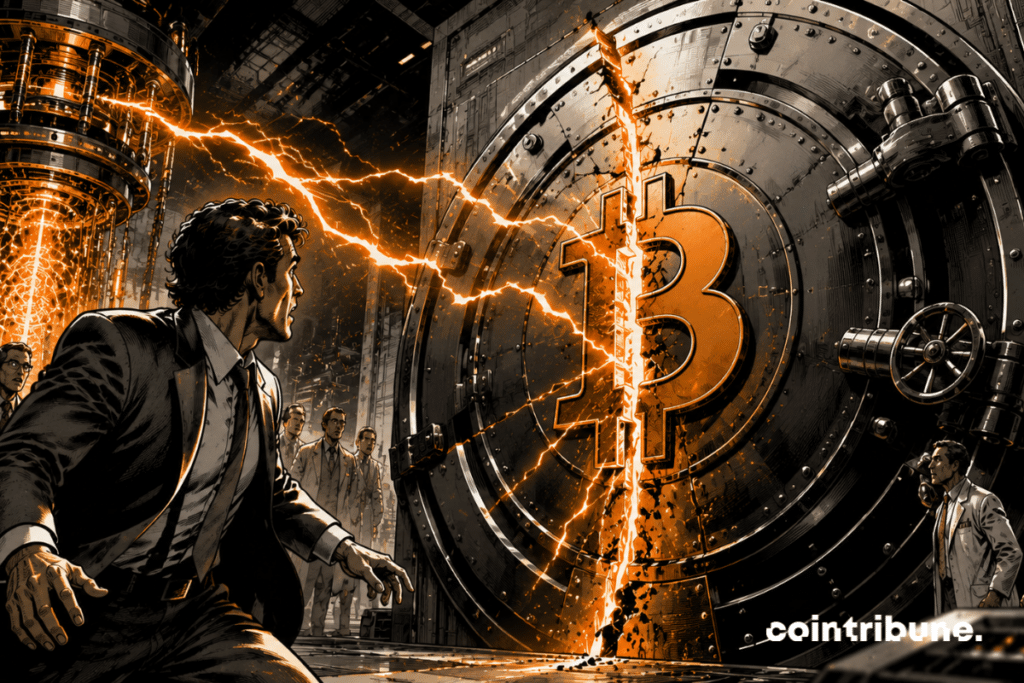
Bitcoin security has just received a new wake-up call. Microsoft unveiled Majorana 2, a quantum chip presented as a major advance towards quantum computers capable of solving problems currently beyond the reach of classical machines. While this innovation does not yet directly threaten the network created by Satoshi Nakamoto, it revives a question that has worried the crypto ecosystem for years: how long will the cryptography protecting bitcoin withstand the rise of quantum computing?
In brief
- Microsoft presents Majorana 2, a new quantum chip presented as a major advance in the sector.
- The company claims to have developed technology up to 1,000 times more reliable than previous generations.
- This announcement renews questions about Bitcoin’s future ability to resist quantum computers.
- Researchers and developers are already working on post-quantum cryptography solutions to anticipate this risk.
The company claims a major breakthrough with its Majorana 2 chip
Microsoft officially presented Majorana 2, a new generation quantum processor based on a topological qubit architecture, while a researcher has already managed to break a crypto key. The company believes this technology could be a decisive step toward building quantum computers capable of solving complex industrial problems.
Microsoft claims that its new approach is “1,000 times more reliable” than previous generations of quantum chips. This improvement in reliability represents one of the main obstacles researchers have been trying to overcome for several years to make quantum computers truly usable on a large scale.
Microsoft highlights several elements that distinguish Majorana 2 from traditional quantum approaches :
- An architecture based on topological qubits ;
- The use of Majorana particles to improve calculation stability ;
- A reliability claimed to be 1,000 times greater than previous generations ;
- The ambition to facilitate the development of large-scale quantum computers ;
- A roadmap aiming for commercial applications in the coming years.
Through this announcement, Microsoft aims to demonstrate that quantum computing is gradually approaching a stage where it can move beyond the experimental stage to meet concrete uses.
Bitcoin faces the return of the post-quantum security debate
The interest triggered by Microsoft’s announcement goes far beyond scientific research. For the Bitcoin community, every significant advance in the quantum field reactivates an old concern: the possibility that a sufficiently powerful quantum computer could one day compromise the cryptographic mechanisms protecting transactions and wallets on the network.
Indeed, technological progress made by industry players is gradually closing the gap between this theoretical hypothesis and a potential reality. Every technological breakthrough by sector giants brings the quantum threat closer, illustrating the change in perception that accompanies advances in the field.
This prospect has already led several researchers and developers to study so-called post-quantum cryptography solutions. The goal is to design systems capable of resisting the computational power that future quantum machines might achieve. These considerations concern bitcoin, but also all digital infrastructures relying on current cryptographic methods.
At this stage, no precise deadline allows determining when a quantum computer might have the capabilities to present a concrete threat to bitcoin. The debate is more about the speed of technological progress than about the very existence of the risk.
The announcement of Majorana 2 therefore does not mean that bitcoin is currently vulnerable to a quantum attack. However, it reminds us that the foundations of cybersecurity evolve at the pace of scientific innovations. As technological giants reach new milestones, actors in the crypto ecosystem will need to continue anticipating the necessary transformations to preserve the robustness of decentralized networks. For bitcoin, the question may no longer be if an adaptation will be necessary one day, but how much time remains available to prepare for it.
Maximize your Cointribune experience with our "Read to Earn" program! For every article you read, earn points and access exclusive rewards. Sign up now and start earning benefits.

Diplômé de Sciences Po Toulouse et titulaire d'une certification consultant blockchain délivrée par Alyra, j'ai rejoint l'aventure Cointribune en 2019. Convaincu du potentiel de la blockchain pour transformer de nombreux secteurs de l'économie, j'ai pris l'engagement de sensibiliser et d'informer le grand public sur cet écosystème en constante évolution. Mon objectif est de permettre à chacun de mieux comprendre la blockchain et de saisir les opportunités qu'elle offre. Je m'efforce chaque jour de fournir une analyse objective de l'actualité, de décrypter les tendances du marché, de relayer les dernières innovations technologiques et de mettre en perspective les enjeux économiques et sociétaux de cette révolution en marche.
The views, thoughts, and opinions expressed in this article belong solely to the author, and should not be taken as investment advice. Do your own research before taking any investment decisions.