Bitcoin: Saylor and Back View the BIP-110 Proposal as More Dangerous Than the “Spam” It Targets
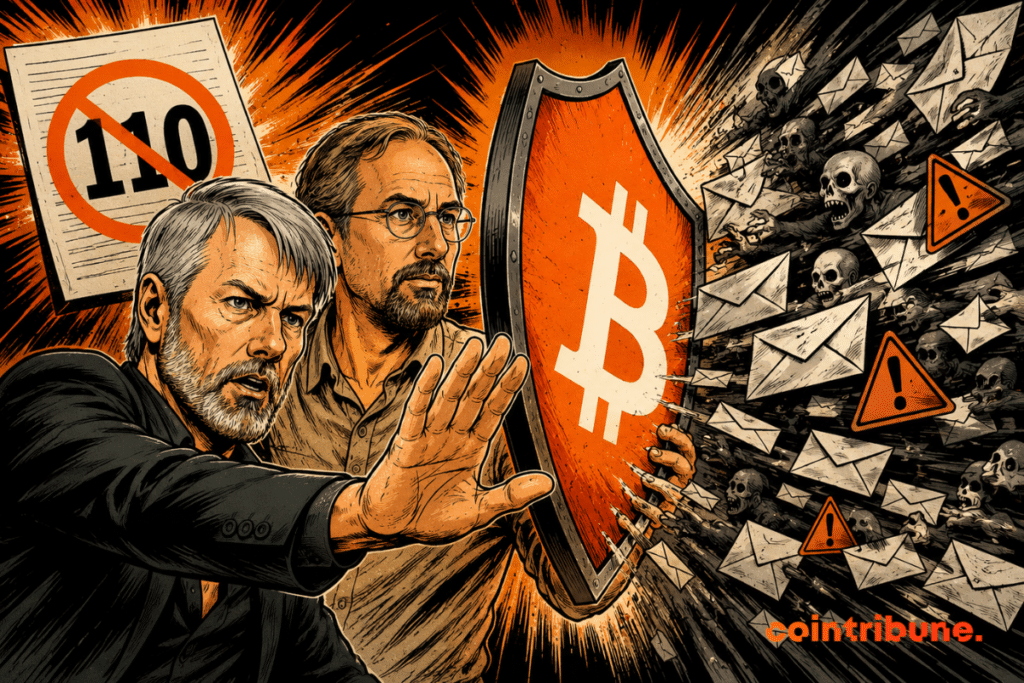
The debate around the evolution of the Bitcoin network is experiencing a new episode with the BIP-110 proposal, designed to limit non-monetary transactions and certain data considered undesirable. While its defenders believe it would protect the initial use of the protocol, several influential figures dispute this approach. Michael Saylor and Adam Back believe such a modification could create more risks than it solves. Their positions thus revive an important discussion on the balance between network protection, decentralization, and protocol stability.
In brief
- Michael Saylor and Adam Back oppose BIP-110, believing that this proposal presents more risks than the “spam” it seeks to limit.
- BIP-110 aims to restrict Ordinals inscriptions and non-monetary data to preserve Bitcoin’s use as a payment system.
- Opponents fear that this temporary fork would weaken the network’s credibility and invalidate certain transactions.
- Supporters assure that BIP-110 would not cause a chain split and would only limit the effects of Ordinals for one year.
- With only 1% of block support during the last signaling period, BIP-110 activation remains very unlikely.
Bitcoin at the Heart of a New Debate Around BIP-110
The debate on BIP-110 is intensifying within the Bitcoin community, pitting supporters of a technical intervention against defenders of the status quo. The BIP-110 proposal was introduced in December 2025 as a mechanism aiming to limit Ordinals inscriptions of non-fungible token type as well as other arbitrary data on the network. Its purpose, according to its developer, is to preserve the primary use of Bitcoin as a peer-to-peer payment system. The proponents of the text believe that these ancillary uses unnecessarily clutter the blockchain and divert the protocol from its original function.
Michael Saylor, however, has expressed clear opposition to this initiative. In a message published on X, he stated that there are many greater risks to Bitcoin than the phenomenon labeled as “spam.” According to him, BIP-110 could have a more worrying effect by invalidating certain ordinary transactions on the network, which would weaken its credibility with users.
Adam Back shares this analysis. In his post on X, the Blockstream leader believes that “a change of this nature goes beyond a simple technical issue.” He argues that “such an approach risks introducing a control logic incompatible with the historic principles of the protocol.” For him, decentralization precisely means that no group can impose its vision on all participants.
A Proposal That Revives a Historic Disagreement
The debate surrounding the BIP-110 soft fork represents one of the most significant technical disputes observed within the community since the block size wars between 2015 and 2017. At that time, developers and ecosystem players were already questioning the opportunity to modify the protocol at the risk of causing a chain split. This new controversy reminds us that fundamental changes remain particularly sensitive in the world of Bitcoin.
The proposal was introduced by pseudonymous developer Dathon Ohm with support from Luke Dashjr, founder of the Ocean protocol. The project’s supporters believe that the proliferation of Ordinals inscriptions poses a serious threat to the network. They advocate a swift intervention to limit the blockchain bloat caused by this data.
These supporters also dispute the idea that BIP-110 would cause a network split. They explain that the measure only provides for a temporary fork lasting one year. According to them, this limit would prevent the long-lasting effects feared by some opponents and would not invalidate paying transactions in the long term.
Support Still Very Limited Despite Proponents’ Arguments
Despite the intensity of the exchanges, activating BIP-110 now appears very unlikely. The proposal can only take effect if 55% of nodes validating blocks support this evolution for a determined period. This threshold remains far from being reached according to the latest available figures.
During period number 475, between blocks 955,584 and 957,599, only 1% of blocks signaled their support for the proposal. This level of adherence shows that consensus remains very far from the conditions necessary for activation. Thus, this low mobilization constitutes an important indicator of the current state of the debate.
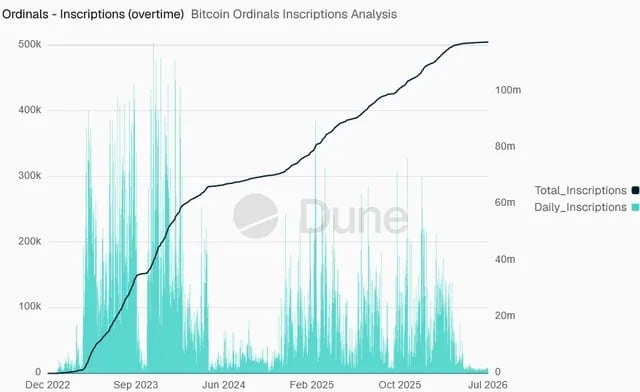
At the same time, the network context has evolved. Activity related to Ordinals is now at a level close to its historic low. Less than 10,000 daily inscriptions were recorded on the Bitcoin blockchain in the last month, compared to over 400,000 at the peak observed in August 2023. This decrease indirectly fuels discussions on the necessity of adopting BIP-110, as the targeted phenomenon appears much less significant than before.
The evolution of this issue will now depend on the ability of the different parties to convince more participants. As long as the level of support remains this low, the proposal should continue to fuel exchanges without modifying the functioning of the blockchain protocol. Future signaling cycles will allow observation of whether the debate remains essentially theoretical or takes a new dimension within the Bitcoin community.
Maximize your Cointribune experience with our "Read to Earn" program! For every article you read, earn points and access exclusive rewards. Sign up now and start earning benefits.

Journaliste et rédacteur web passionné par l’univers des cryptomonnaies et des technologies Web3. J’y traite les dernières tendances et actualités afin de proposer un contenu de haute qualité à un large public du secteur.
The views, thoughts, and opinions expressed in this article belong solely to the author, and should not be taken as investment advice. Do your own research before taking any investment decisions.