Bitcoin: The Computing Power Rises, But Miners Remain Under Pressure
The Bitcoin network regains computing power above 1 zettahash per second after several months below this threshold. This recovery occurs as several major mining companies redirect their investments towards artificial intelligence and high-performance computing. Yet, mining revenues are decreasing while the network difficulty is increasing. Between more efficient hardware, increased competition, and weakened margins, miners now have to maintain their activity in a more demanding economic environment.
In Brief
- Bitcoin’s hashrate goes back above 1 ZH/s for the first time since March 3rd.
- Network computing power reaches 1,080.23 EH/s, despite some companies shifting to artificial intelligence.
- New mining machines improve performance and reduce power consumption.
- Hashprice falls to $36.04 per PH/s per day, down from $40.42 on September 25th.
- Mining difficulty increases by 5.92%, increasing pressure on small miners’ margins.
Bitcoin’s Hashrate Goes Back Above 1 ZH/s After Eight Months
The network’s computing power has crossed a symbolic threshold. The hashrate reaches 1,080.23 exahashes per second, or 1.08023 zettahashes per second, according to hashrateindex.com data as of October 25, 2026. This measure corresponds to over one sextillion calculations per second. Miners mobilize this power to secure transactions and participate in the creation of new bitcoins.
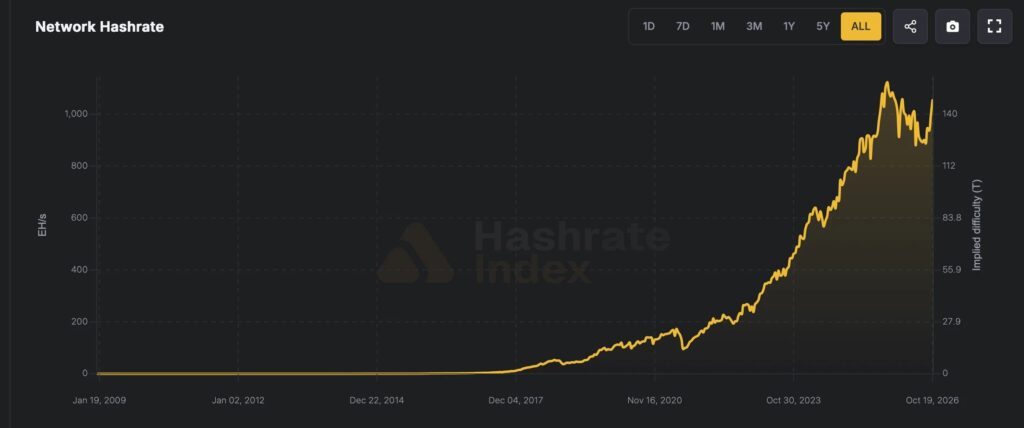
The seven-day average has also surpassed 1 ZH/s for the first time since March 3. This progression occurs while the cryptocurrency’s price is around $80,000. The last difficulty adjustment was about nine days ago, at block 971,712. Since then, the total network power has continued to grow, despite changes affecting the mining sector.
This development contrasts with the strategy of several large mining companies. Some are redirecting their equipment, capital, and infrastructure towards artificial intelligence. These activities offer new outlets to operators with significant computing capacities. However, small individual and private operations seem to help fill part of this gap. Their presence thus helps the network maintain its power, even as some of the investments move away.
New Hardware Supports Network Computing Power
Improvements in mining equipment partly explain this recovery. Over the past two years, manufacturers have developed faster and more energy-efficient machines. These improvements allow operators to produce more calculations without increasing their consumption proportionally. In a sector where electricity costs weigh heavily on results, this evolution represents a significant advantage.
The latest machines can now perform hundreds of trillions of calculations every second. Some models even exceed 1 petahash per second, or 1,000 terahashes per second. These performances strengthen operations’ capacity to compete globally. They can also help smaller operators stay active despite the larger financial resources of big companies.
Energy efficiency is another determining factor. Professionals notably measure this performance in joules per terahash, a unit indicating the energy needed to perform a given amount of calculations. The lower this value, the less electricity a machine consumes to deliver the same power. Several recent pieces of equipment from Bitmain and MicroBT now show consumption below 10 J/TH. These machines can thus reduce energy expenses compared to previous generations.
This improvement comes as mining companies evaluate new commercial possibilities. Artificial intelligence and high-performance computing attract part of their capital. However, technical progress still allows operators to increase their computing capacities. The return above 1 ZH/s thus shows that the redirection of some companies does not currently lead to a lasting drop in the network’s overall power.
Revenues Under Pressure Despite Bitcoin Hashrate Recovery
Despite this progression, computing power remains below previous peaks. The network had reached levels between about 1.3 and 1.44 ZH/s before its decline. In July, the hashrate fell close to 726 EH/s. The current rise therefore marks a notable recovery, without fully erasing the previous drop.
The cryptocurrency’s price represents a key factor for mining profitability. Its drop over the last thirty days contributed to reducing income linked to computing power. Miners thus need to produce efficiently to preserve their margins. When the price falls, rewards obtained in fiat currency lose value, even if machines keep operating at the same pace.
The hash price tracks this change. This indicator measures the daily income generated by a given amount of computing power. According to figures from Hashrate Index, it currently stands at $35.91 per petahash per second per day. On September 25, 2026, it was still $40.42. This decline reduces operators’ potential income while their electricity and operating expenses continue to weigh on their accounts.
Mining difficulty also increases this pressure. At the last adjustment, it rose by 5.92%, forcing participants to mobilize more power to keep their chances of finding a block. Yet, blocks appeared every nine minutes and thirty-one seconds on average during the past twenty-four hours. This quick pace suggests a new upward adjustment, expected on October 29. Such a change could further complicate cost management for less efficient operators.
Small Miners Face More Uncertain Profitability
The increase in hashrate does not guarantee increased revenues for every operator. Indeed, higher overall power comes with greater competition among participants. Each miner must thus maintain efficient equipment to stay competitive. Older machines are more likely to suffer pressure when revenues fall and difficulty rises.
Small private operations could face particular difficulties. They sometimes have fewer means to renew equipment or reduce energy costs. Even if their contribution helps support total network power, their results depend directly on the calculation price and their expenses. The hashrate growth thus hides potentially very different economic situations among operators.
In the short term, market evolution and the next difficulty adjustment will remain decisive. Should revenues continue to fall, some miners may have to adjust their expenses or production capacity. Conversely, more efficient equipment could help some operators sustain their activity. Maintaining high power will thus depend as much on technical advances as on the sector’s economic conditions.
Bitcoin’s return above 1 ZH/s confirms the recent increase in its computing power, despite investments directed toward AI. However, the drop in hash price and the rise in difficulty limit the potential gains from this recovery. Upcoming data will determine whether small operators can maintain this momentum without enduring excessive pressure on their margins.
Maximize your Cointribune experience with our "Read to Earn" program! For every article you read, earn points and access exclusive rewards. Sign up now and start earning benefits.

Journaliste et rédacteur web passionné par l’univers des cryptomonnaies et des technologies Web3. J’y traite les dernières tendances et actualités afin de proposer un contenu de haute qualité à un large public du secteur.
The views, thoughts, and opinions expressed in this article belong solely to the author, and should not be taken as investment advice. Do your own research before taking any investment decisions.