Bitcoin Weathers the Storm Without Losing Its Supporters
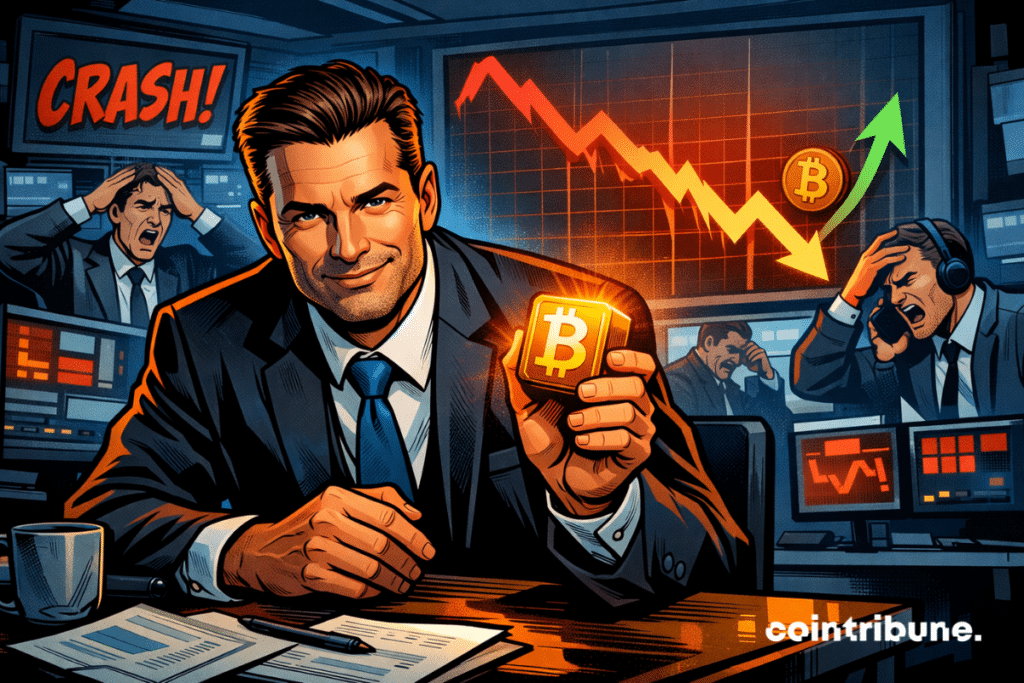
The crypto market is going through a brutal digestion phase since the October shock. However, a message comes up from the professional desks. Indeed, many institutional investors believe that bitcoin is worth more than its current price. The idea is not new, but the timing is intriguing.
In brief
- The figures published by Coinbase reveal that some institutions see bitcoin as cheap.
- But the crypto market remains fragile and nervous. Macro and politics could tip the outcome, one way or the other.
An unexpected signal at the heart of the bitcoin correction
According to Coinbase, about 71% of institutional investors surveyed consider Bitcoin undervalued when it trades between 85,000 and 95,000 dollars.
The contrast is striking. At the same time, bitcoin has fallen about 30% since its October peak, and the market remains marked by a phase of massive liquidations.
This type of survey does not move the price by itself. But it highlights a point often invisible to the public: in certain zones, institutions do not just see a falling chart. They see an asset that goes “on sale”, or at least becomes defensible again in an investment committee.
The survey cited by Coinbase is based on 148 investors in total, including 75 institutional and 73 independent investors. They were surveyed between December 10, 2025 and January 12, 2026.
The sample size can be debated. But the coherence of the result matters. Indeed, nearly three-quarters of the institutions speak of bitcoin undervaluation, and only a minority mention overvaluation.
Behind the word “undervalued”, there is no single model. Some compare Bitcoin to gold and its safe haven narrative. Others look at scarcity, adoption, liquidity, or the hedging role against monetary uncertainties. And many keep it simpler: they compare the current price to what they agreed to pay a few months ago, factoring risk into the margin.
The pros’ “hold” reflex and what it says about risk
80% of institutional investors say that in case of a new 10% drop in the crypto market, they would hold their positions or buy more.
This is not wishful thinking. It resembles a portfolio discipline. Indeed, one avoids chasing green candles, one strengthens when volatility scares others. This behavior, when real, acts like a psychological floor, not an absolute shield.
Coinbase also indicates that more than 60% of institutions have maintained or increased their exposure since October. This suggests a fundamental thesis. The current decline is not necessarily the announcement of abandonment, but rather a period where appetite reorganizes. Less euphoria, more selection.
Coinbase shows a rather constructive reading for early 2026. It mentions the hypothesis of two Fed rate cuts in 2026 as potential support for risky assets, therefore for crypto.
The report also cites precise macro elements, like inflation around 2.7% in December and robust growth estimated via the GDPNow model for Q4 2025.
This setting matters, because Bitcoin does not evolve in a vacuum: it reacts to rates, the dollar, risk appetite, and overall liquidity.
But the same document emphasizes the “comet tails” that can break everything: geopolitical tensions, energy shocks, and renewed political uncertainties. In this context, the idea of undervaluation is not a promise of immediate rebound. It is rather a value judgment over a longer horizon, with an implicit sentence: “if the storm does not worsen.”
Maximize your Cointribune experience with our "Read to Earn" program! For every article you read, earn points and access exclusive rewards. Sign up now and start earning benefits.

Enseignante et ingénieure IT, Lydie découvre le Bitcoin en 2022 et plonge dans l’univers des cryptomonnaies. Elle vulgarise des sujets complexes, décrypte les enjeux du Web3 et défend une vision d’un futur numérique ouvert, inclusif et décentralisé.
The views, thoughts, and opinions expressed in this article belong solely to the author, and should not be taken as investment advice. Do your own research before taking any investment decisions.