Bitcoin's Mining Difficulty Falls for the Ninth Time This Year
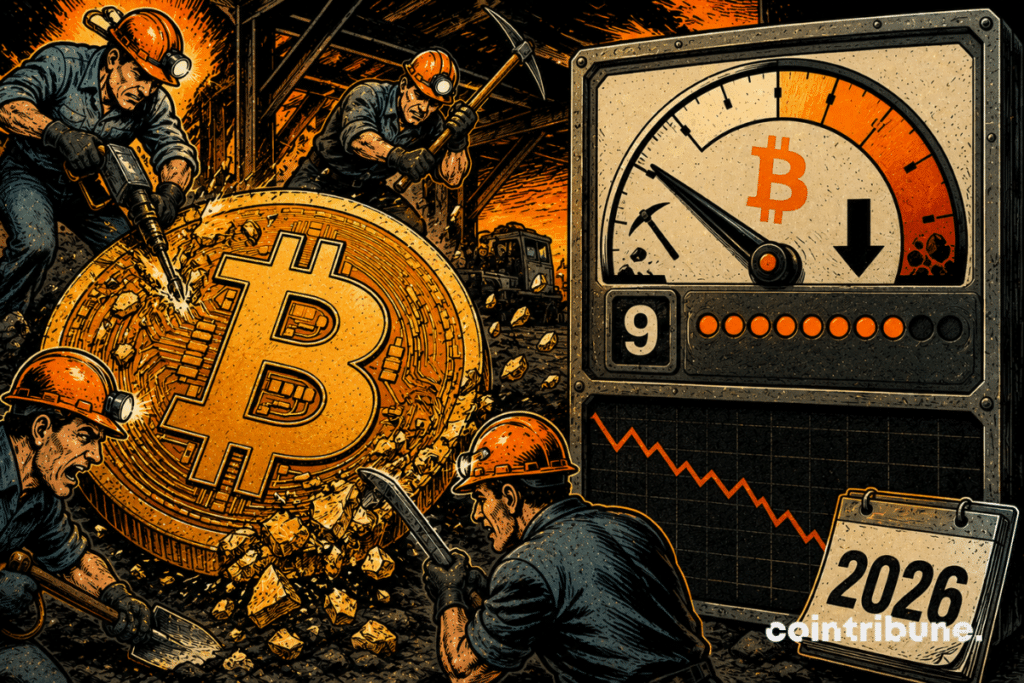
Bitcoin mining difficulty dropped by 0.74% at block 959616 this weekend, marking the 15th adjustment of 2026. In the first seven months, decreases outnumber increases by a ratio of 3 to 2. This self-regulation mechanism tells of an industry facing increasing pressure.
In brief
- The Bitcoin network has recorded 9 difficulty decreases and 6 increases since January 2026, for a net decline of 13.82%.
- Hashprice, the daily revenue per petahash, has fallen from 37.39 to 32.21 dollars in 206 days.
- Bitcoin has lost 26% since January 1st, pushing major miners to redirect their electrical capacity towards artificial intelligence.
An adjustment mechanism that clearly leans downward
Bitcoin difficulty functions like an automatic regulator: every 2,016 blocks, about every two weeks, the protocol recalibrates the target to maintain an average block time of ten minutes. This mechanism, unchanged since the network was created by Satoshi Nakamoto, is a reliable barometer of the computing power deployed by the network’s miners.
Since the beginning of 2026, however, this barometer indicates an almost constant downward pressure. Over 15 adjustments covering 28,224 blocks, between January 8 and July 25, the network yielded 9 decreases for only 6 increases. The average gap per adjustment reaches 6.4 percentage points, a range well above that of previous cycles.
Cumulatively, difficulty increases total 31.04% while decreases reach 43.96%. Result: the indicator has fallen from 146.47 trillion to 126.23 trillion, a decline of 13.82% in just seven months.
The main cause of this erosion is not due to a technical failure of the network. It lies in the economic equation of miners, now harmed by Bitcoin’s underperformance in the markets. Since January 1, the leading cryptocurrency has lost 26% of its value, mechanically compressing the margins of all operators.
Hashprice, an indicator that measures the estimated daily value of one petahash per second (PH/s) of computing power, illustrates this decline. In 206 days, it dropped from 37.39 to 32.21 dollars. Each unit of computing power thus brings in less than at the start of the year, while energy and infrastructure costs remain unchanged or even increase in some jurisdictions.
The silent exodus of miners towards artificial intelligence
Faced with this compression of margins, major mining players are activating a lever few observers anticipated two years ago: converting their infrastructure towards artificial intelligence and cloud computing. Companies holding long-term electricity contracts and already equipped sites now find it more profitable to rent this capacity to AI clients than to continue mining bitcoins.
This movement is not anecdotal. It is directly reflected in the decline of total network computing power. The hardware does not disappear; it simply changes use. Servers that used to compute SHA-256 hashes now process language model inferences or cloud graphics rendering.
For now, the difficulty adjustment algorithm continues to do its job. It reduces the target as computing power withdraws and ensures blocks are still produced every ten minutes. As for the second half of 2026, everything will depend on Bitcoin’s ability to regain market ground and the ongoing appeal of AI for infrastructure operators.
In sum, the 15th difficulty adjustment of 2026 is not an isolated event. It fits into a strong trend where the fall in bitcoin price, hashprice compression, and miners’ migration to AI reinforce each other. Price recovery and competition with AI revenues remain the two decisive factors for the second half-year. The difficulty algorithm demonstrates, meanwhile, the resilience of the protocol in real time.
Maximize your Cointribune experience with our "Read to Earn" program! For every article you read, earn points and access exclusive rewards. Sign up now and start earning benefits.

Passionné par le Bitcoin, j'aime explorer les méandres de la blockchain et des cryptos et je partage mes découvertes avec la communauté. Mon rêve est de vivre dans un monde où la vie privée et la liberté financière sont garanties pour tous, et je crois fermement que Bitcoin est l'outil qui peut rendre cela possible.
The views, thoughts, and opinions expressed in this article belong solely to the author, and should not be taken as investment advice. Do your own research before taking any investment decisions.