BRICS Shift 65 % Of Internal Trade Away From The Dollar
The greenback is increasingly losing ground within the BRICS alliance. Indeed, the use of local currencies in various commercial exchanges is now intensifying among the member states of the bloc. The reduction of their dependence on the dollar as well as the related costs of cross-border payments are the objectives thus set. This revolution then constitutes a new phase in the struggle for monetary sovereignty, while the US administration tries to safeguard the international power of its currency. The BRICS are gradually reshaping the global financial power relations, between dedollarization, sovereign digital currencies, and the American response.
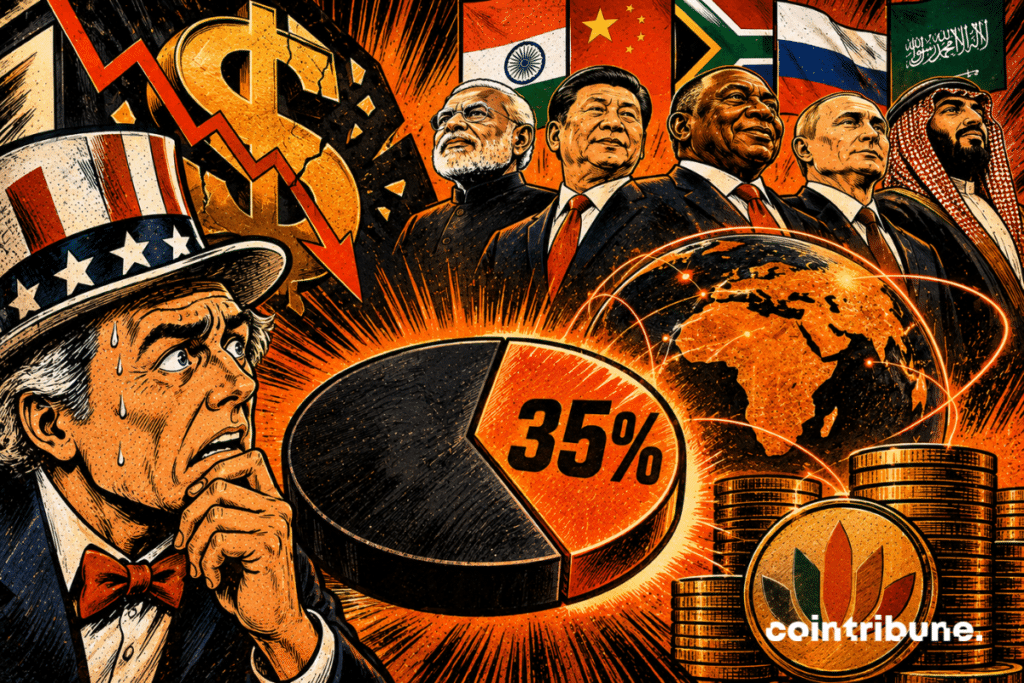
In Brief
- Only 35 % of trades within BRICS remain denominated in US dollars.
- A 65 % share now dominated by bilateral settlements in national currencies.
- An acceleration driven by the Saudi petro-yuan and the diversified use of the rupee, ruble, and dirham.
- Threats of 100 % tariffs formulated by Donald Trump to curb dedollarization.
- Potential future automation of cross-border payments discussed at the BRICS summit.
The BRICS trade flow report: the historic breakthrough of local currencies
The timeline of dedollarization undertaken resolutely by the BRICS alliance since 2022 has just reached an important milestone in terms of international payments. In a report published by Pradip Dhir, director of Pranan Consulting, the data reveal that the bloc used the dollar for only 35% of the total of its internal cross-border trade.
Meanwhile, the rest of the trade transactions were entirely conducted in national currencies, which marks a significant decline of the US dollar in the payment balance of the alliance members. This change is based on the multiplication of bilateral agreements, such as trade flows between China and Russia, now settled in yuan and rubles. Also, the use of the Chinese yuan has accelerated with Iran due to US financial sanctions.
This model change is based on the creation of custom exchange channels. Since 2024, the Chinese government has been establishing special contractual systems appropriate for the use of local currencies to facilitate transactions for its partners.
Conversely, Saudi Arabia has taken a decisive economic step by choosing the yuan for settling oil contracts. The multiplication of these bilateral agreements has helped push the use of national currencies to this 65% threshold, which places the US dollar in a minority position in trade within the alliance.
Numerous statistical data and bilateral agreements really demonstrate this restructuring of flows :
- Dollar settlements : reduced to only 35% for cross-border transactions within the bloc ;
- Local currencies : a 65% share occupied by the alliance’s national currencies ;
- Indian diversification : India settles part of its trades within BRICS in rupees, rubles, and dirhams ;
- Saudi petro-yuan : Saudi Arabia validates the use of the yuan for settling oil transactions.
Tariff threats and crisis diplomacy : Washington’s response
The deliberate exposure of this approach excluding the dollar has nevertheless encountered a firm response from the Trump administration. Following the targeting of the greenback on the global financial stage by alliance members, Donald Trump’s return to the head of the United States has constituted a brake on the trajectory of the BRICS bloc.
The US president hurried to intimidate by imposing punitive surcharges capable of reaching 100% on member countries continuing to execute their dedollarization agenda. Given the firmness of these warnings, the bloc has provisionally moderated official declarations on this subject.
The existence of trade transactions already carried out in national currencies was not shaken by this strategic political pause. It simply allows the reassessment of the short-term priorities of the BRICS. Careful compromises now replace direct confrontation. Thus, each member country evaluates the effect of tariffs on its personal exports to the United States.
The horizon of CBDCs: toward a digitized monetary infrastructure
Beyond diplomatic conflicts and the use of classical fiat currencies, the continuation of these parallel exchange channels is now becoming concrete thanks to technological innovations. This is why Indian authorities have indicated their willingness to raise the issue of settlements through central bank digital currencies (CBDCs) during the BRICS summit scheduled for September. The connection of these sovereign digital currencies could offer the prospect of automating cross-border payments potentially avoiding conventional correspondent banking systems.
In the long run, this shift towards digital payment networks would stabilize the ratio of trade outside the dollar, despite external political pressures. According to financial and crypto experts, this overhaul of monetary infrastructures by central banks would contribute to the search for new technological alternatives for securing the sovereignty of international payments.
Maximize your Cointribune experience with our "Read to Earn" program! For every article you read, earn points and access exclusive rewards. Sign up now and start earning benefits.

Diplômé de Sciences Po Toulouse et titulaire d'une certification consultant blockchain délivrée par Alyra, j'ai rejoint l'aventure Cointribune en 2019. Convaincu du potentiel de la blockchain pour transformer de nombreux secteurs de l'économie, j'ai pris l'engagement de sensibiliser et d'informer le grand public sur cet écosystème en constante évolution. Mon objectif est de permettre à chacun de mieux comprendre la blockchain et de saisir les opportunités qu'elle offre. Je m'efforce chaque jour de fournir une analyse objective de l'actualité, de décrypter les tendances du marché, de relayer les dernières innovations technologiques et de mettre en perspective les enjeux économiques et sociétaux de cette révolution en marche.
The views, thoughts, and opinions expressed in this article belong solely to the author, and should not be taken as investment advice. Do your own research before taking any investment decisions.