US Stablecoin Law Unfinished Five Months Before Taking Effect
Five months before the deadline, the American law meant to regulate stablecoins remains an open project. In this context, the US Treasury has just published its most anticipated draft rules. Added to this is the launch of a decisive consultation. But between accumulated delays and a paralyzed Congress, nothing is decided yet. Behind the regulatory urgency also lies the global dominance of the dollar.

In brief
- On August 17, 2026, the US Treasury published a draft of rules defining who must obtain a federal license to issue stablecoins in the United States.
- The text opens a 60-day public consultation, with a response deadline set for mid-October 2026.
- The GENIUS Act must come into force on January 18, 2027, but no final rules have yet been finalized.
Stablecoins: what the new Treasury draft really changes
On August 17, 2026, the US Treasury Department published a Notice of Proposed Rulemaking (NPRM) relating to section 3 of the GENIUS Act. Approved by the Senate in June 2025, this law regulates payment stablecoins in the United States.
Specifically, this text defines two previously vague concepts:
- what it means to “issue” a stablecoin in the United States;
- what it means to “offer or sell” a stablecoin to a person residing on US soil.
These definitions are not just legal details. They determine which issuer will need to obtain a federal license and which can settle for a state authorization.
The US Treasury specifies that it has deliberately excluded certain reflexes stemming from traditional securities law. Indeed, it considers that stablecoins are intended to serve as a means of payment rather than as investment instruments.
Treasury Secretary Scott Bessent justifies the current approach in a statement released Monday:
These new rules must provide companies with the regulatory certainty necessary to innovate, strengthen the dollar’s role as the world’s reserve currency, and make the United States the global cryptocurrency capital.
A declaration illustrating Washington’s stated ambition: to make the tokenized dollar a global standard for digital payments.
A schedule for stablecoins at high risk of slippage
The text sets two deadlines:
- From January 18, 2027, the scheduled date of the law’s entry into force, any entity wishing to issue a stablecoin in the United States will have to hold either a federal or state license.
- From July 18, 2028, digital asset service providers will no longer be able to offer any stablecoin to US residents if it is not issued by a licensed issuer.
There is thus an 18-month transition window between the two deadlines. However, the actual timeline already worries industry professionals. In reality, the law originally required regulators to finalize their rules within 120 days after the vote on the text in July 2025. This deadline expired in July 2026, without any definitive rules being published.
The result: the Genius Act could come into force in January 2027 without a complete user guide. A very rare situation for financial regulation of such magnitude!
The public now has 60 days after publication in the Federal Register to comment on the text, with a deadline estimated for mid-October 2026. The Treasury will then have to review these responses before drafting a final version. The process generally takes several additional months.
Why is stablecoin regulation so delayed?
The US Treasury is not the only player. The Office of the Comptroller of the Currency (OCC), the Federal Deposit Insurance Corporation (FDIC), and the Federal Reserve each published their own draft rules in 2026, without perfect coordination among the agencies. This institutional fragmentation partly explains the accumulation of delays. The fact is that each regulator advances on its own schedule, with its own priorities.
Added to this is a political deadlock. The Digital Asset Market Clarity Act is currently stuck in the Senate. This piece of legislation is supposed to rewrite certain provisions of the GENIUS Act, notably the treatment of yield programs offered to stablecoin holders on exchanges. Key votes could not begin before the August summer recess, casting doubt on the final coordination between the two texts.
For analysts, this situation reflects a structural imbalance: the United States legislated quickly on the principle of stablecoins, but struggles to turn this general framework into precise operational rules. A classic gap between the political ambition of a text and the slow mechanics of its administrative implementation!
Tether, USDC: who has the most to lose in the stablecoin battle?
The market does not pause while Washington legislates. According to data aggregated by DefiLlama, the cumulative stablecoin capitalization stands at $308.0 billion. This represents a 14.3% increase year-on-year, with a historic peak of $322.4 billion on May 17, 2026.
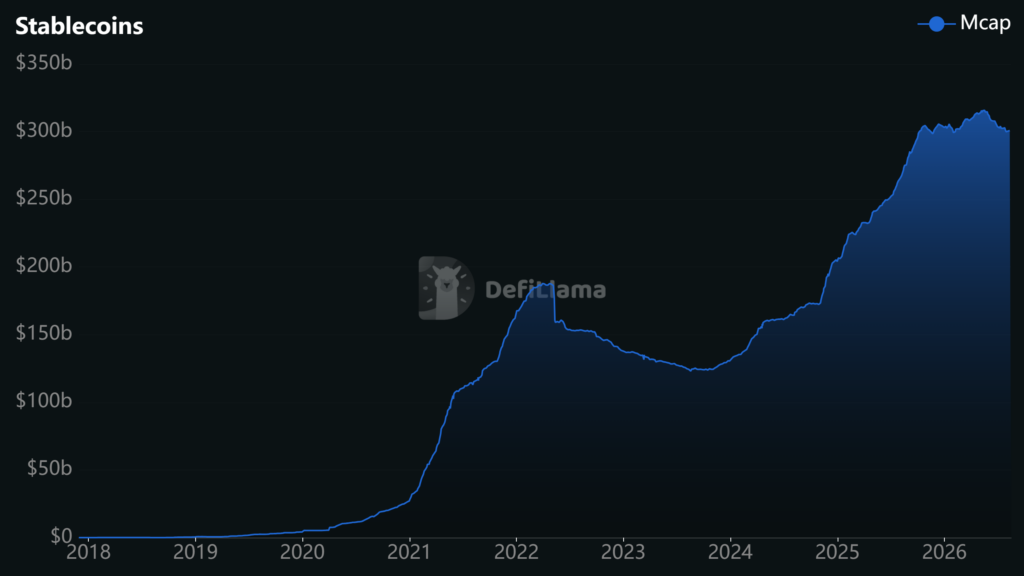
Tether (USDT) maintains a dominant position with nearly $183 billion in capitalization, about 59% of the market (far ahead of USDC issued by Circle).
The industry’s attention is precisely focused on the treatment of foreign issuers. Tether, based outside the United States, is a textbook case. Indeed, the Treasury text will need to specify under what conditions a foreign issuer can continue to be distributed on US soil without a local license, provided that certain reciprocal commitments between jurisdictions are respected. A regulatory misstep could therefore weaken the world’s largest stablecoin’s access to the US market, with cascading repercussions on the liquidity of the entire crypto ecosystem.
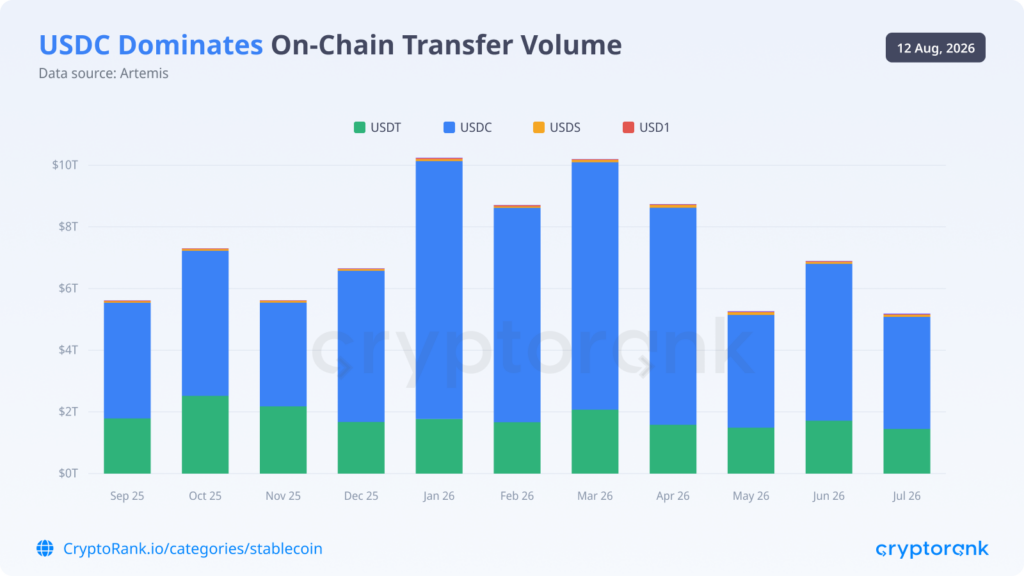
The onchain transfer volumes illustrate the stakes. According to CryptoRank Research, USDC transfers reached about $3,600 billion in July 2026 (compared to $1,400 billion for USDT). These data show two very distinct usage logics (institutional payment for one and trading liquidity for the other) that the future Treasury rule will have to address with equal rigor.
Five months before the deadline, the stablecoin law is moving forward without a definitive safety net. Between scattered agencies, a stuck Congress, and a market already at $310 billion, the future depends on a simple factor: the speed at which Washington turns ambition into applicable rules.
Maximize your Cointribune experience with our "Read to Earn" program! For every article you read, earn points and access exclusive rewards. Sign up now and start earning benefits.

My name is Ariela, and I am 31 years old. I have been working in the field of web writing for 7 years now. I only discovered trading and cryptocurrency a few years ago, but it is a universe that greatly interests me. The topics covered on the platform allow me to learn more. A singer in my spare time, I also cultivate a great passion for music and reading (and animals!)
The views, thoughts, and opinions expressed in this article belong solely to the author, and should not be taken as investment advice. Do your own research before taking any investment decisions.