CLARITY Act: New Version Expected Week of July 13
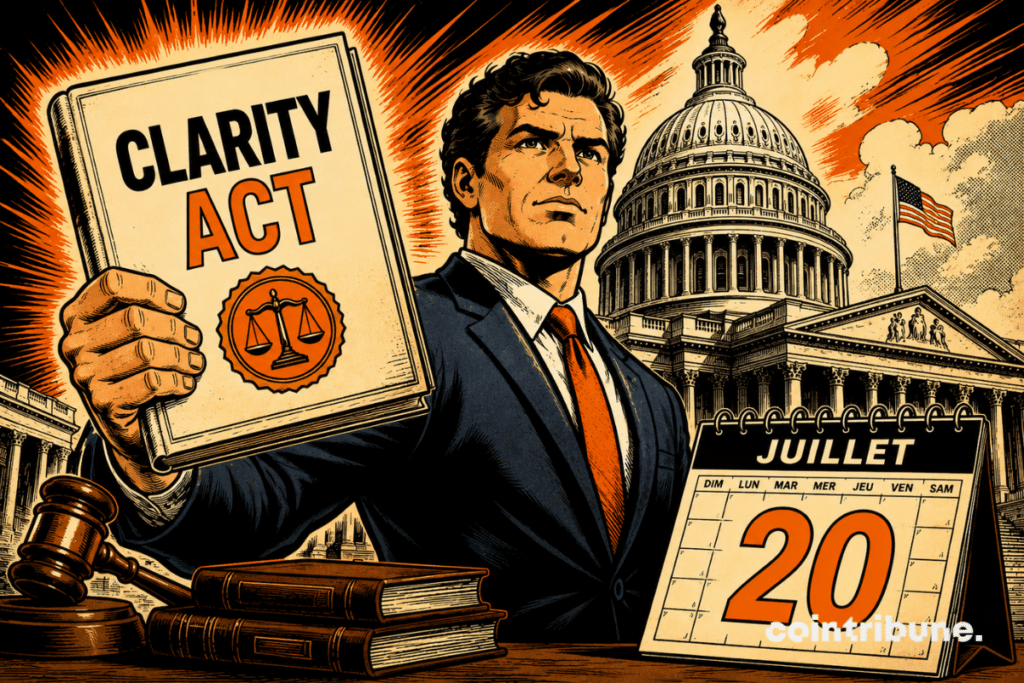
The US Senate could unveil a merged version of the CLARITY Act as early as the week of July 13, with a vote scheduled for July 20. The text, enriched by over 70 pages compared to previous versions, still needs to overcome the hurdle of 60 required votes. Will unresolved ethical issues be enough to derail this tight schedule?
In Brief
- The Senate could publish a merged version of the CLARITY Act as early as the week of July 13, before a vote scheduled on July 20.
- The text requires 60 votes in the Senate; two Democrats threaten to withdraw their support as long as the ethics rules remain unclear.
- The White House has neither approved the merged text nor participated in recent negotiations on the subject.
Four Decisive Weeks Before the Senate Break
The Senate plans a vote on the CLARITY Act for July 20, after a possible publication of the merged text as early as the week of July 13. This single text, officially named Digital Asset Market Clarity Act, combines the versions drafted by the banking and agricultural committees.
Moreover, pressure from the industry adds to this tight schedule. In early July, over 200 companies, including Coinbase and Ripple, had already asked Senate leaders to schedule a quick vote on the text before the summer break.
Republican leaders, like the banking committee chairman Tim Scott and majority leader John Thune, are coordinating their efforts to secure this July vote, as reported by Bitcoin.com News. The Senate indeed has only eight legislative days before the August recess, considered the real deadline.
Why Do the Ethics Rules Still Block the Text?
A provision demanded by Democrats would prohibit senior government officials, including the president, from having business ties with the crypto sector. However, the final text has not yet settled this point, one option under consideration being to allow state attorneys general to bring prosecutions in case of violation.
Two Democrats who supported the version passed in the banking committee have warned they might withdraw their backing as long as this section remains unclear. In contrast, Senator Cynthia Lummis defends a text designed as a consumer-friendly framework rather than a mere update of the 1933 laws.
This is a consumer-friendly disclosure framework for digital assets. Not a 1933 adaptation, but a framework designed for 2026 and beyond.
Lummis also responded to Senator Elizabeth Warren’s criticisms regarding illicit financing, highlighting over 16 guarantees integrated into the text. The White House, on its side, has neither approved the merged version nor participated in recent negotiations and has also pointed out the absence of Democratic candidates for the minority seats at the SEC and CFTC.
The Senate must also deal with the issue of federal preemption of state rules, still unresolved. Even if adopted, the House of Representatives will have to vote on its own version of the text before any transmission to President Trump, while internal tensions within the Republican camp already complicate this process.
Thus, Galaxy Research recently revised its forecasts, reducing to 50-50 the chances of a federal regulatory framework for digital assets by the end of the year. The window from July 13 to August 7 remains, for now, the best chance for the industry to obtain a law before the midterm elections.
Maximize your Cointribune experience with our "Read to Earn" program! For every article you read, earn points and access exclusive rewards. Sign up now and start earning benefits.

Passionné par le Bitcoin, j'aime explorer les méandres de la blockchain et des cryptos et je partage mes découvertes avec la communauté. Mon rêve est de vivre dans un monde où la vie privée et la liberté financière sont garanties pour tous, et je crois fermement que Bitcoin est l'outil qui peut rendre cela possible.
The views, thoughts, and opinions expressed in this article belong solely to the author, and should not be taken as investment advice. Do your own research before taking any investment decisions.