Crypto: How Europe Wants to Enforce Its Version of the SEC
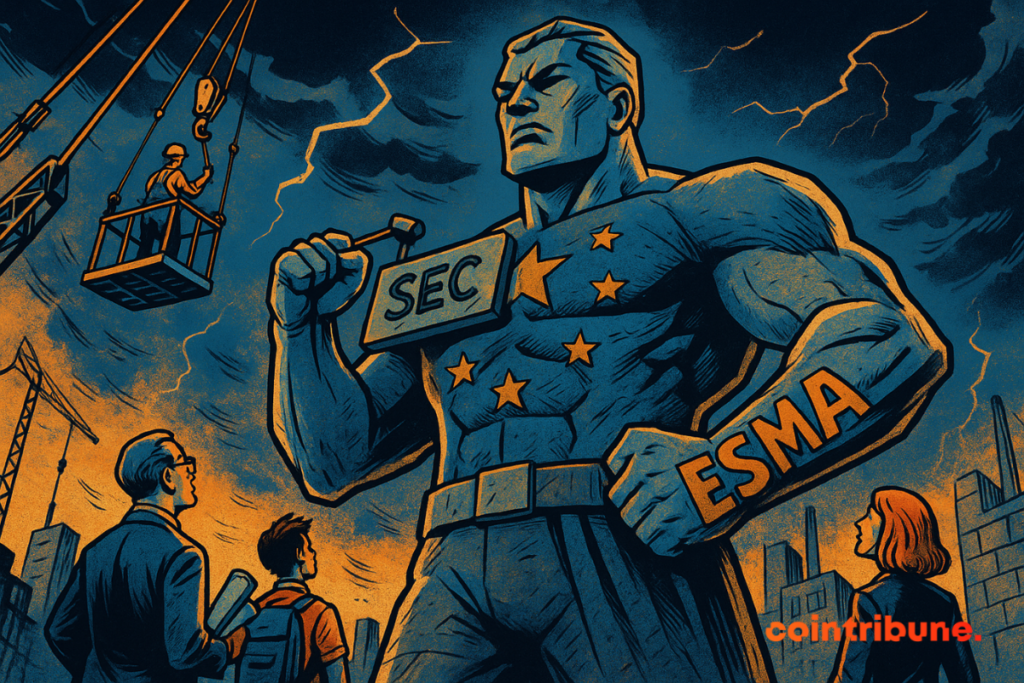
When it comes to crypto, Europe sends mixed signals. One day it simplifies procedures, the next it tightens regulatory measures. This hesitant dance has consequences for entrepreneurs, crypto investors, or blockchain projects seeking stability. And today, a true turning point is emerging. The European Union wants to grant ESMA powers similar to those of the American SEC. A change in scale… and tone.
In brief
- Europe wants to centralize crypto regulation under the aegis of an ESMA with extended powers.
- Tech startups fear authorization delays slowing innovation and growth of small players.
- The reform aims to harmonize European finance to compete with the more integrated American markets.
- Some member states contest, fearing an inefficient, heavily bureaucratic centralized model.
A “European SEC” to Strengthen EU Finance
On December 4, 2025, the European Commission presented an ambitious reform: unifying the supervision of financial markets and cryptos within a single European gateway, embodied by the ESMA. The goal: to strengthen the EU’s competitiveness against the United States and their $62 trillion stock exchange. For comparison, the EU’s caps at $11 trillion.
Maria Luís Albuquerque, Commissioner for Finance, summarizes Brussels’s vision as follows:
For too long, Europe has tolerated a level of fragmentation that hampers our economy. Today, we are deliberately choosing to change course. By building a true single financial market, we will offer citizens better opportunities to grow their savings, while unlocking stronger funding for Europe’s priorities. Market integration is not a technical exercise — it is a political imperative for Europe’s prosperity and global relevance.
With this new model, ESMA will be able to directly supervise crypto platforms, digital asset managers, and major financial infrastructures. The current European passport system, which allowed a startup to establish in one country to operate across the EU, could disappear. A major break for the balance between regulation and innovation.
Crypto Startups: The Specter of a Regulatory Slowdown
For crypto startups, it is a cold shower. Many fear a boomerang effect. While MiCA is just beginning to roll out, a new administrative layer could slow down procedures and chill crypto investors. Faustine Fleuret, from Morpho, warns:
I am even more concerned that the proposal assigns ESMA both authorization and supervision of CASPs, and not just supervision.
Similar sentiment from Elisenda Fabrega, from Brickken:
Without adequate resources, this mandate could become unmanageable, leading to delays or overly cautious assessments that could disproportionately impact small businesses or innovative companies.
Some believe reopening discussions on MiCA, even before its full implementation, would add unnecessary legal uncertainty. Regulators claim to want harmonization, not complexity. But the line between the two seems very thin.
Behind the Promise of Integration, Very Real Divisions
While major European powers — France, Germany, Italy — support the idea of centralized supervision, other countries like Luxembourg or Malta are hesitant. Minister Gilles Roth said his country favors supervisor convergence rather than a centralized model considered costly and ineffective.
Among institutions, some also fear loss of sovereignty. Even within supportive states, tensions arise about modalities: should ESMA be given sanction power? Who will finance its increased means? At what pace will these changes apply?
Exchanges on X also show concerns. Several users highlight the risk of turning the EU into an “audit machine,” disconnected from the field. Others, on the contrary, applaud the desire to put an end to 27 divergent national regulations.
5 key facts about the EU crypto reform:
- The US stock market is worth $62 trillion, compared to $11 trillion for the EU;
- ESMA would become the sole supervisor for crypto actors;
- The current European passport model would be abolished;
- Crypto startups fear bureaucratic suffocation;
- Progressive implementation starting in 2026, with no precise date.
As long as the ECB presents the digital euro as the engine of a “stronger” European economy, cryptos will have no respite. Regulation will advance at the pace of this monetary ambition. Behind the promise of a more integrated system, an entire industry will have to learn to survive in a Europe that wants to both encourage digital finance… and control it.
Maximize your Cointribune experience with our "Read to Earn" program! For every article you read, earn points and access exclusive rewards. Sign up now and start earning benefits.

La révolution blockchain et crypto est en marche ! Et le jour où les impacts se feront ressentir sur l’économie la plus vulnérable de ce Monde, contre toute espérance, je dirai que j’y étais pour quelque chose
The views, thoughts, and opinions expressed in this article belong solely to the author, and should not be taken as investment advice. Do your own research before taking any investment decisions.