Crypto Markets Crashed After The US Iran deal
The volatility of cryptos and their close links with global geopolitical events have just written a new and surprising chapter for digital finance investors. While a major diplomatic breakthrough foretold a wave of widespread optimism, the crypto market reacted quite asymmetrically, surprising all operators. This dynamic reveals the complexity of risk transfer mechanisms, an important subject that is now redefining institutional and private fund allocation strategies at the international level.
In Brief
- The crypto market abruptly erased gains recorded after the first signs of geopolitical easing, with Bitcoin falling below several major technical thresholds.
- Despite the signing of a historic peace agreement between the United States and Iran, investors favored massive profit-taking rather than a new bullish momentum on cryptos.
- Capital redirected toward traditional stock markets, while oil prices declined due to easing in the Middle East.
- Bitcoin’s drop triggered a wave of liquidations in derivative markets, with over 600 million dollars of long positions wiped out in just 24 hours.
A Sudden Drop That Erases the Peace Rally
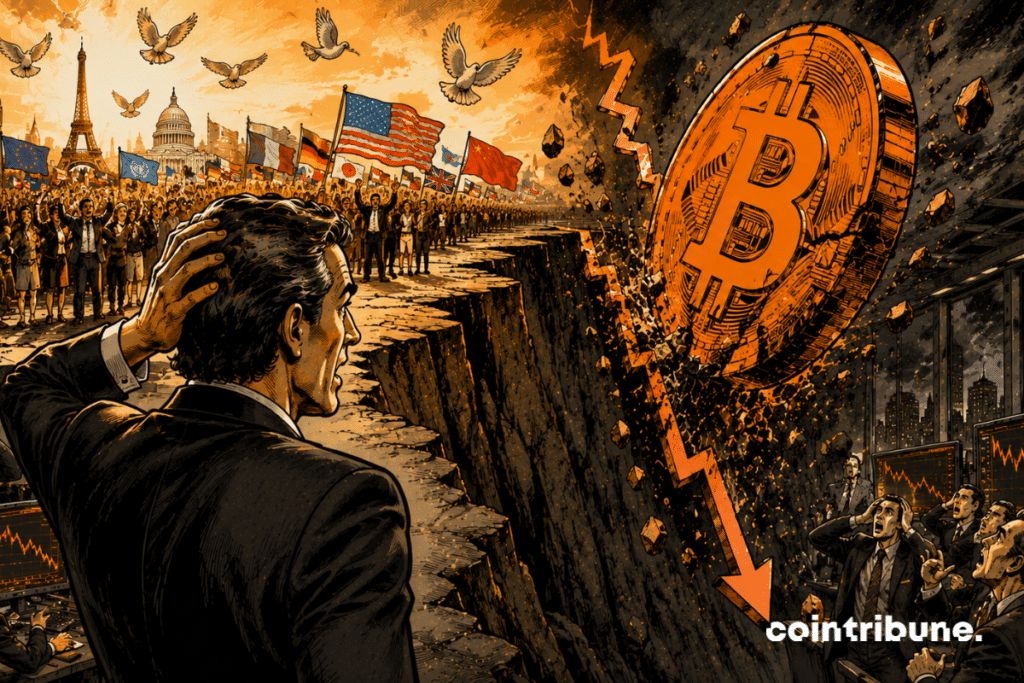
The crypto market experienced a significant correction, wiping out all gains made thanks to the easing of international tensions.
Thursday session showed the intensity of the short-term movement :
- The breaking of technical supports : Bitcoin plummeted heavily, breaking key thresholds to settle at the lowest point of its drop at $62,236, before a fragile stabilization above $62,812 ;
- The scale of the daily correction : the market’s leading crypto registered an immediate 5% decline on Thursday alone ;
- The erasure of the bullish rally : the overall retreat amounts to 7.5 % from the peak of $67,300 recorded on June 15, born from early rumors of easing ;
- The contraction in market capitalization : Bitcoin’s valuation dropped to $1.25 billion, dragging the entire crypto market down by 4.3 % to $2.24 billion.
This capitulation is technically explained by investors’ behavior in response to a major announcement publication. Indeed, the initial momentum was sharply broken on Wednesday midday with an unsuccessful attempt to test the $66,000 resistance. Before midnight, a first slide brought the price down to $63,643.
The final blow came a little later, after a brief rebound attempt on Thursday at a 0.1% difference around $64,500, then a precarious stabilization at $64,340. Bitcoin’s value suddenly dropped by $2,000 in just two hours, confirming that operators widely took advantage of the official announcement of the new geopolitical situation to liquidate their positions and eliminate any risk exposure.
The Great Market Paradox : Wall Street Jubilation, Energy Collapse
This reversal generated localized crypto risk aversion, imposing a major capital reallocation from alternative assets to traditional markets. The global stock markets absorbed much of this liquidity, with Wall Street showing better conditions: Nasdaq rose by 1.71%, S&P 500 increased by 1.22%, and Dow Jones gained 0.5%. In Asia, optimism also pushed the Japanese Nikkei up by 1.65% and the South Korean Kospi surpassed the historic threshold of 9,000 points. Traditional stocks completely overshadowed the crypto sector, benefiting from a global rotation of institutional portfolios toward equity markets.
This phenomenon of connected vessels occurred in direct reaction to the major geopolitical news of the day: the signing of a peace agreement and an official protocol between the American and Iranian presidents. Such historic easing is already reflected on the ground by “tankers sailing freely through the Strait of Hormuz”. The easing resulted in an immediate drop in energy prices with West Texas Intermediate (WTI) falling below $74 per barrel and Brent below $77 per barrel.
The Slaughter of Futures Contracts and Crypto Investors’ Horizon
The collapse of margin positions on derivatives markets sharply increased the technical purge on trading platforms. The reverse rush trapped optimistic traders, causing waves of forced liquidations.
In just 24 hours, no less than $601 million of long positions across all cryptos were wiped from the market, compared to only $85.6 million for short positions. Specifically concerning Bitcoin, volatilized long positions amount to $177 million, compared to $19 million for shorts. The general sentiment collapsed, with the Crypto Fear & Greed index falling into the “extreme fear” zone at a level of 15.
In the long term, prospects oscillate between short-term capitulation and structural adjustment of the forces at play. The removal of the geopolitical risk premium brings Bitcoin back to its pure liquidity fundamentals, where the end of a major conflict can ultimately stabilize global macroeconomic policies.
While the current volatility risks, in the short term, draining individual portfolios overly exposed to leverage effects, the disappearance of international tensions paradoxically offers a healthier macroeconomic framework for the global economy. The history of financial cycles shows that corrections triggered by such events often end up purging market excesses, paving the way for a constructive sideways phase awaiting the return of more stable capital flows.
Maximize your Cointribune experience with our "Read to Earn" program! For every article you read, earn points and access exclusive rewards. Sign up now and start earning benefits.

Diplômé de Sciences Po Toulouse et titulaire d'une certification consultant blockchain délivrée par Alyra, j'ai rejoint l'aventure Cointribune en 2019. Convaincu du potentiel de la blockchain pour transformer de nombreux secteurs de l'économie, j'ai pris l'engagement de sensibiliser et d'informer le grand public sur cet écosystème en constante évolution. Mon objectif est de permettre à chacun de mieux comprendre la blockchain et de saisir les opportunités qu'elle offre. Je m'efforce chaque jour de fournir une analyse objective de l'actualité, de décrypter les tendances du marché, de relayer les dernières innovations technologiques et de mettre en perspective les enjeux économiques et sociétaux de cette révolution en marche.
The views, thoughts, and opinions expressed in this article belong solely to the author, and should not be taken as investment advice. Do your own research before taking any investment decisions.