Crypto: Solana Connects to Cash via MoneyGram
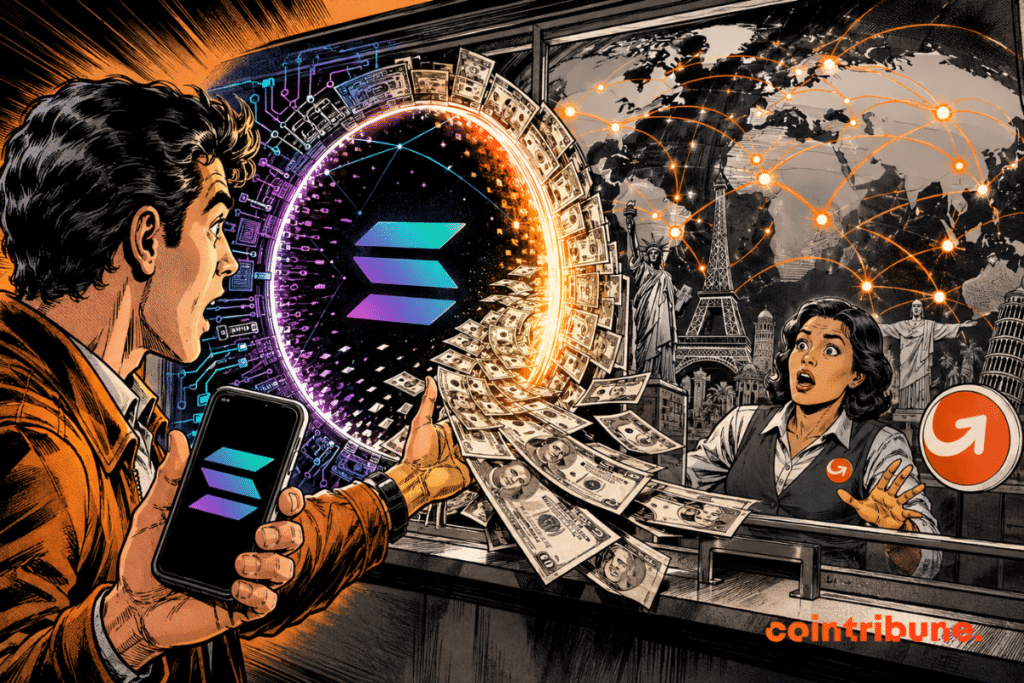
August 11, 2026, will certainly be one of those many dates to mark with a white stone in the history of cryptocurrency. And rightly so, it has just gained a life-sized gateway to cash. A revolution owed to MoneyGram, which officially opens its Ramps service on Solana. More than a simple announcement, the project has a clear goal: to expand the use of digital assets beyond bank cards and crypto exchanges.
In brief
- MoneyGram officially launches its Ramps service on Solana.
- The Rift wallet becomes the first Solana player to integrate this cash-to-crypto solution.
- The service covers cash deposits in more than 25 countries and withdrawals in more than 170 countries.
- Solana becomes the second crypto blockchain connected to Ramps, after Stellar.
Solana becomes MoneyGram’s physical payment network
MoneyGram is expanding its Ramps service to Solana, the second blockchain to integrate this infrastructure after Stellar. Specifically, this cash-to-crypto connects MoneyGram’s physical network to applications, wallets, and exchanges running on Solana. Users can deposit cash and receive digital assets. Conversely, they will have the option to convert their stablecoins into local currency. Withdrawals can then be made at an agency.
This crypto alliance is especially significant given MoneyGram has more than 60 million active customers. Added to this are:
- almost 500,000 physical points of sale;
- a digital presence covering more than 200 countries and territories.
That’s not all! The Ramps service also allows cash deposits in more than 25 countries and withdrawals in more than 170 countries and territories. For the Solana crypto ecosystem, this figure represents a geographic coverage that few fintech players can claim today.
These data nevertheless reveal a fundamental asymmetry of the service: a user will have the option to withdraw cash by exchanging their stablecoins via MoneyGram. However, they might not necessarily be able to deposit liquid cash at a MoneyGram office to buy SOL.
This simply means that the on-ramp remains confined to selected markets, while the off-ramp covers most of the globe. For Solana developers, this is a technical detail that matters. Certainly, they no longer need to negotiate banking relationships country by country thanks to the single API. Nevertheless, the promise of financial inclusion remains variable in scope.
Analysis: Solana primarily gains a massive off-ramp, not a universal gateway to crypto. Its success will now depend on the number of integrations, the total cost, and the quality of the user journey.
A crypto infrastructure particularly advantageous for developers
The integration of MoneyGram Ramps into the Solana Developer Platform is a strong signal. The fact is that developers now have access to:
- SDKs;
- a sandbox;
- comprehensive documentation.
All instantly! No more negotiating with banks or navigating complex regulations. Everything is ready to use.
According to the official statement published by Solana on August 11, 2026, this crypto infrastructure opens the door to three major use cases:
- Cross-border remittances: a worker can receive stablecoins and convert them into local cash, without a bank account.
- Payroll payment: companies pay in crypto and employees withdraw in fiat via MoneyGram.
- Humanitarian aid: funds arrive on-chain and are distributed in cash to hard-to-reach areas.
In this respect, Solana Foundation President Lily Liu emphasizes an important point:
Solana is an infrastructure for more than six billion people on the Internet. By connecting our ecosystem to MoneyGram’s network, developers can build financially useful applications on a global scale.
This approach contrasts with purely speculative DeFi projects. Indeed, crypto now serves to solve real problems: financial inclusion, payment speed, cost reduction… In this context, Solana establishes itself as the crypto utility network par excellence.
From Stellar to Solana: MoneyGram strengthens its crypto market offensive
MoneyGram is not new to cryptocurrencies. The money transfer giant has been working in this area for over five years. On June 22, 2026, it notably became an active validator on Solana. It was staking SOL and processing transactions directly on the crypto network. A few weeks later, it integrated the Solana Developer Platform alongside Mastercard.
The group also maintains its foothold on Stellar. In early June, it launched its own MGUSD stablecoin in collaboration with payment company Tempo.
The launch of Ramps on Solana therefore confirms a clear multi-chain strategy. Stellar remains the primary supported network. Solana becomes the second. This multi-chain approach goes far beyond mere diversification. It reveals a deep conviction, also confirmed by MoneyGram CEO Anthony Soohoo:
The future of payments relies on access.
This diversification also illustrates a deep trend in institutional finance: large payment groups no longer bet on a single blockchain. They replicate their infrastructure where user demand and available crypto liquidity exist.
What this crypto alliance changes for the Solana ecosystem
The question is no longer whether MoneyGram can connect its network to Solana. That is already done! The short and medium-term goal is rather to determine:
- how many wallets, crypto exchanges, and applications will follow Rift in the coming months;
- if this adoption will translate into significant volumes of cash-to-crypto conversions.
In the long term, this integration is part of a larger battle for global payment infrastructure. Solana aims to establish itself as a reference settlement rail against competing networks. The next indicator to watch will be the addition of other Solana wallets to Ramps and the evolution of volumes traded through this new bridge between cash and crypto.
A new partnership that is not without challenges
Compliance and regulation remain major challenges. MoneyGram must ensure that every transaction complies with local laws, especially in terms of anti-money laundering. Developers will need to integrate robust KYC/AML checks. MoneyGram already has solid compliance expertise. However, scaling a service across 170 territories requires considerable regulatory agility.
Added to this is competition. Native crypto players such as MoonPay, Transak, or Ramp Network already offer similar solutions. These companies are more agile and less burdened by legacy structures. However, they do not have MoneyGram’s global physical network.
Another risk not to be underestimated: dependence on Solana. Indeed, this crypto network has already suffered major outages testing its resilience. Certainly, its stability has significantly improved. Nevertheless, an institution like MoneyGram cannot afford service interruptions.
Towards payment tokenization? The future after this partnership
This launch raises a broader question within the crypto community: is MoneyGram testing the full tokenization of its business model? According to analysts, signals converge:
- the group is already a validator on Solana;
- it has integrated the Solana Developer Platform;
- it deploys its ramps via an open API.
Each step brings its traditional infrastructure closer to the blockchain.
Some DeFi experts even see a precedent here. If MoneyGram succeeds in migrating a significant share of its volumes to Solana, other institutions will follow. Specifically, this refers to Mastercard, which is already present on the Solana Developer Platform. Central banks are also observing this live laboratory. They are already working on their CBDC.
One thing is certain: the MoneyGram/Solana partnership goes far beyond a simple marketing announcement. It is proof that a leading historic financial institution is transforming its core business into an open infrastructure. For Solana, the implications are just as significant. The crypto network gains newfound institutional legitimacy. It no longer competes only with Ethereum on DeFi or NFTs. It becomes a settlement layer for global financial flows.
Maximize your Cointribune experience with our "Read to Earn" program! For every article you read, earn points and access exclusive rewards. Sign up now and start earning benefits.

My name is Ariela, and I am 31 years old. I have been working in the field of web writing for 7 years now. I only discovered trading and cryptocurrency a few years ago, but it is a universe that greatly interests me. The topics covered on the platform allow me to learn more. A singer in my spare time, I also cultivate a great passion for music and reading (and animals!)
The views, thoughts, and opinions expressed in this article belong solely to the author, and should not be taken as investment advice. Do your own research before taking any investment decisions.