Solana Leads Ethereum on Fees, but ETH Still Wins on Burn
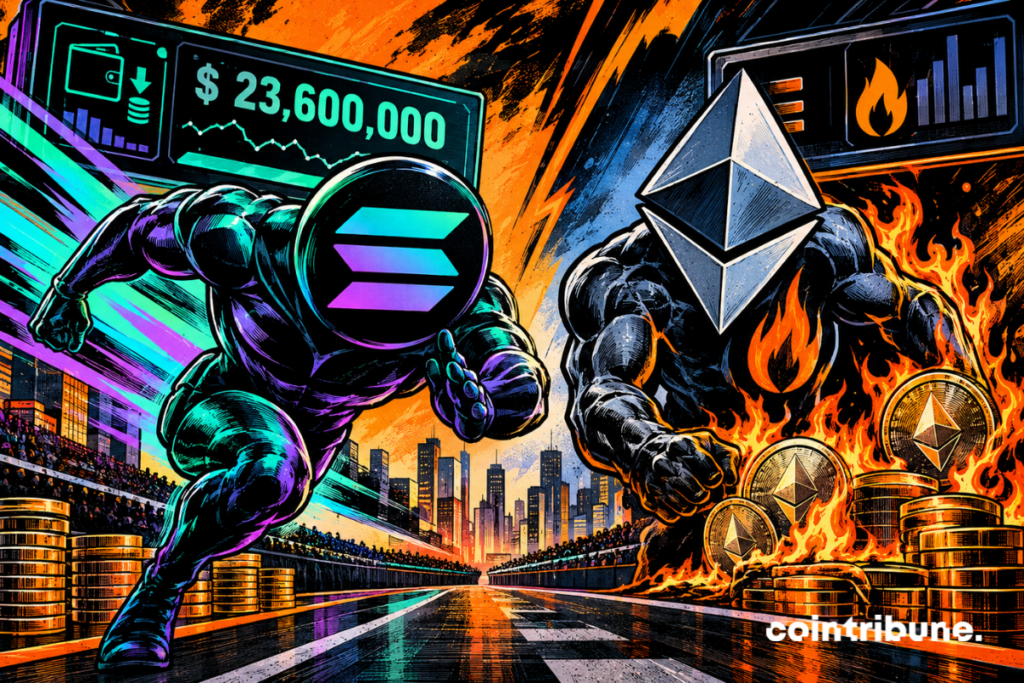
$1.1 million in fees in 24 hours for Solana, versus $649,423 for Ethereum. Over 30 days, the same scenario: $23.58 million against $12.04 million. On paper, Solana thus takes the lead. Then the burn comes to blur the cards. Ethereum destroyed $2.80 million in tokens over the period, versus $2.66 million for its rival. The fees tell one story. The burn tells another.
In brief
- Solana dominates fees: $23.58M generated over 30 days, almost twice as much as Ethereum.
- The burn changes the game: Ethereum burns $2.80M, slightly ahead of Solana’s $2.66M.
- Two opposing economies: Solana relies on activity, Ethereum maintains massive capital depth.
- Samani bets on SOL: the Multicoin co-founder sees Solana surpass Ethereum in market cap during this cycle.
- The real test remains open: adoption, capital, and captured value will show if activity turns into lasting gains.
Solana is turning network activity into serious fee revenue
Solana is no longer much of an underdog from a few years ago. September’s numbers tell the story of a network running at full speed: 3.04 million active addresses and 113.95 million transactions over the studied period. On the decentralized exchanges side, the seven-day volume reaches $16.61 billion, against $9.03 billion for Ethereum.
These are considerable volumes, but they do not yet allow us to know who actually benefits from this activity.
Over thirty days, users generated $23.58 million in fees on Solana. Yet, only $2.66 million was accounted as burn. Why such a gap?
The detail is in the plumbing. The base fee is 5,000 lamports per signature. Half is burned. The other half goes to the validator. And when users pay more to get ahead of others, priority fees also go to the validator. This is an important difference. A network can experience huge pressure without seeing its burn keep pace.
Applications also contribute to this frenzy: $7.7 million in revenue in 24 hours within the studied snapshot. The blockchain makes a lot of noise. The question now is what this noise really brings to the token.
Ethereum still holds the deeper pool of capital
Meanwhile, capital remains massively concentrated on Ethereum. DeFi represents $51.53 billion in TVL there, against $6.13 billion on Solana. For stablecoins, the gap is even wider: $146.94 billion versus $15.40 billion.
The same observation applies to tokenized real-world assets. There is $13.50 billion on Ethereum, against $1.58 billion on Solana.
These are markets very different from simple transactions. Some of this capital serves as liquidity. Some serves as collateral. Some is locked into protocols for weeks or months. That is why fee levels are not enough to measure the footprint of a network.
The burn adds an additional layer. Over 30 days, the reported burn reaches $2.80 million, slightly ahead of Solana’s $2.66 million.
Ethereum destroys its base execution fees as well as those linked to blobs, while priority tips go to validators.
However, be cautious of the classic shortcut: burning tokens does not mean directly paying holders. The tokens concerned are simply removed from circulation. They are not distributed to those who hold ETH.
Staking further complicates the picture. A validator’s income depends on several parameters, including their commission, performance, and the amount delegated to them.
Fees reveal only part of the value battle
In the snapshot of September 22, Ethereum shows a market cap of about $335 billion, against $69 billion for Solana.
And yet, the smaller network generates almost twice as much in fees over 30 days.
This discrepancy deserves attention. Solana charges its users more while its token weighs much less on the market. This might give the impression that something doesn’t add up. But fees are only part of the calculation.
Money generated by a transaction can pay a validator. It can be distributed to stakers. It can be burned. It can also remain in an application’s economy.
A blockchain can be extremely active without capturing all the value created by this activity.
The same goes for active addresses. The 3.04 million recorded on Solana do not necessarily represent 3.04 million people sitting behind their screens. A user can own multiple wallets. Bots can also multiply transactions.
This is where the comparison becomes less spectacular but more interesting. Solana has a lot of activity. Ethereum maintains a lot of capital. To differentiate the two models, one must look at what happens after payment: issuance, burn, staking, validator income, and token demand.
Samani is betting on a Solana flip
Kyle Samani, co-founder of Multicoin Capital, does not simply see Solana as a network catching up. He believes SOL can surpass Ethereum in market cap during this cycle.
The numbers give an idea of the scale of the bet. In the data he cites, Solana is worth about $58 billion against $293 billion for ETH. So SOL would need almost five times more market cap to overtake.
Samani relies notably on current activity. Solana generates more fees on seven- and thirty-day windows, shows more transactions, and dominates the DEX volume of the studied period. He also believes some crypto companies could choose this infrastructure over another for their new products.
But his journey should be kept in mind. He entered crypto via Ethereum in 2016, and Multicoin then participated very early in funding Solana. His view on the subject thus also comes from a personal history with these two ecosystems.
This does not make his thesis false. But it helps to put it back into context.
And the current context remains shared. Ethereum keeps a huge lead on stablecoins, DeFi, and real-world assets. Solana still has to prove that its volumes and fees can turn into lasting token demand.
Key figures
- $2,674: ETH price at the time of writing.
- $23.58M: fees generated by Solana over 30 days.
- $12.04M: fees recorded by Ethereum over the same period.
- $2.80M vs $2.66M: burn reported for Ethereum and Solana.
- $335B vs $69B: market caps shown in the September 22 snapshot.
The massive adoption advocated by Michael Saylor adds another dimension to the debate. His idea is simple: the crypto market will eventually surpass the regulatory debates alone if usage continues to expand. This might be where the future is decided. Solana attracts spectacular activity. Ethereum maintains a considerable mass of capital. If adoption accelerates, fees and burn alone will no longer suffice: it will be necessary to see which of the two networks truly transforms its users into lasting value.
Maximize your Cointribune experience with our "Read to Earn" program! For every article you read, earn points and access exclusive rewards. Sign up now and start earning benefits.

La révolution blockchain et crypto est en marche ! Et le jour où les impacts se feront ressentir sur l’économie la plus vulnérable de ce Monde, contre toute espérance, je dirai que j’y étais pour quelque chose
The views, thoughts, and opinions expressed in this article belong solely to the author, and should not be taken as investment advice. Do your own research before taking any investment decisions.