Crypto: Stablecoins Settle in Daily Card Payments
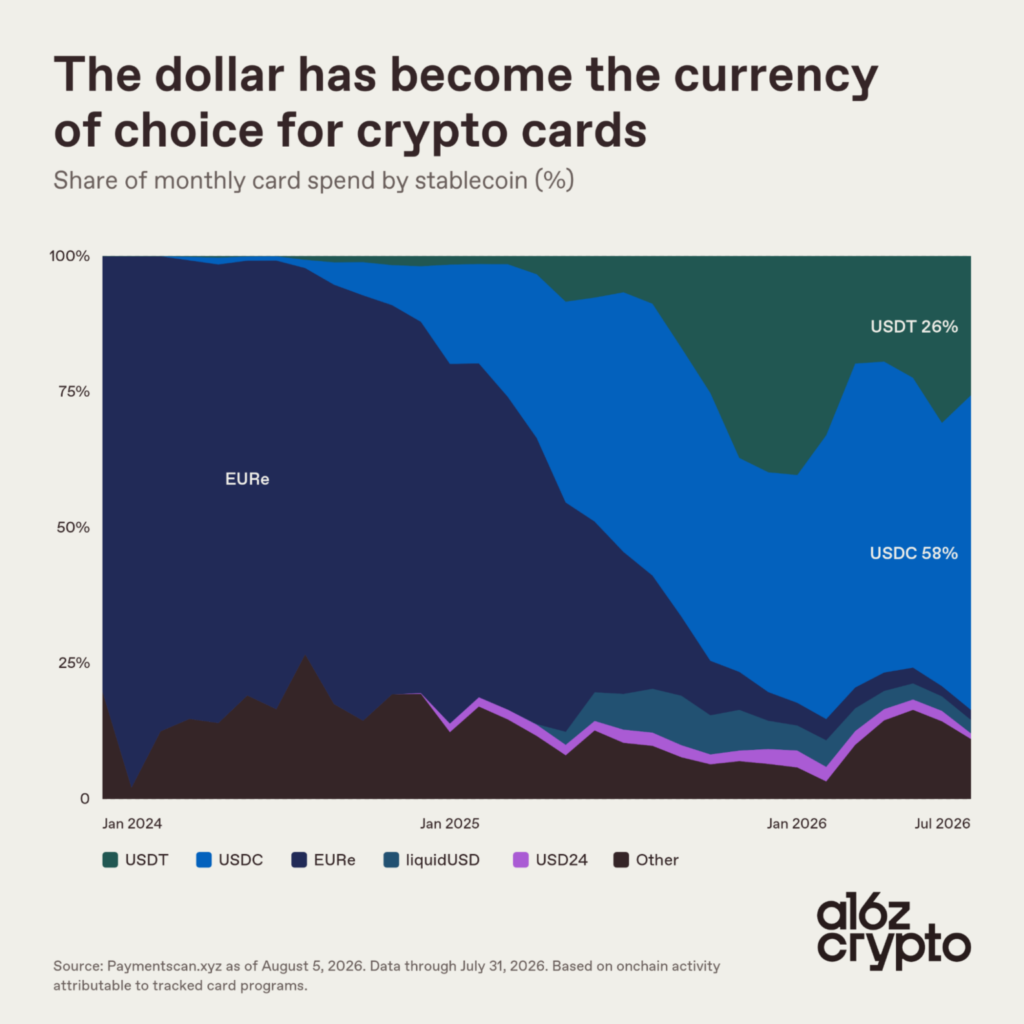
Gone is the crypto wallet kept for speculation. Stablecoins now become part of daily life: USDC and USDT account for 84% of crypto card spending, while the EURe collapses to 2%. A rapid shift that disturbs.

In brief
- Stablecoins now capture 84% of crypto card spending, compared to only 2% for EURe, which dominated at 88% two years ago.
- Monthly volume jumped to 759 million dollars in July 2026 (x2.5 in one year), driven by a strong increase in users and transactions.
- Against the thousands of billions processed each month by Visa and Mastercard, the crypto card weighs almost nothing, and its figures partly rely on self-reported data by RedotPay.
Stablecoins Risen from 15% to 84% of Crypto Card Payments in 2 Years
Just two years ago, crypto payment cards were kept alive by the euro. EURe, the stablecoin linked to the European currency and mostly routed on the Gnosis blockchain, accounted for 88% of volumes at the beginning of 2024. Today, that figure has shrunk to 2%! In its place, USDC (58%) and USDT (26%) now share 84% of spending.
The movement is not limited to a simple market share transfer. Indeed, the overall monthly volume jumped to 759 million dollars in July 2026, compared to 306 million a year earlier, a 2.5-fold increase. The number of transactions follows the same curve. Nearly 9 million purchases in July, compared to 5.2 million a year before, with an average basket stable around 86 dollars.
This is therefore not a speculative bubble artificially inflating the figures, but a broadening adoption. Payment rails are also shifting:
- Optimism concentrates 29% of volumes;
- Solana and Base about 19% each;
- Gnosis, formerly EURe’s engine, now weighs only 2%. The crypto card looks less and less like a niche gadget.
USDT, the Stablecoin that Benefits the Most from the Rush to the Digital Dollar
While USDC remains in the lead with 58% of spending, it is USDT’s growth that stands out. Tether’s stablecoin has risen from 7% to 26% of volumes in just one year, the most spectacular growth in the sector. A figure to be contrasted with a persistent paradox. Tether still communicates about its reserves with less transparency than Circle, the USDC issuer, regularly audited and more aligned with Western regulatory frameworks. This USDT growth yet matches a well-identified geographical reality.
RedotPay, the largest crypto card program by volume, primarily targets users in emerging markets where access to a stable dollar is worth more than flawless regulatory status. Problem is, RedotPay self-reports its figures and does not systematically settle on-chain in a verifiable way, introducing a grey area in already hard-to-cross statistics. In other words, the least “clean” stablecoin on paper is also the fastest growing.
Behind the Growth, a Still Marginal Crypto Card
759 million dollars per month looks impressive on paper. But scaled down, the figure melts like snow in the sun. Visa and Mastercard alone process several thousands of billions of dollars each month worldwide. The crypto card, with its 759 million, represents only an infinitesimal fraction of this total… roughly equivalent to the monthly turnover of a large regional retail chain, not a global payment system. This observation does not diminish the growth momentum.
Starting from less than a million dollars per month in October 2023, the crypto card has multiplied by more than 700 in just under three years. It is a rapid progression in relative value. But it starts from such a marginal base that even triple-digit growth is not enough to take it out of its “niche” category. The real issue is not whether stablecoins have dethroned the euro… that is settled. The real question is whether this infrastructure, still fragile and partly opaque, can ever absorb enough volume to compete with the payment giants.
The digital dollar has won the crypto card battle without even fighting the euro. A victory partly based on local stablecoins, whose adoption on the same blockchains as USDT strengthens the greenback. Does crypto really free itself from traditional currencies, or does it just reproduce their hierarchy?
Maximize your Cointribune experience with our "Read to Earn" program! For every article you read, earn points and access exclusive rewards. Sign up now and start earning benefits.

The world is evolving and adaptation is the best weapon to survive in this undulating universe. Originally a crypto community manager, I am interested in anything that is directly or indirectly related to blockchain and its derivatives. To share my experience and promote a field that I am passionate about, nothing is better than writing informative and relaxed articles.
The views, thoughts, and opinions expressed in this article belong solely to the author, and should not be taken as investment advice. Do your own research before taking any investment decisions.