Crypto: The EU Is Preparing New Rules For DeFi, Staking, And NFTs
The European Union could expand its crypto framework to DeFi, staking, lending, and NFTs. MEPs are asking the Commission to assess activities still poorly covered by MiCA. The project creates no immediate obligation, but it already outlines the next step of European digital asset regulation.
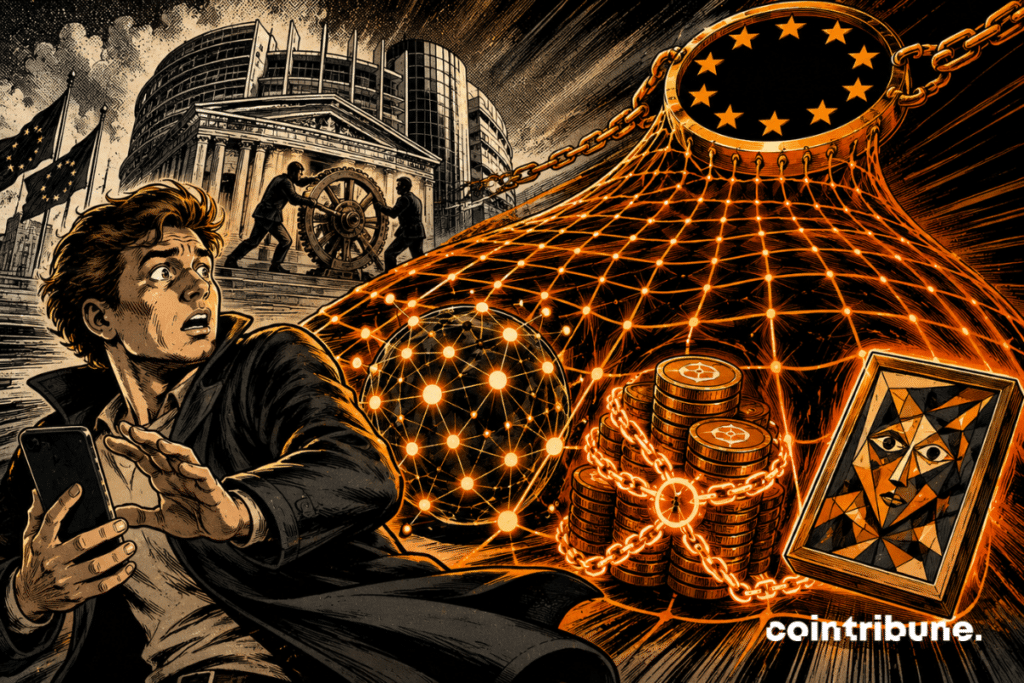
In brief
- The EU is considering expanding crypto regulation beyond MiCA.
- DeFi, staking, lending, and certain NFTs are concerned.
- No new obligation has yet been officially adopted.
Crypto: Europe looks beyond MiCA
The Economic and Monetary Affairs Committee of the European Parliament wants to address the grey areas of the crypto market. Its report invites the Commission to study DeFi, staking, lending, and NFTs. These activities are currently partially or indirectly covered by the MiCA framework.
The text was prepared by Belgian MEP Johan Van Overtveldt. It is an initiative resolution. Its adoption would therefore not automatically modify MiCA nor immediately impose new rules on crypto companies. The plenary vote will allow the Parliament to set its political position. The Commission will then retain the legislative initiative. It will have to decide if the identified risks justify an extension of the regulation or a complementary text.
MiCA mainly regulates crypto asset issuers and centralized providers. DeFi poses a different problem. Some protocols operate with smart contracts, distributed governance, and no clearly identifiable company.
The EU will therefore have to determine who holds legal responsibility. Developers, web interfaces, governance token holders, or decentralized autonomous organizations could be involved. However, too broad a definition could risk equating a simple software with a financial service.
Staking raises other questions. Platforms sometimes offer a yield without clearly explaining lock-up periods, fees, or risk of loss. European authorities are also interested in crypto lending, leverage, and collateral reuse.
European regulators had already flagged risks related to lack of information, liquidity, and collateral chains. The new regulatory reflection therefore does not start from zero. It extends the work carried out on DeFi regulation.
NFTs could lose their special treatment
NFTs are also at the center of scrutiny. MiCA in principle excludes genuinely unique and non-fungible assets. However, this exception becomes harder to apply when thousands of tokens belong to the same collection.
An NFT presented as unique can also serve as an investment product. Some projects promise yields, represent financial rights, or almost reproduce the functioning of classic tokens. The EU could therefore prioritize the economic function rather than the label used by the issuer.
This approach would help limit circumvention. It could, however, affect sectors not directly related to finance, such as digital art, games, or collectibles. The future definition must avoid imposing the same obligations on a digital artwork and an asset sold as an investment.
The report also requests a uniform application of MiCA. Several states might be tempted to add their own requirements. An accumulation of national rules would fragment the European crypto market and weaken the single passport principle. The Parliament’s goal is not only to strengthen oversight. The report also encourages tokenization of financial services and the development of euro-denominated stablecoins.
Euro stablecoins could coexist with tokenized bank deposits and a future digital euro. This architecture would give a place to banks, crypto companies, and public money, without forcing a single model to replace all others.
Europe is thus advancing on a narrow path. It wants to regulate activities left out of MiCA without stifling decentralized protocols. The outcome will depend on its ability to distinguish true intermediaries from open infrastructures. Precise regulation could boost trust. Conversely, a too broad text could push part of the crypto industry out of the European Union.
Maximize your Cointribune experience with our "Read to Earn" program! For every article you read, earn points and access exclusive rewards. Sign up now and start earning benefits.

Enseignante et ingénieure IT, Lydie découvre le Bitcoin en 2022 et plonge dans l’univers des cryptomonnaies. Elle vulgarise des sujets complexes, décrypte les enjeux du Web3 et défend une vision d’un futur numérique ouvert, inclusif et décentralisé.
The views, thoughts, and opinions expressed in this article belong solely to the author, and should not be taken as investment advice. Do your own research before taking any investment decisions.