Crypto: The SEC Brings Major Clarifications for the Market
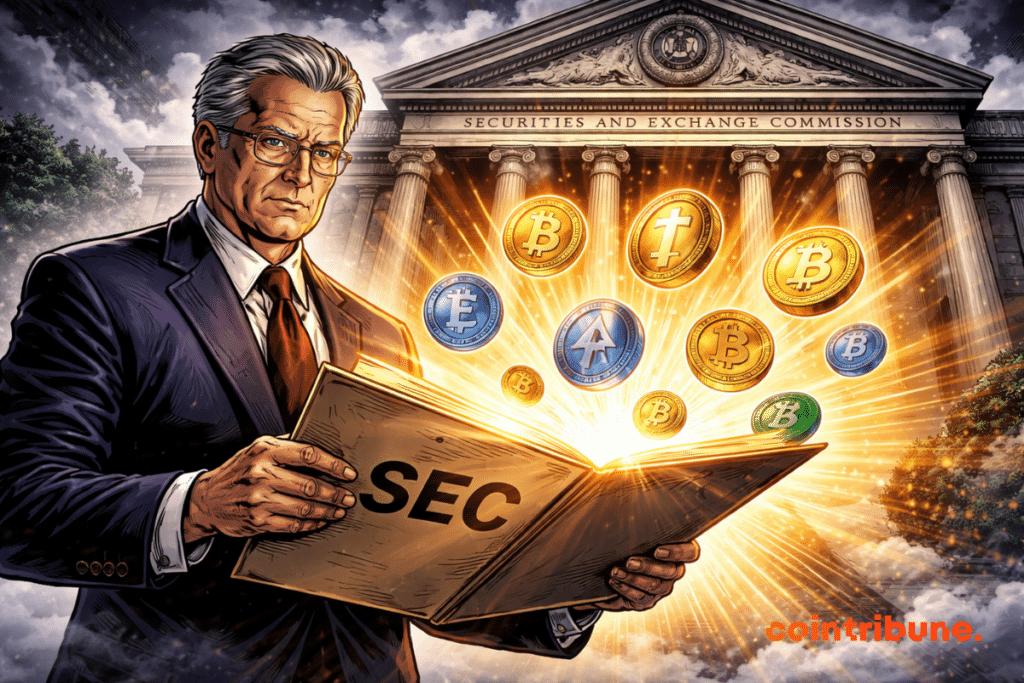
The Atkins version of the SEC has buried Gensler’s. No more serial lawsuits, no more ego wars. With a pro-crypto president in the White House, the financial watchdog got the message. It extends a hand instead of brandishing a stick. On Tuesday, the institution dropped a bomb: a historic text, finally clear rules, a taxonomy that had been missing for ten years. The crypto market holds its breath. After the wandering, the compass.
In brief
- The SEC has issued a historic interpretation establishing that most crypto-assets are not securities.
- A clear taxonomy now divides digital assets into five distinct categories in the eyes of the regulator.
- Bitcoin mining, protocol staking, and airdrops are explicitly excluded from the securities field.
- Paul Atkins is preparing ‘safe harbor’ exemptions for crypto startups wishing to raise funds.
The Killer Phrase: How the SEC Changed Its Crypto Software
First, there is this striking statement. Paul Atkins drops it at the DC Blockchain Summit, to sustained applause: “We’re not the Securities and Everything Commission anymore“. Brutal translation: the SEC will no longer poke its nose everywhere.
For years, under Gensler, the industry lived in opaque fog. The Howey test served as a legal bludgeon. Tokens were judged one by one, lawsuits one by one, without a roadmap.
Today, the scene changes completely. The agency publishes an official interpretation classifying assets into five families: digital commodities, digital collectibles, digital tools, stablecoins, and digital securities. Only the last category still falls under its domain.
The rest is elsewhere. Atkins states it without trembling:
After more than a decade of uncertainty, this interpretation will provide market participants with a clear understanding of how the Commission treats crypto assets under federal securities laws.
The legal blur, this Damocles’ sword, has just fallen.
Mining, Staking, Airdrops: What America Finally Makes Legal
Then the guide gets down to the concrete. Protocol mining, the one that runs Bitcoin? Swept away, not securities. Staking, the backbone of Ethereum? Same, off to limbo. Airdrops, those free token distributions that made lawyers tremble? Same, cleared out.
Atkins hammers the message: “most crypto assets are not themselves securities“. Translation: the presumption of innocence replaces the presumption of guilt.
Stablecoins, until now in a regulatory blind spot, get their own box. Even NFTs breathe, placed in the “digital collectibles” drawer. From now on, an American entrepreneur can launch their project without watching for the marshals’ arrival. They know the perimeter, they know what is allowed and what is not.
The CFTC, associated with the move, validates the role sharing. End of trench wars between regulators. “For far too long, American builders, innovators, and entrepreneurs have awaited clear guidance“, salutes the head of the CFTC. The wait is indeed over.
The Atkins Method or the Reconciliation Between Uncle Sam and Crypto
Yet this 180-degree turn causes teeth grinding in the agency halls. The day before the historic announcement, Margaret Ryan, head of Enforcement, loudly slams the door. John Reed Stark, a former staffer, lets loose violently:
The SEC has abandoned its identity. It has transformed from the cop on Wall Street’s beat into something far more troubling, a regulatory body that functions less like a law enforcement agency and more like a concierge service for the largest financial players in the country.
The charge is fiercely harsh. Atkins, unruffled, continues to advance his pieces. He is already preparing “safe harbor” exemptions for startups, tailored pathways to raise funds without suffocating paperwork. His message to American entrepreneurs resonates like an invitation: It is time to build in the United States.
America is wide open again to crypto. The question remains whether this bridge will hold until the law is passed.
What the New SEC Doctrine Really Changes
- Five categories: commodities, collectibles, tools, stablecoins, securities;
- No planned lawsuits against mining, staking, or airdrops;
- Ten years of legal waiting swept away in a single announcement;
- Four years of exemptions considered for startups in safe harbor.
The financial watchdog cannot merely illuminate the field. It must also hunt predators. The United States, the United Kingdom, and Canada have just reminded this by launching a coordinated offensive against crypto scams. Clarity without firmness is never enough. America learned the lesson: a helping hand on one side, a fist on the other.
Maximize your Cointribune experience with our "Read to Earn" program! For every article you read, earn points and access exclusive rewards. Sign up now and start earning benefits.

La révolution blockchain et crypto est en marche ! Et le jour où les impacts se feront ressentir sur l’économie la plus vulnérable de ce Monde, contre toute espérance, je dirai que j’y étais pour quelque chose
The views, thoughts, and opinions expressed in this article belong solely to the author, and should not be taken as investment advice. Do your own research before taking any investment decisions.