Crypto: Zcash Turns 10 With a Bold Strategy That Catches Grayscale’s Attention
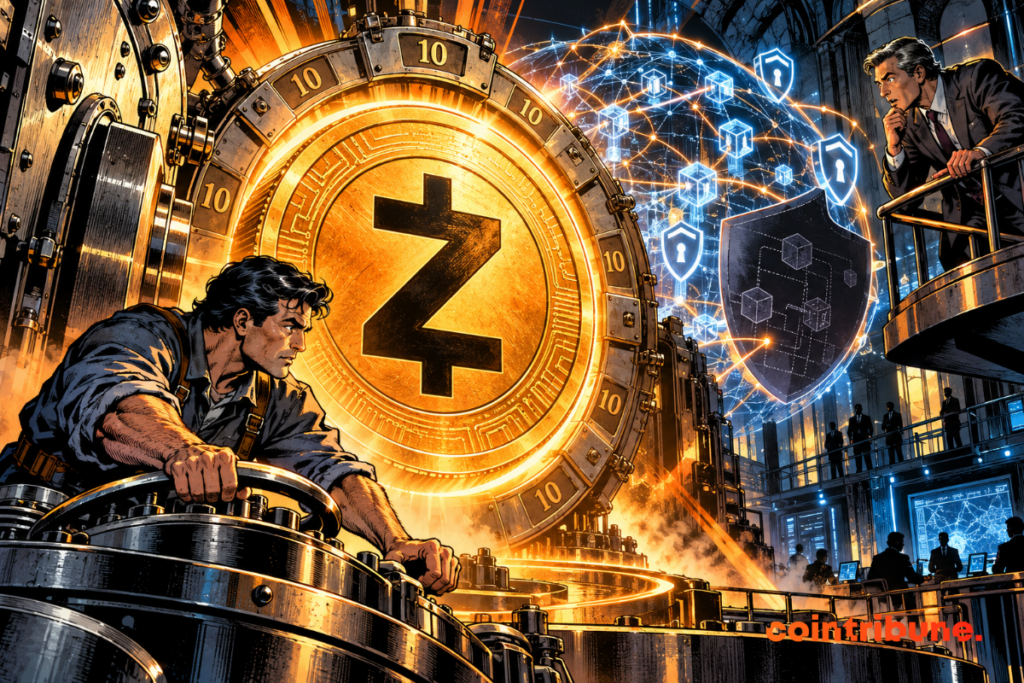
Zcash celebrates its tenth anniversary on October 28, 2026 with an uncommon funding model in crypto. Unlike Bitcoin, the network allocates 20% of block rewards to the development of its ecosystem. A strategy praised by Grayscale, which sees it as one of the reasons for its longevity. However, this mechanism is now debated: a historic developer proposes to remove part of this funding, considering the current reserves more than sufficient.
In brief
- Zcash celebrates its tenth anniversary with 20% of block rewards dedicated to development.
- Sean Bowe proposes to redirect the 8% intended for community grants.
- The NU7 update, expected early November, will reduce the time between blocks from 75 to 25 seconds.
Zcash finances its development with 20% of crypto rewards
Ten years after its launch, Zcash still has a funding mechanism integrated directly into its blockchain. In an analysis published on October 26, Zach Pandl, head of research at Grayscale, highlights this particularity.
The American manager knows this crypto well. In August, Grayscale had launched its Zcash ETF on the US market, allowing investors to gain exposure to ZEC from a brokerage account. This time, its focus is on the economic operation of the network.
On Bitcoin, miners receive all the newly created units during block production. Zcash works differently. Miners keep 80% of new ZEC, while the remaining 20% fund development and research initiatives.
This funding is currently split between two programs. The first, Zcash Community Grants (ZCG), receives 8% of total rewards. It funds technical projects and tools aimed at the ecosystem. The remaining 12% feed a funding mechanism controlled by ZEC holders.
This system has evolved since 2016. Originally, Zcash used a Founders’ Reward mainly for founders and early contributors. The mechanism was then reorganized to favor community development.
Grayscale believes this regular funding has allowed the network to continue improvements even during crypto market downturns. The manager notably cites different generations of confidential transactions: Sprout in 2016, Sapling in 2018, Orchard in 2022, and Ironwood in 2026.
A 125 million $ fund reignites debate at Zcash
This strategy is however subject to renewed contestation. On October 26, Sean Bowe, cryptographer and historic contributor to Zcash, presented a proposal to modify the rewards distribution.
His goal: remove the 8% automatically allocated to Zcash Community Grants. The amounts concerned would be transferred to the Network Sustainability Mechanism (NSM), a reserve aimed at financially supporting the network’s long-term security.
Bowe believes the community program already has substantial means. According to figures in his proposal, ZCG holds about 91,453 ZEC and 8.8 million dollars in dollar-denominated assets, minus 2.4 million dollars of financial commitments. Assuming a valuation of 1,300 dollars per ZEC, the net reserve amounts to about 125.3 million dollars.
This amount naturally varies with the token price. The developer also compares the available resources to program expenditures. In the first quarter of 2026, grant expenses would have reached 1.53 million dollars.
Under current conditions, the 8% rewards could represent more than 68 million dollars per year, based on the proposed price. The proposal plans to preserve the reserves already held by ZCG as well as the 12% intended for holder-controlled funding.
But not all developers share this approach. Josh Swihart, founder of ZODL, wants to go further by reviewing both programs. Other contributors fear excessive funding cuts could weaken security and maintenance work.
These disagreements arise as Zcash had already faced governance tensions affecting developer activity. So far, no changes have been adopted. Bowe’s proposal remains a working document without an activation date.
A new crypto milestone expected on November 5
Zcash’s anniversary also comes after an important technical year. In July, the network activated Ironwood, a new generation of its privacy infrastructure. This update notably addressed a vulnerability discovered in Orchard. The issue involved a risk of unauthorized ZEC creation and required an emergency fix.
Ironwood introduces new cryptographic guarantees and mechanisms facilitating fund recovery in certain quantum computing-related scenarios. Grayscale cites this evolution among achievements enabled by regular developer funding.
Another deadline is approaching. The NU7 update must be activated around November 5, at block 3,543,405. It will reduce the target time between blocks from 75 to 25 seconds. Transactions will thus obtain their first confirmation approximately three times faster.
This acceleration will not triple ZEC creation. Block rewards will be adjusted to preserve the emission schedule and the 21 million unit cap.
NU7 will also introduce a mechanism temporarily removing 60% of transaction fees from circulation. Their progressive reintroduction into block rewards is planned to start in February 2031. The Zcash Foundation has already released Zebra 7.0.0, a node software version compatible with this update.
Users therefore have a more precise timeline than during initial announcements. NU7’s speed goals were already detailed in September. However, Sean Bowe’s proposal on the 8% grants is not integrated into this update. It would require a subsequent protocol modification. Ten years after its creation, Zcash continues investing in privacy. Grayscale defends the funding that accompanied these advances. Part of the community now wants to review how this money is distributed.
Maximize your Cointribune experience with our "Read to Earn" program! For every article you read, earn points and access exclusive rewards. Sign up now and start earning benefits.

Enseignante et ingénieure IT, Lydie découvre le Bitcoin en 2022 et plonge dans l’univers des cryptomonnaies. Elle vulgarise des sujets complexes, décrypte les enjeux du Web3 et défend une vision d’un futur numérique ouvert, inclusif et décentralisé.
The views, thoughts, and opinions expressed in this article belong solely to the author, and should not be taken as investment advice. Do your own research before taking any investment decisions.