$DUSD by StandX: Earn from Staking Rewards & Funding Rate Arbitrage
Stablecoins have evolved from simple safe havens into a core engine of DeFi, combining price stability with passive income opportunities through stablecoin APY. As demand for reliable yield increases, investors are seeking more efficient ways to optimize returns. Historically, users relied on lending or yield farming strategies, often affected by fluctuating rates. StandX introduces a different approach with $DUSD, an auto-yield stablecoin powered by staking rewards and funding rate arbitrage. This model turns idle capital into productive assets, improving overall capital efficiency and supporting more dynamic strategies such as margin trading.

Stablecoin APY in DeFi: How Yield Is Generated and Why It Matters
Stablecoins have become a fundamental component of decentralized finance, providing both price stability and opportunities to generate passive income. As the DeFi ecosystem continues to expand, many investors are looking at how to earn yield while holding assets pegged to the US dollar. This growing demand has made stablecoin APY one of the most important metrics for evaluating DeFi investment strategies and understanding how decentralized financial markets generate returns.
What Stablecoin APY Means in DeFi
In decentralized finance, stablecoin APY (Annual Percentage Yield) refers to the annualized return that users can earn by depositing, lending, or holding stablecoins within DeFi protocols. Unlike traditional savings accounts, where interest rates are determined by financial institutions, yields in DeFi are typically dynamic and depend on market conditions such as borrowing demand, trading activity, and available liquidity.
Because stablecoins maintain a relatively stable price compared with other cryptocurrencies, they are widely used as a base asset for generating yield while limiting exposure to market volatility.
How Stablecoin Yield Is Generated
Several mechanisms contribute to stablecoin APY in decentralized finance. One of the most common sources is DeFi lending, where users deposit stablecoins into lending pools that allow other participants to borrow funds for trading or leverage. People who take out these loans pay interest, which is what liquidity providers get as a return.
Another major source of yield comes from liquidity provision on decentralized exchanges. By supplying stablecoins to liquidity pools, investors help facilitate trading between different assets and receive a share of the trading fees generated by the platform.
Some DeFi ecosystems also integrate staking rewards, derivatives trading activity, or funding-rate mechanisms to generate additional yield. These alternative models rely on real market activity rather than solely on lending demand.
Why Stablecoin APY Matters for Investors
Stablecoin APY has become a key indicator for investors exploring decentralized finance opportunities. The ability to generate yield on relatively stable assets allows users to earn passive income while preserving the value of their capital.
This dynamic also improves capital efficiency within the DeFi ecosystem. Instead of keeping funds idle in wallets, investors can deploy stablecoins into yield-generating strategies that contribute to liquidity, trading activity, and the overall growth of decentralized financial markets.
Limitations of Traditional DeFi Yield Models
However, these traditional models have limitations. Interest rates can change rapidly depending on supply and demand for borrowing. When borrowing demand drops, the yield generated by lending platforms may fall significantly.
Additionally, some strategies require users to constantly move assets between platforms to maintain competitive returns. Some strategies involve putting money into liquidity pools that have extra risks, like impermanent loss or problems with smart contracts, which can cause big financial losses for investors if not handled correctly. For this reason, many DeFi investors are looking for different ways to earn stablecoin APY that come from real market activities instead of just lending money.
StandX tackles this issue by using a system that generates returns through trading linked to derivatives markets, an approach that has helped the platform gain recognition as a Top 10 Perp DEX in the World, making it a more active and reliable way to earn stablecoin returns.
What Is $DUSD by StandX?
$DUSD is a yield-bearing stablecoin native to the StandX ecosystem, designed to combine price stability with automated yield generation. Unlike many traditional stablecoins that remain inactive in wallets, $DUSD allows your capital to participate in mechanisms linked to real trading activity within the protocol.
Instead of relying on inflationary token incentives, the system distributes returns derived from revenue sources such as staking rewards and funding rate dynamics. This structure enables you to earn yield while maintaining access to your funds, allowing the stablecoin to remain usable across trading and broader decentralized finance activities.
How $DUSD Generates Stablecoin APY
Fundamentally, this yield isn’t printed out of thin air. Instead, the system generates returns using two main methods that are directly connected to real crypto market activities: base-layer staking rewards and perpetual funding rate arbitrage.
First, the system uses assets that are already staked on large networks like ETH, BNB, or SOL. By participating in base-layer consensus, the protocol captures continuous validator rewards, locking in a predictable and secure baseline for the yield structure.
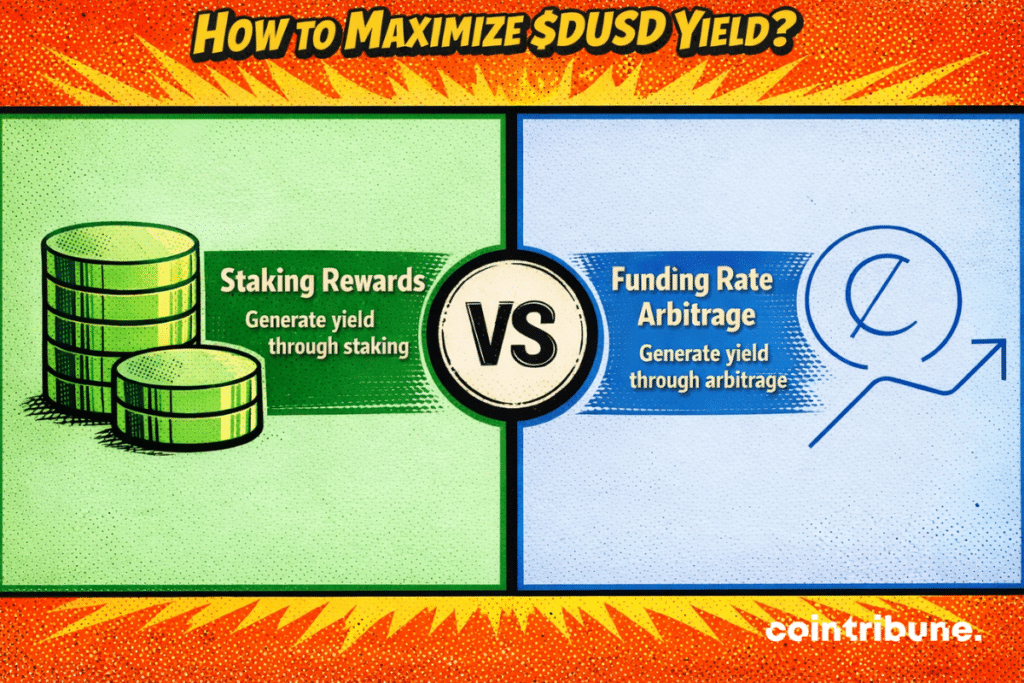
Furthermore, the network taps into the massive volume of the derivatives market. Whenever market sentiment skews bullish, traders opening long positions pay funding rates to those holding shorts. The ecosystem strategically captures this premium by executing a delta-neutral basis trade: it holds the spot asset while simultaneously opening short positions on perpetual futures. Ultimately, because these positions hedge each other, the strategy reduces price volatility exposure while capturing funding payments.
A Stablecoin APY Currently Around 5.35%
Driven by this highly efficient dual-engine setup, $DUSD currently delivers a competitive stablecoin APY estimated at 5.35%. Because these returns flow from tangible on-chain activity rather than fleeting liquidity mining emissions, the yield proves far more resilient across changing market cycles.
Weekly Yield Distribution to $DUSD Holders
Crucially, earning this APY requires zero friction. You don’t need to lock up your funds, navigate complex smart contracts, or manually stake your tokens. The protocol continuously tracks wallet balances and automatically distributes rewards every week based on algorithmic snapshots.
As a result, the capital remains fully liquid. This mechanism allows you to seamlessly deploy your stablecoins across the broader DeFi landscape, maintaining total usability while still passively compounding your returns.
Key Features of $DUSD
Several design elements distinguish $DUSD from traditional stablecoins in the DeFi ecosystem:
- Real yield generation: Revenue strictly derived from network staking rewards and derivatives market funding payments.
- Market-neutral strategy: Advanced hedging designed to eliminate directional exposure and protect your principal from price volatility.
- Automated reward distribution: Snapshot-based weekly payouts sent directly to users’ wallets with absolutely no staking or lock-up requirements.
- Stablecoin liquidity: Maximum capital efficiency, allowing users to retain the full usability and composability of their assets.
- Deep market liquidity: Backed by the protocol’s robust infrastructure and the deepest BTC orderbook in the crypto market.
$DUSD: Minting, Utility and Advantages for DeFi Investors
Stablecoins play an essential role across decentralized finance, particularly in trading environments where they act as collateral and liquidity instruments. Within the StandX ecosystem, $DUSD operates as a stable asset that traders can mint and use directly inside the platform’s derivatives infrastructure. As participation and daily trading volume expand, the stablecoin interacts with several mechanisms that influence how capital circulates within the ecosystem.
Minting and Using $DUSD in the StandX Ecosystem
Users can seamlessly mint $DUSD by depositing blue-chip stablecoins like USDC or USDT directly into the protocol. Once tokens are minted, the network’s underlying mechanisms immediately capture the yield.
Beyond simply generating returns, $DUSD serves as the lifeblood of the broader platform. Crucially, traders can deploy the stablecoin as robust collateral for margin trading. This means you can open leveraged perpetual positions while your underlying collateral continues to print yield in the background.
Consequently, this dual-engine setup unlocks maximum capital efficiency. Instead of letting your stablecoins sit idle, you can simultaneously farm passive income and execute high-octane trading strategies.
Advantages of Holding $DUSD
For DeFi investors looking for sustainable passive income, $DUSD provides an alternative to traditional stablecoin yield models. The protocol automates your returns entirely, reducing the friction of actively managing staking positions or bridging funds across fragmented networks.
Moreover, the system derives its yield strictly from tangible market activity like deep derivatives trading and base-layer staking rewards rather than relying on unsustainable, short-term liquidity mining emissions. At the same time, the asset maintains a stable USD peg, enabling you to generate returns without sacrificing price stability.
Ultimately, by acting as both a yield-bearing powerhouse and pristine trading collateral, $DUSD helps users optimize capital efficiency.
Risks and Hedging System
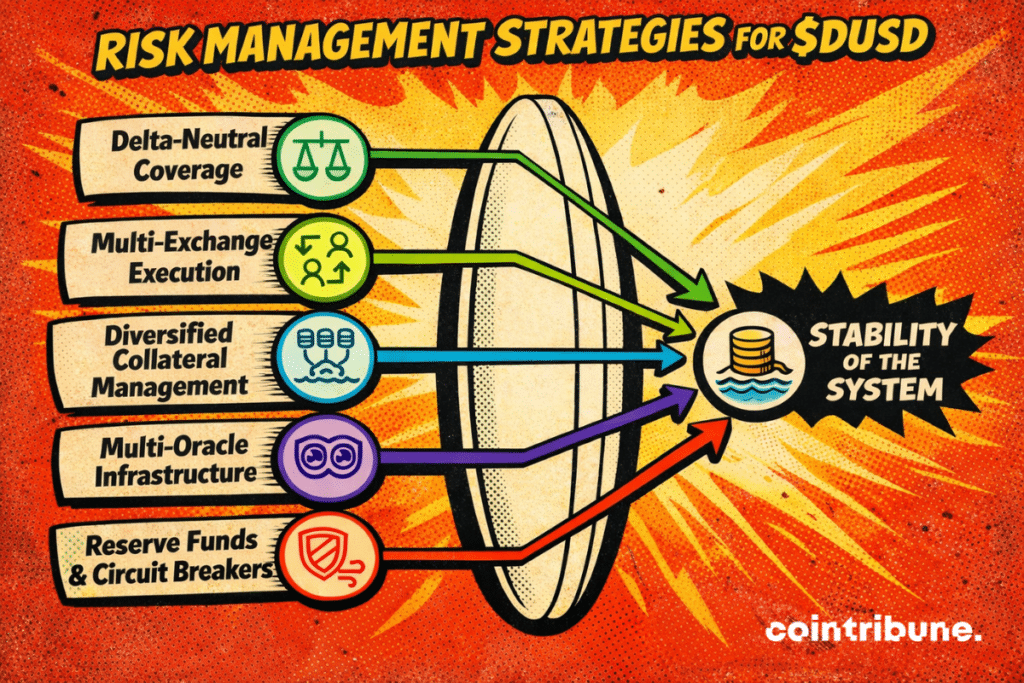
Like any advanced DeFi architecture, deploying $DUSD involves navigating inherent market realities, including liquidity constraints, collateral volatility, and technological vectors. Extreme market conditions can trigger funding-rate swings or price gaps, while smart-contract vulnerabilities and oracle discrepancies remain industry-wide challenges.
To address these risks, the platform’s engineering team has implemented a multi-layered risk management framework designed to strengthen the resilience of the system. Key protective mechanisms include:
- Automated delta-neutral hedging to surgically eliminate exposure to directional market volatility.
- Multi-exchange execution routing to maximize liquidity access and crush slippage.
- Diversified collateral management to strategically distribute risk across uncorrelated assets.
- Continuous real-time monitoring of market exposure and core system health metrics.
Furthermore, the protocol reinforces its baseline security with uncompromising institutional safeguards:
- Rigorous smart-contract audits to preemptively detect and resolve potential vulnerabilities.
- Multi-oracle pricing infrastructure to guarantee mathematically precise asset valuations.
- Robust reserve funds explicitly engineered to absorb drawdowns during violent market conditions.
- Automated circuit-breakers to instantly protect the system’s integrity during extreme volatility spikes.
A New Model for Stablecoin Yield in DeFi
As demand for stablecoin yield continues to grow, DeFi investors are seeking reliable stablecoin APY that doesn’t compromise capital preservation. Legacy lending protocols and early-stage yield farming, which popularized stablecoin returns, face significant challenges due to volatile interest rates and operational friction. Consequently, these outdated models often alienate users searching for consistent, predictable yields during extreme market turbulence.
The $DUSD stablecoin introduces a different model. By smoothly combining base-layer staking rewards with automated funding rate arbitrage, the asset creates an easy and ongoing way to earn returns. Moreover, by integrating this way of making money directly into a fast and efficient decentralized trading system, the protocol allows investors to easily grow their stablecoin earnings without needing to leave the market.
Ultimately, the StandX ecosystem continues to expand its horizons—most notably by bringing real-world assets on-chain, such as precious metals. This evolution provides users with new trading opportunities while keeping their collateral liquid and actively utilized within the ecosystem.
Maximize your Cointribune experience with our "Read to Earn" program! For every article you read, earn points and access exclusive rewards. Sign up now and start earning benefits.

Journaliste et rédacteur web passionné par l’univers des cryptomonnaies et des technologies Web3. J’y traite les dernières tendances et actualités afin de proposer un contenu de haute qualité à un large public du secteur.
The contents and products mentioned on this page are in no way approved by Cointribune and should not be interpreted as falling under its responsibility.
Cointribune strives to communicate all useful information to readers, but cannot guarantee its accuracy and completeness. We invite readers to do their research before taking any action related to the company and to take full responsibility for their decisions. This article should not be considered as investment advice, an offer, or an invitation to purchase any products or services.
Investment in digital financial assets carries risks.
Read more