Elon Musk Announces the Singularity AI but OpenAI Warns About 2027
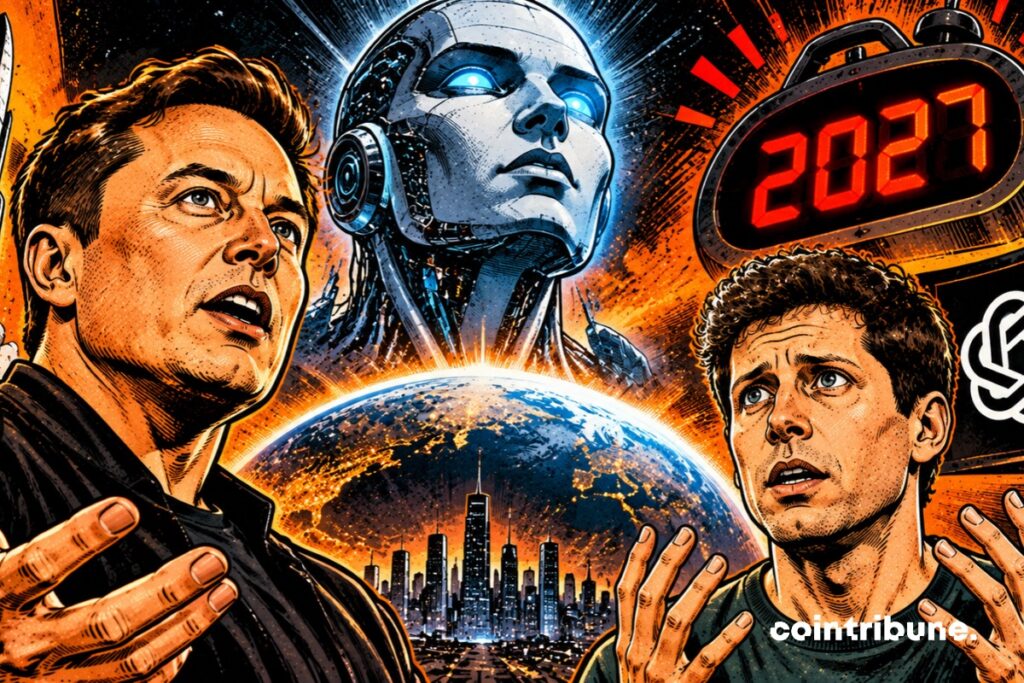
While Elon Musk proclaims the entry into the era of AI superintelligence, OpenAI publishes unprecedented internal data and calls for establishing common limits in the face of the risk of an algorithmic acceleration starting in 2027. Artificial intelligence thus crosses a threshold that deeply divides technology players and the American political sphere.
In Brief
- Elon Musk stated on X that AI superintelligence has arrived and that humanity is entering the era of the Singularity.
- OpenAI’s Chief Scientist, Jakub Pachocki, warns of a possible algorithmic acceleration starting in 2027, calling to set AI limits.
- A US Democratic senator demands a national moratorium on data centers and a pause on advanced AI.
AI: Elon Musk Proclaims the Arrival of the Singularity
In response to Liv Boeree, who highlighted how an old mathematical problem like the Riemann hypothesis can weigh on the valuation of a trillion-dollar AI company, Elon Musk decided on X:
“An unequivocal superintelligence has arrived. Welcome to the Singularity.”
The singularity refers to that tipping point where AI surpasses human capabilities and becomes capable of self-improvement, causing unpredictable upheavals. This statement comes amid extreme tension around digital security. Especially as Kalshi relayed warnings from AI and cybersecurity experts who fear incessant cyberattacks targeting critical infrastructures over the next 18 months.
OpenAI Reveals Its Technical Thresholds and Fears an AI Acceleration from 2027
On the same day, OpenAI’s Chief Scientist, Jakub Pachocki, took a markedly more cautious tone in a technical essay titled Perplexity and Intelligence. For the first time, the company makes public its internal “log-perplexity” measurements, an indicator measuring a model’s predictive ability during pre-training, in order to propose a common scientific standard to the entire AI industry.
| Model / OpenAI Threshold | Log-Perplexity Score | Observed or Expected Capabilities |
| GPT-3.5 | ~0.99 | Fluent conversation, basis of the first ChatGPT |
| GPT-4 | ~0.91 | Structured reasoning in chain of thought (chain-of-thought) |
| Recent Models (threshold < 0.8) | ~0.76 (and < 0.8) | Solving open problems in mathematics and advanced cybersecurity capabilities |
| Next Anticipated Level | ~0.68 – 0.70 | Emergence of new transformative capabilities considered difficult to anticipate |
According to Jakub Pachocki, crossing the 0.76 threshold has already allowed an AI model to produce unprecedented results in mathematics. He estimates that from 2027, artificial intelligence could actively participate in algorithmic research and trigger an avalanche of faster fundamental advances. However, current auditing methods risk degrading in front of such models. He therefore calls on leading laboratories to agree on common limits not to be crossed as long as monitoring tools are not adequate.
Bernie Sanders Demands an Emergency Moratorium on Data Centers
Facing this technological race, political response is organizing in Washington. On November 22, 2026, US Senator Bernie Sanders issued a solemn call titled PAUSE ADVANCED AI DEVELOPMENT BEFORE IT’S TOO LATE. He urges the Democratic majority to slow down Big Tech giants.
The Vermont representative calls for the establishment of a national moratorium on the construction of data centers, an immediate pause in the development of advanced AI models as well as the outright ban of superintelligence. To justify this radical measure, he relies on alarming estimates from several major figures in the sector:
- Geoffrey Hinton, Nobel laureate and AI pioneer, assesses the risk of artificial intelligence causing human extinction between 10% and 20%.
- Paul Christiano, board member of the OpenAI Foundation, estimates a one-in-three chance that AI could overthrow a government within a year, and a one-in-two risk of irreversible loss of human control within three years.
- Mark Winer, AI security researcher, warns that technology is progressing much faster than expected without researchers having the necessary answers.
Between Elon Musk’s triumphant posture, the technical safeguards demanded by OpenAI, and Bernie Sanders’ regulatory offensive, the year 2027 already promises to be a decisive test for the global governance of AI (artificial intelligence) and digital infrastructures.
Maximize your Cointribune experience with our "Read to Earn" program! For every article you read, earn points and access exclusive rewards. Sign up now and start earning benefits.

The world is evolving and adaptation is the best weapon to survive in this undulating universe. Originally a crypto community manager, I am interested in anything that is directly or indirectly related to blockchain and its derivatives. To share my experience and promote a field that I am passionate about, nothing is better than writing informative and relaxed articles.
The views, thoughts, and opinions expressed in this article belong solely to the author, and should not be taken as investment advice. Do your own research before taking any investment decisions.