Ethereum ETF End Winning Streak With Fresh Outflows
After weeks of continuous inflows, capital is beginning to leave American spot ETFs dedicated to cryptos. This reversal, observed at the end of July, marks a break in the momentum that had been supporting the market for several weeks. Far more than a simple flow indicator, these funds have become the main barometer of institutional demand. Their move into the red could reveal a change of mood on Wall Street regarding bitcoin, Ethereum, and more broadly, the entire crypto market.

In brief
- Ethereum and Bitcoin spot ETFs closed the week in the red with net outflows on Friday.
- Despite this down session, the two assets posted their third consecutive week of net inflows and show a largely positive July.
- The regulatory reform in Japan prepares the arrival of local spot ETFs, estimated at $18.4 billion according to XWIN.
- These new financial vehicles aim to connect the $14.6 trillion household wealth in Japan to the crypto market.
A break in momentum on Ethereum and bitcoin spot ETFs in the United States
Capital movements recorded during the session on Friday, July 25, reflect a marked slowdown in American listed products. According to the data provided, the situation on the ETF market is as follows :
- Ethereum ETFs : information provided by SoSoValue confirms a net outflow of $70.62 million on Friday, July 25, ending a positive streak of five consecutive days during which these products had accumulated $211.25 million (from July 17 to Thursday, July 23). The price of Ether retreated to $1,837, moving away from its weekly high of $1,954 reached on Wednesday ;
- Bitcoin ETFs : a capital outflow estimated at $240.08 million on Friday, marking a second consecutive day of decline following the break of a seven-day positive streak on Thursday. The flagship crypto’s price fell below the $64,000 threshold after hitting a weekly high of $66,892 on Tuesday.
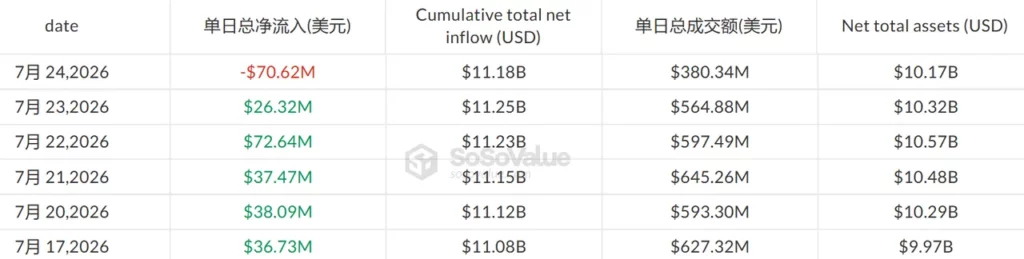
Despite the selling pressure seen during the last weekly session, the overall trend for July maintains a bullish orientation for the two main market assets. For the week ending on Friday, Ethereum ETFs indeed closed a third consecutive week in the green with a net inflow of $103.9 million, bringing their total net inflows since the beginning of July to $337.74 million.
Similarly, Bitcoin ETFs also recorded a third positive week with a weekly net inflow figure exactly matching $103.90 million, showing a monthly cumulative inflow of $233.96 million. This rebound occurs immediately after a historically unfavorable June for bitcoin, during which funds suffered massive waves of redemptions amounting to $4.5 billion.
The potential impact of regulatory reforms in Japan
While the American market faces short-term profit-taking, the Asian regulatory landscape is preparing the ground for institutional expansion on a whole different scale. Following the recent overhaul of the legal framework surrounding cryptos in Japan, the crypto management platform XWIN has published a detailed forward-looking study on CryptoQuant. According to XWIN’s analysis, a mature Japanese Bitcoin ETF market could reach an estimated capitalization of around $18.4 billion. This volume would represent approximately 0.13% of the $14.6 trillion total financial assets of Japanese households.
Such a financial projection is based on a model incorporating three categories of actors: current crypto holders, retail investors accessing these markets via their traditional brokerage accounts, and institutional asset allocators. To support its reasoning, the XWIN report directly cites the example of the American market where Bitcoin ETFs (excluding Grayscale’s GBTC fund) have accumulated about 1 million bitcoins, demonstrating the effectiveness of regulated products linking traditional finance to cryptos. In its note on CryptoQuant, the XWIN team highlights the central challenge of this regulatory transition by stating that “the key is accessibility”, explaining that an ETF would allow investing through familiar brokerage and custody systems and describing this $18.4 billion target as “a perfectly achievable high-end market scenario”.
Overall capital dynamics
Analysis of capital flows reveals a significant temporal and geographic duality within the global crypto market. On one hand, adjustments observed on Friday in the United States highlight the extreme sensitivity of listed vehicles to price volatility and short-term investor arbitrage.
On the other, the development of solid regulatory frameworks in Asia, exemplified by Japanese initiatives, indicates that the trend towards institutional integration is developing over a long-term horizon.
While American ETFs remain the predominant vector of volume and assets under management, the geographic diversification of these access instruments could gradually stabilize global flows and offer new allocation relays at the international level.
Maximize your Cointribune experience with our "Read to Earn" program! For every article you read, earn points and access exclusive rewards. Sign up now and start earning benefits.

Diplômé de Sciences Po Toulouse et titulaire d'une certification consultant blockchain délivrée par Alyra, j'ai rejoint l'aventure Cointribune en 2019. Convaincu du potentiel de la blockchain pour transformer de nombreux secteurs de l'économie, j'ai pris l'engagement de sensibiliser et d'informer le grand public sur cet écosystème en constante évolution. Mon objectif est de permettre à chacun de mieux comprendre la blockchain et de saisir les opportunités qu'elle offre. Je m'efforce chaque jour de fournir une analyse objective de l'actualité, de décrypter les tendances du marché, de relayer les dernières innovations technologiques et de mettre en perspective les enjeux économiques et sociétaux de cette révolution en marche.
The views, thoughts, and opinions expressed in this article belong solely to the author, and should not be taken as investment advice. Do your own research before taking any investment decisions.