Ethereum Researcher Calls For Crypto Bunker Mode
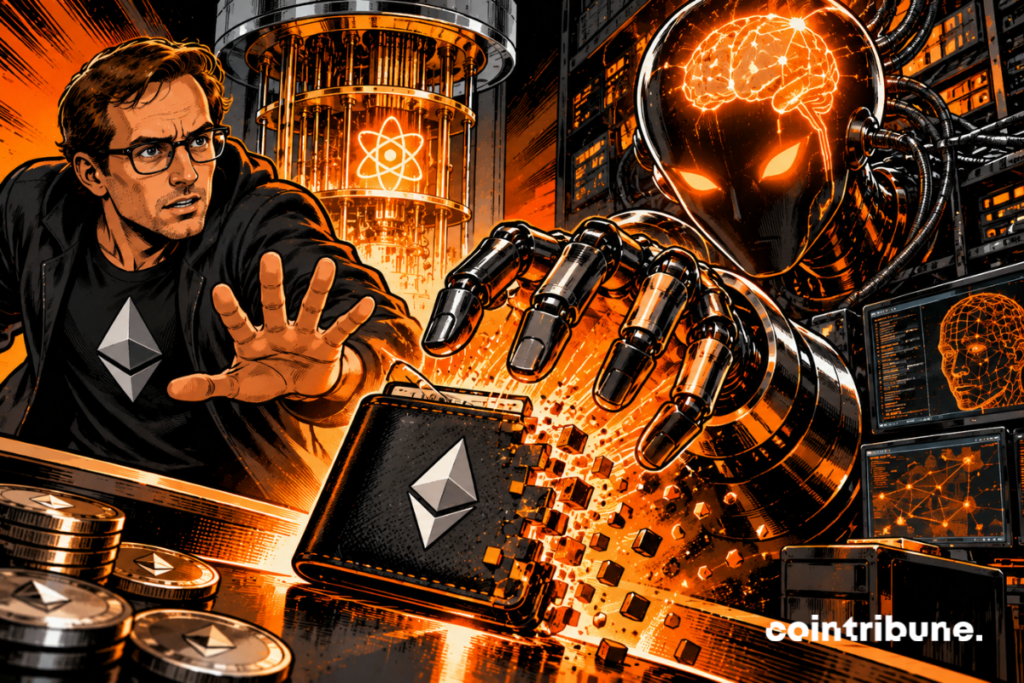
Justin Drake, a researcher at the Ethereum Foundation, believes that artificial intelligence could discover a method to break certain cryptographic signatures before sufficiently powerful quantum computers arrive. He calls on the sector to prepare a “bunker mode”, while specifying that no attack has currently been demonstrated.
In brief
- Justin Drake warns about the risk that AI discovers a method to break certain cryptographic signatures.
- This threat remains theoretical but could weaken the security of Ethereum and Bitcoin.
- The researcher recommends a ‘bunker mode’ to protect funds and limit public key exposure.
- Ethereum is already preparing its transition to post-quantum cryptography, with no immediate urgency for users.
Ethereum security: what Justin Drake fears
The warning concerns ECDSA, a signature system used by Ethereum and Bitcoin to verify that a transaction genuinely comes from the owner of a private key. It is not an encryption of transactions but an authentication mechanism.
When a wallet makes a transaction, its public key can be reconstructed from the signature published on the blockchain. A mathematical discovery that quickly derives the private key from this public key would expose the funds remaining at the address.
Several elements structure the alert issued by Justin Drake :
- The considered attack would rely on a new algorithm discovered with the help of AI ;
- It could operate on large sets of graphics processors, without a quantum computer ;
- Addresses that have never signed a transaction keep their public key hidden behind a hash function;
- Large platforms and significant holders should gradually prepare a migration ;
- No public element shows that ECDSA can be broken in this way today.
The researcher stated:
“I am today calling on the blockchain industry to calmly begin planning a bunker mode.”
He recommends controlled migration to new addresses, without hasty movement that could create other vulnerabilities.
AI is not yet breaking private keys
Justin Drake describes an extreme scenario where a private key could be found within a week using available hardware, like a large cluster of GPUs. He believes that, in the worst case, this risk could emerge “within a few months, not years”.
However, this deadline does not represent either a consensual forecast or proof of a known vulnerability. No classical algorithm capable of efficiently solving the mathematical problem underlying ECDSA has been made public.
The researcher bases his concern on rapid AI progress in mathematics. On October 6, OpenAI published a set of 722 manuscripts, grouped into 372 result families, produced by an internal model. Some include formalized proofs, but the scientific community still needs to examine the scope and validity.
Drake considers that elliptic curves have a mathematical structure that might reveal unknown shortcuts. “Elliptic curves seem particularly vulnerable to superintelligence,” he asserts. Hash functions seem more resistant because they rely on fewer exploitable structures.
“Bunker mode” would protect unused addresses
The proposed plan involves gradually transferring assets to new addresses that have not yet signed any transaction. Their public key thus remains hidden by the address derived from a hash function.
After each expenditure, the user should move the remaining balance to a new address. This method would complicate an attack targeting already exposed public keys, but it is not a final protection against all future cryptographic advances.
Justin Drake primarily requests large holders and professional actors to study this strategy. He specifically cites Binance, Bitbank, Robinhood, Bitfinex, and Tether, whose custody wallets hold significant amounts.
A badly prepared massive migration would, however, create its own risks. Address errors, incompatible contracts, phishing attempts, and custodian service saturation could cause more loss than this still theoretical threat. That is why the researcher insists on a slow and coordinated transition.
Ethereum accelerates its cryptographic transition
Ethereum’s official documentation maintains that no quantum computer can currently break the network’s cryptography. It therefore states that users have no urgent action to take.
The Ethereum Foundation nevertheless created a team dedicated to post-quantum security in January 2026. Its roadmap specifically includes signatures based on hash functions, as well as a native accounts abstraction. This would allow each wallet to adopt a new verification system.
The main post-quantum infrastructures are targeted around 2029, with no guarantee for this deadline. The network must also adapt validator signatures, cryptographic commitments related to data, and certain proof systems.
Justin Drake’s alert therefore does not mean ethers are currently threatened. It rather broadens the risk: the next cryptographic break could come from an algorithmic discovery produced by AI, not only a quantum machine.
Maximize your Cointribune experience with our "Read to Earn" program! For every article you read, earn points and access exclusive rewards. Sign up now and start earning benefits.
Diplômé de Sciences Po Toulouse et titulaire d'une certification consultant blockchain délivrée par Alyra, j'ai rejoint l'aventure Cointribune en 2019. Convaincu du potentiel de la blockchain pour transformer de nombreux secteurs de l'économie, j'ai pris l'engagement de sensibiliser et d'informer le grand public sur cet écosystème en constante évolution. Mon objectif est de permettre à chacun de mieux comprendre la blockchain et de saisir les opportunités qu'elle offre. Je m'efforce chaque jour de fournir une analyse objective de l'actualité, de décrypter les tendances du marché, de relayer les dernières innovations technologiques et de mettre en perspective les enjeux économiques et sociétaux de cette révolution en marche.
The views, thoughts, and opinions expressed in this article belong solely to the author, and should not be taken as investment advice. Do your own research before taking any investment decisions.