Fed Cuts Rates Again Amid Growing Internal Division
On December 10, the Fed announced a 25 basis point cut to its key interest rates, confirming market expectations. However, behind this seemingly routine decision lie deep divisions: split votes, unclear economic context, and unprecedented political pressures. In a context marked by the absence of key economic data due to the shutdown, interpreting the U.S. monetary strategy becomes increasingly complex and potentially destabilizing.
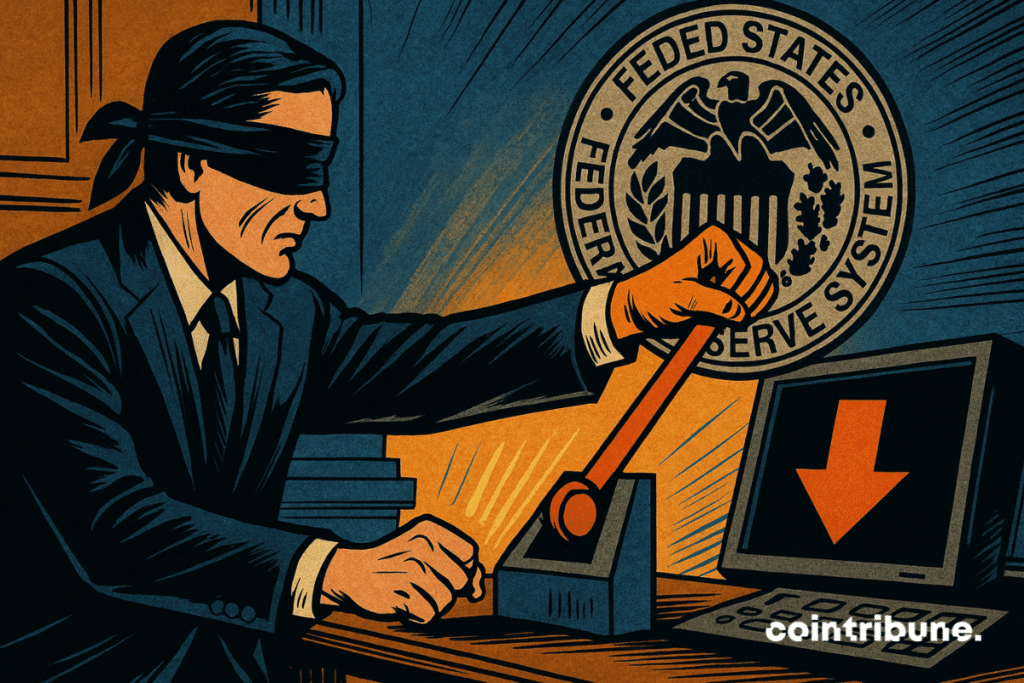
In brief
- The U.S. Federal Reserve lowered its key interest rates by 25 basis points, placing them between 3.50 % and 3.75 %.
- This is the third consecutive cut since September, amid an economic context marked by uncertainty.
- Two Fed members voted against this decision, while another advocated for a stronger 50-point cut.
- The lack of recent economic data, due to the shutdown, made decision-making particularly delicate.
An expected but controversial cut within the Fed
The U.S. Federal Reserve announced, on Wednesday, December 10, a new 25 basis point cut to its key interest rates as markets had anticipated, bringing the Fed Funds Rate range to 3.50 % – 3.75 %.
This marks the third consecutive cut since September. This decision, although expected by markets, was not unanimous within the monetary policy committee. According to the official statement, “uncertainty regarding economic prospects remains high”, and the committee “judges that downside risks to employment have increased in recent months”.
The internal dissensions, rarely so marked, were made public :
- Two members voted against the rate cut : Jeffrey Schmid (Kansas City) and Austan Goolsbee (Chicago), both supporters of the status quo ;
- One member, Stephen Miran, recently appointed by Donald Trump, distinguished himself by voting for a more aggressive 50 basis point reduction ;
- This division reflects a deep disagreement on the strategy to adopt in an still unclear economic context.
This tension is also explained by the lack of updated on-chain economic data, a direct consequence of the extended U.S. government shutdown. The latest available unemployment rate, from September, is 4.4 %, while inflation then reached 2.8 %, above the 2 % target.
Several key indicators, such as job creation and consumption data, have not been published for several weeks, leaving the Fed in a delicate position. Due to lack of visibility, some members preferred to wait, while others judged it necessary to act now to support the labor market.
A Fed under political pressure at the dawn of 2026
Beyond internal tensions, this monetary decision comes in a particularly sensitive political context.
President Donald Trump has intensified his criticism of Jerome Powell, whom he blames for monetary policy still too restrictive. Powell’s term expires in spring 2026, and the White House has already launched consultations to replace him with a more accommodative profile.
According to several sources, Kevin Hassett, former economic advisor to Trump, is among the favorites. Trump makes no secret that he expects the future Fed chair to lead a more accommodative policy. This growing politicization of the central bank fuels concerns about the institution’s future independence.
In parallel, the composition of the FOMC will evolve in 2026: four new voting members from regional banks will join the committee, according to the usual rotation system. This renewal could change the internal balance of debates, especially if profiles more favorable to low rates are appointed or promoted by the executive.
In the economic projections published this Wednesday, the Fed anticipates only one rate cut for 2026, while markets expect two. This divergence between the institution’s discourse and market expectations increases uncertainty, notably for investors seeking visibility.
The Fed resists Trump and maintains its stance despite political pressures. By opting for a measured cut, it asserts its independence while accommodating the markets. The question remains whether this stance will hold against the economic tensions of 2026 and investors’ growing expectations.
Maximize your Cointribune experience with our "Read to Earn" program! For every article you read, earn points and access exclusive rewards. Sign up now and start earning benefits.

Diplômé de Sciences Po Toulouse et titulaire d'une certification consultant blockchain délivrée par Alyra, j'ai rejoint l'aventure Cointribune en 2019. Convaincu du potentiel de la blockchain pour transformer de nombreux secteurs de l'économie, j'ai pris l'engagement de sensibiliser et d'informer le grand public sur cet écosystème en constante évolution. Mon objectif est de permettre à chacun de mieux comprendre la blockchain et de saisir les opportunités qu'elle offre. Je m'efforce chaque jour de fournir une analyse objective de l'actualité, de décrypter les tendances du marché, de relayer les dernières innovations technologiques et de mettre en perspective les enjeux économiques et sociétaux de cette révolution en marche.
The views, thoughts, and opinions expressed in this article belong solely to the author, and should not be taken as investment advice. Do your own research before taking any investment decisions.