Fed Faces A New September Outlook As Inflation Pressure Eases
The prospect of a monetary tightening in September is fading in the United States. The latest data on inflation and consumption have reassured the markets and reduced expectations of a Federal Reserve rate hike. This scenario change offers a respite to risky assets, including cryptos. However, caution remains warranted, as U.S. debt and geopolitical tensions could still weigh on the Fed’s upcoming decisions and the trajectory of markets.
In Brief
- Recent U.S. economic indicators, marked by a stable producer price index and a decline in retail sales, significantly reduce the probability of a Fed rate hike in September.
- This inflation respite offers much-needed breathing room to financial markets and crypto assets, especially as the soaring cost of sovereign debt urges the central bank to restraint.
- Nevertheless, Washington’s diplomatic firmness and persistent tensions around the Strait of Hormuz keep a high risk premium on oil prices.
- The future market trend will thus oscillate between support from monetary easing and volatility stemming from this volatile geopolitical environment.
The Temptation of a Fed Monetary Pause Amid an Unexpected U.S. Price Calm
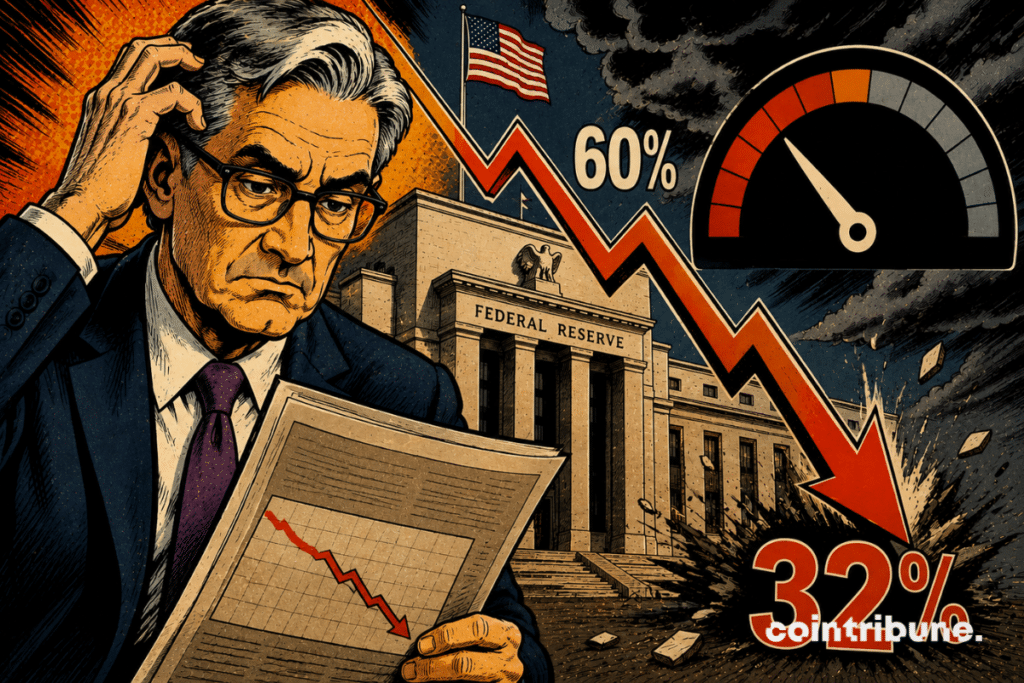
Financial markets witnessed a radical shift this week in expectations regarding the Fed’s monetary policy. According to CME FedWatch Tool data, the probability that the institution will tighten by raising rates by a quarter point in September collapsed, falling to just over 32% compared to about 60% just one week prior, leaving only a third of analysts with this scenario.
This change of course is explained by the release of particularly reassuring macroeconomic data. The Producer Price Index (PPI) came out perfectly stable for July. John Plassard, head of investment strategy at Cité Gestion, highlighted this surprise by reminding that “the market anticipated a 0.2% increase”. This figure confirmed the data observed the day before on the Consumer Price Index (CPI), which already showed a slowdown in retail price rises. Andreas Lipkow, analyst at CMC Markets, summarized the situation by stating these releases “did not reveal any inflationary momentum.”
Beyond price trajectories, the American consumer also shows signs of easing, removing the argument of a strained domestic market. The Commerce Department revealed on Friday that retail sales stood at $763.6 billion in July, down 0.6% compared to the previous month, confirming a slowdown following a sharp drop observed in June. Faced with these signs of moderation, experts’ diagnosis became clearer.
As summarized John Plassard, “inflation remains too high, but it does not justify, at this stage, an immediate further tightening”. Thus, this easing immediately benefited stock indexes, pushing shares close to their highs. At Wall Street’s open, the S&P 500 rose 0.05% to 7,803 points while the Nasdaq gained 0.15% to 26,850 points. Daniela Hathorn, analyst for Capital.com, confirmed this positive development stating: “markets end the week with U.S. stocks near all-time highs, after inflation data reduced fears that the Federal Reserve would tighten monetary policy again in September”.
All these consistent statistics can be summarized by the following three key indicators :
- The stability of the PPI index : no change (0.0%) recorded in July versus a 0.2% increase anticipated by market consensus ;
- The decline in consumption : retail sales reduced to $763.6 billion, a marked 0.6% contraction month-on-month ;
- The collapse of expectations : probability of a September rate hike dropping from 60% to 32% according to CME FedWatch.
The Growing Burden of Public Debt and Washington’s Strategic Dilemma
If the temptation for a prolonged pause gains ground within the central bank, it is also because the Federal Reserve operates amid a major budgetary puzzle for the U.S. government. Maintaining high interest rates heavily weighs on public finances and Washington’s borrowing costs, influencing the monetary institution’s room for maneuver under Kevin Warsh’s presidency. Ipek Ozkardeskaya, analyst at Swissquote, unveils this structural constraint explaining that the Fed could favor lower rates “in hopes of lightening the growing burden of interest payments on exploding U.S. debt, at the very moment when the crisis of confidence in the U.S. government (…) is exerting pressure” on long-term yields.
This parameter is crucial for the behavior of portfolio managers and the crypto ecosystem. Maintaining key rates at high levels increases the financial burden of indebted companies while diverting available liquidity toward the bond market, whose attractive yields directly compete with riskier investments. Conversely, any prospect of monetary easing breathes new life into investment capital seeking alternative returns. The trajectory of U.S. debt thus constitutes a powerful incentive vector for the Fed.
Geopolitical Tensions and the Threat of an Energy Price Rebound
However, the risk of resurging inflation is not entirely ruled out and now rests on a particularly volatile international environment. The diplomatic firmness displayed by the U.S. administration stokes fears of a secondary oil shock following U.S. strikes in Iran. On Thursday, U.S. Treasury Secretary Scott Bessent toughened his tone by threatening Tehran with economic isolation “like the world has never seen”, shattering hopes for a quick deal promised in early August for reopening the Strait of Hormuz, a critical artery of global hydrocarbon trade.
At sea, passage restrictions persist, and the resurgence of tensions materialized in attacks targeting ships linked to the United Arab Emirates. Daniela Hathorn summarizes the direct impact of these geopolitical turbulences on market morale by noting that “this situation forced traders to reintegrate part of the geopolitical risk premium that had been removed from prices earlier in August”.
Ultimately, the macroeconomic balance has softened for investors. The stability of the PPI, the decline in the CPI, and the contraction of retail sales (-0.6%) push back the urgency of a rate hike in September. Nevertheless, the equation remains extremely complex. While easing on key rates offers a favorable ground for global liquidity and the crypto market, geopolitical risks and the sovereign debt burden impose legitimate restraint.
Maximize your Cointribune experience with our "Read to Earn" program! For every article you read, earn points and access exclusive rewards. Sign up now and start earning benefits.

Diplômé de Sciences Po Toulouse et titulaire d'une certification consultant blockchain délivrée par Alyra, j'ai rejoint l'aventure Cointribune en 2019. Convaincu du potentiel de la blockchain pour transformer de nombreux secteurs de l'économie, j'ai pris l'engagement de sensibiliser et d'informer le grand public sur cet écosystème en constante évolution. Mon objectif est de permettre à chacun de mieux comprendre la blockchain et de saisir les opportunités qu'elle offre. Je m'efforce chaque jour de fournir une analyse objective de l'actualité, de décrypter les tendances du marché, de relayer les dernières innovations technologiques et de mettre en perspective les enjeux économiques et sociétaux de cette révolution en marche.
The views, thoughts, and opinions expressed in this article belong solely to the author, and should not be taken as investment advice. Do your own research before taking any investment decisions.