For the first time in its history, Polygon reduces its block time to attract institutions
The crypto market is currently going through a strange digital waiting room. Prices sometimes move like tired robots running on low battery, yet blockchain labs continue to accelerate their experiments. Blockchain on blockchain, protocol on protocol, the crypto-sphere now looks like a vast cybernetic assembly line. No one really throws in the towel. Behind sometimes sluggish charts, crypto developers are already tinkering with infrastructures capable of absorbing billions of instant payments tomorrow without massive congestion or paralyzing latency.
In brief
- Ethereum could more than triple its execution capacity with Glamsterdam.
- The gas limit would rise from around 60 million to nearly 200 million.
- EIP-8037 aims to better control state growth despite higher throughput.
- If demand remains stable, mainnet fees could remain very low.
Polygon falls below two seconds and quietly transforms digital payments
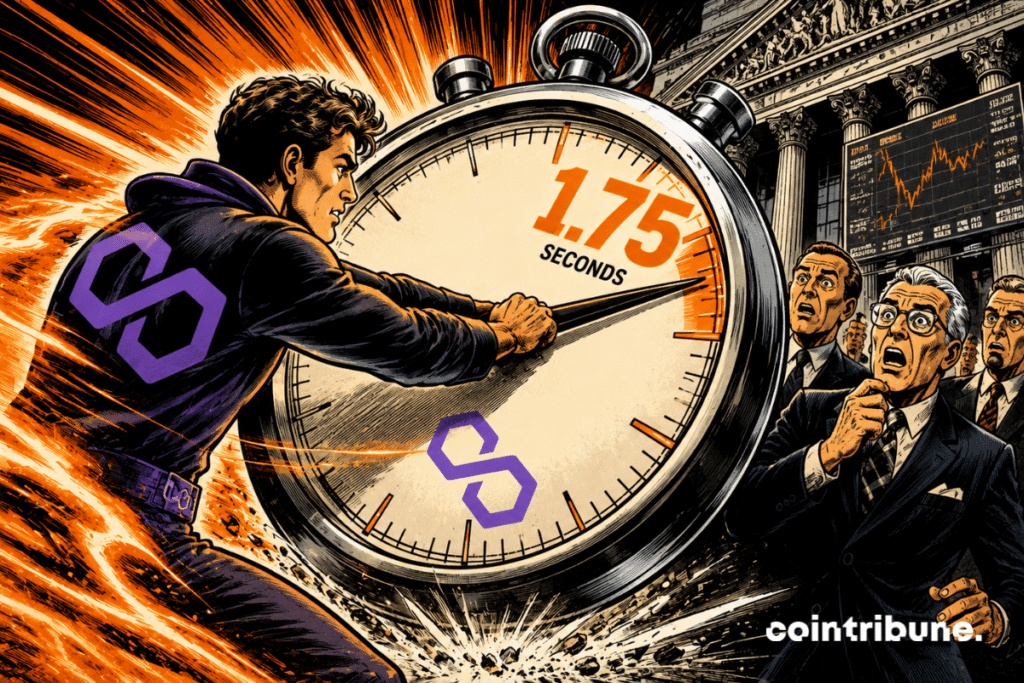
Polygon, armed with a new crypto strategy, has just reduced its block time to 1.75 seconds. This move seems tiny on paper, but it acts like a surgical operation on the entire network infrastructure. Indeed, Polygon now gains about 14% more transactions per second.
The network now reaches a theoretical capacity close to 3,260 TPS.
Lucca Martins, software engineer at Polygon, summarized it directly on X:
We just delivered 250ms reduction on BlockTime Which means: – 14% more TPS (~3260 TPS now) – 0.25s on finality reduction
Source: X / @0xlucca30
This reduction mainly represents a much deeper strategic shift for Polygon. The network now targets high-frequency payments, stablecoins, and some sensitive institutional uses.
Congestions become shorter, fees explode less brutally, and validations look more like modern banking infrastructures.
Private stablecoins become the new laboratory for blockchain giants
Polygon now pushes its pawns towards a much more discreet finance. The new wallet presented this week masks the sender, recipient, and transferred amounts. However, the system remains compatible with KYT controls and regulatory audits.
This mechanism relies on zero-knowledge proofs, the famous “ZK proofs.” Polygon is therefore attempting an extremely delicate exercise: offering more privacy without scaring financial institutions.
The official Polygon account also summarized this acceleration with a particularly aggressive formula:
Every payment on Polygon becomes faster. We have just improved the chain again with 14% more payments every second.
Source: X / @0xPolygon
In the comments, several crypto developers remind why this speed now becomes crucial. User @criptoedegen even estimates that slow confirmations still destroy the massive adoption of stablecoins on a large scale throughout the crypto industry.
Visa watches the network while the POL token still holds the brake tight
Polygon accelerates technically, yet the POL token remains surprisingly fragile. The ex-MATIC is currently trading around 0.0990 dollar after an annual drop close to 54%. This paradox now intrigues the entire crypto-sphere. On one side, Polygon multiplies institutional integrations.
Visa recently added Polygon to its stablecoin pilot program. Meta also uses Polygon for some USDC payments intended for digital creators.
Meanwhile, the Gigagas roadmap now targets 100,000 TPS. The Bhilai, Rio, and then Madhugiri upgrades have already profoundly transformed Polygon’s architecture. The network progressively resembles a financial highway built for massive global flows.
However, several crypto investors are still waiting for sufficiently explosive adoption to sustainably absorb the POL token emissions.
Numbers currently shaking Polygon dashboards
- Polygon now reduces its historic block time to only 1.75 seconds;
- The Polygon network progressively aims for a theoretical capacity close to 100,000 TPS;
- POL Price: 0.0990 dollar during this extremely volatile writing;
- Visa now integrates Polygon into its global stablecoin pilot;
- Institutional crypto volumes now become a priority in the Polygon strategy.
The crypto market sometimes slows down, yet blockchain infrastructures continue to advance like engines on digital steroids. Ethereum itself now chains adjustments at an almost surgical pace. The upcoming Glamsterdam upgrade would even promise to triple certain network capacities while progressively bringing transaction fees closer to zero.
Maximize your Cointribune experience with our "Read to Earn" program! For every article you read, earn points and access exclusive rewards. Sign up now and start earning benefits.

La révolution blockchain et crypto est en marche ! Et le jour où les impacts se feront ressentir sur l’économie la plus vulnérable de ce Monde, contre toute espérance, je dirai que j’y étais pour quelque chose
The views, thoughts, and opinions expressed in this article belong solely to the author, and should not be taken as investment advice. Do your own research before taking any investment decisions.