France Taps Mistral AI To Find Flaws In Government Systems
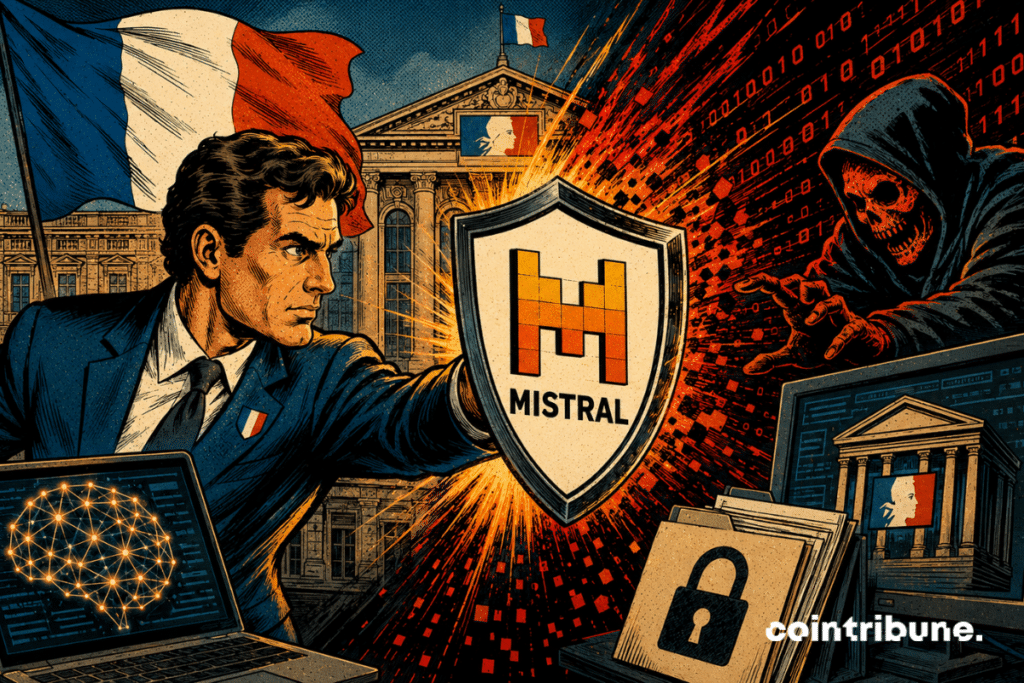
The hacking of the Directorate General of Public Finances pushes the French State to review its cybersecurity strategy. Faced with vulnerabilities affecting administrations and exposing sensitive data, the executive wants to deeply strengthen its digital audits thanks to AI. A response worthy of a threat that now goes beyond public systems alone. The stolen information can feed social engineering campaigns and directly target citizens, including crypto holders. Behind this shift lies a major question: that of French digital sovereignty.
In Brief
- France calls on Mistral AI to detect vulnerabilities in its public services and formally excludes OpenAI.
- Intrusion tests rely on the ‘Our AI’ ecosystem and SecNumCloud certified data centers to guarantee digital independence.
- A massive leak orchestrated via a compromised VPN exposed personal and tax data of nearly 700,000 taxpayers.
- The stolen information feeds targeted phishing and physical extortion threats aiming at the crypto community.
The Sovereign Response from Bercy and the Exclusive Choice of AI from Mistral AI
On Tuesday, August 18, 2026, following the Council of Ministers in Paris, the French government adopted a major technological shift to strengthen the resilience of its IT infrastructures, while nearly 700,000 taxpayers are threatened following a cyberattack against the DGFiP. The Budget Minister, David Amiel, announced that the State would use tools based on artificial intelligence to proactively identify and test the vulnerabilities of its own public services.
To accomplish this delicate mission of offensive auditing, France deliberately chose to exclude American giants in favor of local players. David Amiel was particularly categorical in front of the press. He stated that the government would call on so-called sovereign AI companies, “such as Mistral”, before explicitly specifying: “this excludes OpenAI”.
This political orientation is a direct continuation of the “Our AI” program unveiled a few months earlier by the Ministry of Budget. This plan already aimed to deploy sovereign tools within State services, notably through “The Assistant”, a system designed by the Interministerial Digital Directorate (DINUM), based on the model of the Parisian gem Mistral AI and hosted exclusively in SecNumCloud certified data centers.
By entrusting the detection of its security vulnerabilities to Mistral, a company supported by the equipment manufacturer ASML, Paris refuses to expose the mapping of its IT weaknesses to extra-European technologies. This preventive engineering choice comes as a direct response to the shock caused by the infiltration of tax servers, officially announced a few days earlier.
To understand the scope of this institutional direction, three fundamental pillars now structure the new government audit doctrine :
- The exclusive use of local gems : the State mandates French actors such as Mistral AI to audit its own systems without relying on American actors ;
- The firm exclusion of third-party models : the decision formally excludes OpenAI to avoid any transfer of vulnerability mappings to servers subject to extraterritorial legislation ;
- Anchoring in certified infrastructures : integration is based on the “Our AI” program and hosting within SecNumCloud labeled data centers.
A Huge IT Vulnerability at the Directorate General of Public Finances
The trigger for this governmental reorganization lies in an unprecedented security breach at the Directorate General of Public Finances (DGFiP). Revealed the previous Thursday thanks to on-chain data by the Ministry of Economy and Finance, the attack allowed a hacker to access the taxpayer search tool by compromising an internal VPN access using stolen credentials.
The intrusion, detected and closed at the end of June 2026, led to the exfiltration of files of nearly 700,000 people, including names, full contact details, tax access numbers, withholding tax rates, and correspondence histories. The situation worsened on Monday when the DGFiP Director General, Amélie Verdier, confirmed that her teams had just discovered a second data leak, currently under evaluation.
Although the tax administration specified that passwords and login credentials were not stolen, the nature of the information proves particularly toxic when crossed with the financial ecosystem of cryptos. The leak of physical addresses and detailed tax data constitutes an ideal breeding ground for ultra-targeted phishing and identity theft.
This vulnerability echoes concerns expressed earlier in the year by Pavel Durov. In April 2026, the founder of Telegram publicly pointed out the flaws in public registers by revealing that France had recorded 41 kidnappings or extortion attempts targeting crypto holders during the first three and a half months of the year.
Between Ambition for Sovereignty and the Imperative of Data Protection
Beyond the emergency response provided by Bercy, this partnership with the local ecosystem raises important questions about the future management of critical European infrastructures. By refusing to supply American models with the directory of public administration vulnerabilities, France is trying to impose a strict confidentiality standard under the control of European law.
However, this method of automated testing by sovereign AI will have to prove its effectiveness against human operating modes often based on compromising legitimate credentials, a breach that algorithmic code analysis alone does not always suffice to plug. The confrontation between the analytical power of large language models and the reality of human risk promises to be decisive.
In the future, the French reaction could set a precedent within the European Union regarding the obligation to audit critical systems through artificial intelligences strictly confined under local legal sovereignty. However, while the technology of Mistral AI offers guarantees against information leaks to third parties, it cannot retroactively erase the hundreds of thousands of taxpayer files now in circulation. For investors and capital holders, the urgency no longer lies only in the technical securing of their wallets, but in constant vigilance against social engineering attempts, made dreadfully effective by the involuntary exposure of their administrative identity.
Maximize your Cointribune experience with our "Read to Earn" program! For every article you read, earn points and access exclusive rewards. Sign up now and start earning benefits.

Diplômé de Sciences Po Toulouse et titulaire d'une certification consultant blockchain délivrée par Alyra, j'ai rejoint l'aventure Cointribune en 2019. Convaincu du potentiel de la blockchain pour transformer de nombreux secteurs de l'économie, j'ai pris l'engagement de sensibiliser et d'informer le grand public sur cet écosystème en constante évolution. Mon objectif est de permettre à chacun de mieux comprendre la blockchain et de saisir les opportunités qu'elle offre. Je m'efforce chaque jour de fournir une analyse objective de l'actualité, de décrypter les tendances du marché, de relayer les dernières innovations technologiques et de mettre en perspective les enjeux économiques et sociétaux de cette révolution en marche.
The views, thoughts, and opinions expressed in this article belong solely to the author, and should not be taken as investment advice. Do your own research before taking any investment decisions.