Gloomy Christmas for Bitcoin: the market shifts into extreme fear
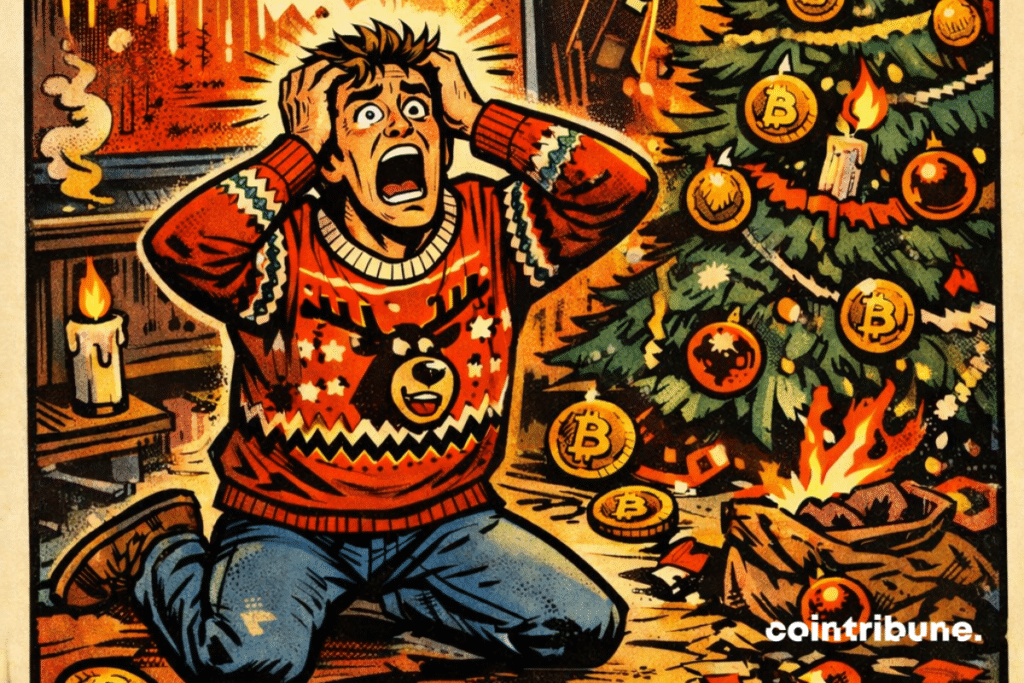
Bitcoin did not offer a gift this year. On December 25, in full “holiday” liquidity (that is to say almost empty), the price slipped below $87,000 before bouncing back timidly. And the market’s psychological gauge hardened: fear shifted into extreme mode.
In brief
- Bitcoin fell below $87,000 at Christmas, pushed down by low liquidity and ETF outflows.
- Sentiment has deteriorated to extreme fear, making the market particularly unstable.
- Despite everything, the on-chain data shows seller fatigue, with a risk of a rebound that could be as rapid as it is violent.
A market that is emptying… and it shows on the chart
When order books thin out, Bitcoin becomes nervous. Not necessarily because everyone is selling. But because a few orders are enough to create a wick, trigger a cascade of stops, then erase the movement as if nothing happened. This is the signature of periods of low liquidity, typical of holidays.
Regarding levels, the scenario feels like déjà vu: recovery attempts run into a zone of resistance $88,000–89,000. XWIN Finance talks about a “heavy” ceiling, reinforced by options positioning, and a market in “mild downtrend” with a score of 34/100 on its Trend Index.
Result: volatility that seems “calm” on the surface but can bite very quickly. In this type of configuration, Bitcoin does not warn: it hesitates for a long time, then cuts sharply, often when everyone thinks “nothing is happening.”
Bitcoin ETFs set the tone, and it remains gray
The real heavyweight at the moment is ETF flows. In the last session mentioned, about 2,900 BTC (around $251M) are said to have exited spot products, extending a withdrawal sequence weighing on price and sentiment.
This detail matters: Bitcoin ETFs have become a thermometer for “institutional” demand in the short term. When outflows occur, the spot market alone bears the burden. And during the holidays, it doesn’t always have the strength. Several media outlets also highlighted outflows from ether ETFs, which maintains an atmosphere of seasonal disengagement rather than pure panic.
But not everything is uniformly negative. “Diversification” flows are appearing elsewhere (products linked to Solana, and some vehicles around XRP). In other words: money doesn’t necessarily leave crypto, it moves. And this movement sometimes makes Bitcoin temporarily less desired.
Beneath fear, signs of seller fatigue
Extreme fear is real: the “Fear & Greed” index hit 24 around Christmas, and some readings show it stayed in the extreme zone on December 26 (around 20).
Yet, beneath the surface, the picture is less hysterical. XWIN highlights on-chain signals that look more like seller fatigue than capitulation: low whale inflows to exchanges, network activity still sluggish. Translation: big holders don’t seem to be frantically pressing “sell,” but demand hasn’t really come back either.
And there is an almost ironic detail: while the market trembles, “dollars on-chain” accumulate. Stablecoin capitalization rose to a record close to $310 billion. It’s fuel on the sidelines. Not a promise of immediate takeoff, but a power reserve making the market susceptible… to a surprise, in either direction.
Maximize your Cointribune experience with our "Read to Earn" program! For every article you read, earn points and access exclusive rewards. Sign up now and start earning benefits.

Fascinated by Bitcoin since 2017, Evariste has continuously researched the subject. While his initial interest was in trading, he now actively seeks to understand all advances centered on cryptocurrencies. As an editor, he strives to consistently deliver high-quality work that reflects the state of the sector as a whole.
The views, thoughts, and opinions expressed in this article belong solely to the author, and should not be taken as investment advice. Do your own research before taking any investment decisions.