Gold’s Decline Sparks Debate Over Bitcoin’s Role
The growing interconnection between traditional finance and the crypto ecosystem has just crossed a critical threshold, marked by a major technical capitulation signal in the commodities market. As global investors try to decipher the new capital rotation dynamics at work this year, gold, a historic pillar of safe havens, is undergoing an unprecedented correction. This trend break, which shakes the certainties of institutional fund managers and Web3 observers, occurs in a rapidly changing macroeconomic context.
In Brief
- Gold falls below $4,000 for the first time in 2026, a technical threshold marking a major market break.
- The correction extends to all precious metals, with a spectacular collapse of silver compared to its annual peak.
- This movement fuels questions about investor strategies and the destination of capital leaving traditional assets.
- Faced with this upheaval, bitcoin could strengthen its status as an alternative to historical safe havens.
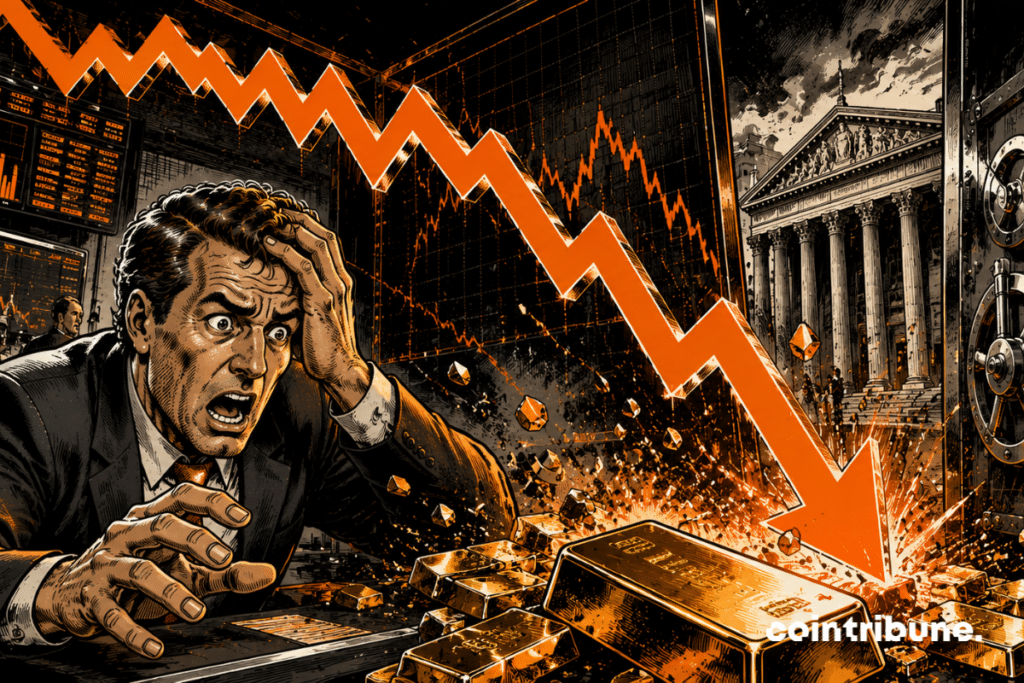
A historic support break : gold plunges below $4,000
While gold had surged thanks to massive retail purchases, the commodities market has just suffered a fundamental technical break that calls into question several months of bullish consolidation. According to recent official performance data, the asset’s price structure reveals critical levels :
- The price of gold (XAU) has sharply broken below a major psychological threshold ;
- The asset is currently trading at $3,972 ;
- This dip below the symbolic $4,000 mark constitutes a critical technical milestone for financial analysts, signaling the end of a period of relative stability.
Historical price cycle analysis quantifies the scope of this macroeconomic correction. Market records attest that this is the first time since November 2025 that the yellow metal has traded below the $4,000 mark.
This regression thus erases all gains accumulated during the first half of the year. Such a downward move, confirmed by high trading volumes, calls into question the absolute safety of gold amid global financial turmoil and forces investors to rethink their hedging portfolio construction.
Sector contagion effect : silver’s collapse and TradFi’s capitulation
This correction dynamic does not stop at the gold market’s borders. It spreads across the entire precious metals market, reflecting widespread disaffection for these tangible assets. Silver follows an even more volatile path, confirming the negative correlation currently afflicting the sector.
Market data indicate that silver is now trading at a level more than “50% below its historical peak at $121.” This all-time high was “recorded in January” of the same year, highlighting the rapid and violent trend reversal affecting traditional finance (TradFi) assets.
The scale of this price correction, notably silver losing half of its value compared to its annual peak, underscores a structural pivot by major capital allocators. The fact that gold trades at $3,972 and silver erases half of its historical gains reveals a forced disengagement or a massive shift towards other asset classes. In front of this precious metals defeat, quantitative finance analysts examine liquidity movements to determine whether these departing funds are heading towards government bonds, fiat currencies, or entering other speculative markets.
Bitcoin facing the new safe haven paradigm
This massive outflow inevitably raises the question of value transfers to the crypto ecosystem, notably to bitcoin, often called digital gold by proponents of algorithmic scarcity.
However, the decline in traditional safe havens can reflect either a global liquidity crisis pushing investors to sell everything or a genuine strategic rotation favoring cryptos. The prospects ahead will depend on the crypto market’s ability to demonstrate decoupling from the commodities collapse.
If bitcoin and stablecoins manage to absorb part of this institutional capital flight, this year could confirm a historic paradigm shift, where mathematical security definitively supplants the physical security of vaults. This profound reshaping of power dynamics forces fund managers to rethink the very notion of systemic risk hedging. Clearly, the simultaneous correction of gold and silver opens an unprecedented conceptual breach, the outcome of which will determine whether decentralized finance can establish itself as the ultimate receptacle of global wealth.
Maximize your Cointribune experience with our "Read to Earn" program! For every article you read, earn points and access exclusive rewards. Sign up now and start earning benefits.

Diplômé de Sciences Po Toulouse et titulaire d'une certification consultant blockchain délivrée par Alyra, j'ai rejoint l'aventure Cointribune en 2019. Convaincu du potentiel de la blockchain pour transformer de nombreux secteurs de l'économie, j'ai pris l'engagement de sensibiliser et d'informer le grand public sur cet écosystème en constante évolution. Mon objectif est de permettre à chacun de mieux comprendre la blockchain et de saisir les opportunités qu'elle offre. Je m'efforce chaque jour de fournir une analyse objective de l'actualité, de décrypter les tendances du marché, de relayer les dernières innovations technologiques et de mettre en perspective les enjeux économiques et sociétaux de cette révolution en marche.
The views, thoughts, and opinions expressed in this article belong solely to the author, and should not be taken as investment advice. Do your own research before taking any investment decisions.