Grayscale Favors BTC, ETH And ZEC As US Debt Keeps Rising
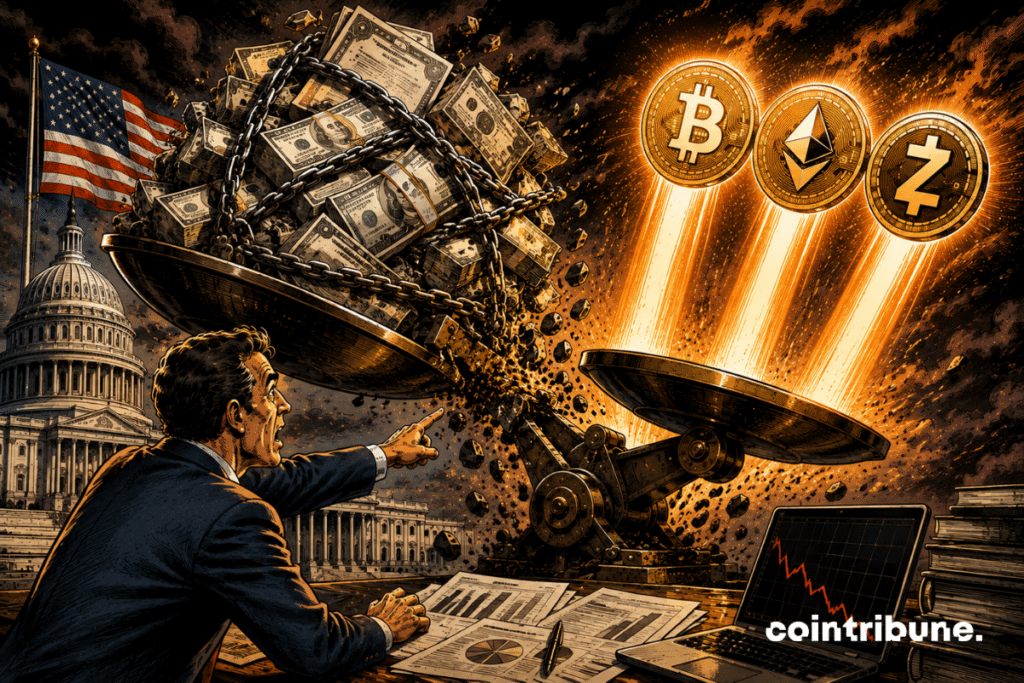
Grayscale believes that the evolution of US debt would favor Bitcoin, Ether, and Zcash. These three cryptos could benefit from significant demand for assets independent of fiat currencies. Indeed, this theory arises as federal debt has just exceeded 40 trillion dollars. However, it does not represent a current projection. A rate increase triggered by the US financing needs would also penalize the crypto ecosystem in the short term.
In Brief
- Grayscale bets on Bitcoin, Ether, and Zcash against the rise of US debt.
- US public debt exceeds 40 trillion dollars, increasing concerns about monetary dilution.
- Treasury bond buybacks support liquidity, without reducing the causes of debt.
- The rise in debt could favor cryptos long-term, but high rates risk penalizing them short-term.
Grayscale selects BTC, ETH, and ZEC
The research head at Grayscale, Zach Pandl, presented this analysis on August 26. For him, an uncontrolled increase in public debt can weaken confidence in national currencies and encourage investors to seek other stores of value.
He explains the selection by Grayscale as follows :
In cryptos, we believe that the hedge against monetary dilution will primarily benefit Bitcoin, Ether, and Zcash.
The characteristics of the chosen assets are as follows :
- Bitcoin has a maximum supply capped at 21 million BTC ;
- Ether is used to pay for transactions and to secure Ethereum ;
- Zcash combines a limited supply of 21 million ZEC with optional confidential transactions.
This hedge against monetary dilution (debasement trade) constitutes a strategy aimed at acquiring rare assets to protect against the loss of purchasing power of currencies. Historically, this theory concerns gold. Grayscale believes that some cryptos now fulfill a similar function.
However, the three cryptos do not have the same specifics. Indeed, Bitcoin and Zcash apply a predetermined issuance, while Ether does not have an absolute cap. Its supply mainly depends on new emissions granted to validators and the burning of part of the fees.
Predefined scarcity does not guarantee price stability either. Therefore, BTC, ETH, and ZEC remain volatile. Their progress also depends on available liquidity, regulation, institutional flows, and investors’ risk appetite.
Treasury buybacks do not necessarily reduce this liability
Total US public debt exceeded 40 trillion dollars on August 18. Of this amount, nearly 32,266 billion dollars are held by the public while 7,782 billion dollars correspond to claims among various federal structures.
The US Treasury released, a few days later, an increase in its long-term bond buybacks. From September 9, the cap will rise from at least 2 to 4 billion dollars per transaction for securities with maturities between 10 and 30 years.
With these acquisitions, the Treasury can withdraw older, less liquid bonds and continue issuing new securities. They facilitate operations on the secondary market and reduce some yield tensions.
However, this transaction does not equate to debt repayment. The Treasury statement explicitly describes the measure as support for the bond market’s liquidity. It does not rectify the budget deficit nor the gap between federal expenditures and revenues. Grayscale considers then that these buybacks address the symptoms but not the root cause of the problem.
Debt supports Grayscale’s thesis without guaranteeing a rise
The Congressional Budget Office projects a federal deficit of 1,900 billion dollars for the current 2026 fiscal year. This amount would reach 3,100 billion in 2036 if current legislative regulations generally remain unchanged.
Public debt held by the public could simultaneously rise from 101% of GDP in 2026 to 120% in 2036, according to CBO projections. Thus, interest-related charges would justify a significant part of this evolution.
This progression may consolidate the search for rare assets. It may also create the opposite effect in the short term. If the abundance of bond issuances keeps yields at a high level, risk-free investments become more attractive and capital cost increases. Investors may then reduce their exposure to cryptos.
Scheduled for November 4, the next US Treasury quarterly announcement will clarify the progress of the buyback program. Bond yields, the dollar, and flows to crypto products will help verify if the scenario indicated by Grayscale is truly beginning to materialize.
Maximize your Cointribune experience with our "Read to Earn" program! For every article you read, earn points and access exclusive rewards. Sign up now and start earning benefits.

Diplômé de Sciences Po Toulouse et titulaire d'une certification consultant blockchain délivrée par Alyra, j'ai rejoint l'aventure Cointribune en 2019. Convaincu du potentiel de la blockchain pour transformer de nombreux secteurs de l'économie, j'ai pris l'engagement de sensibiliser et d'informer le grand public sur cet écosystème en constante évolution. Mon objectif est de permettre à chacun de mieux comprendre la blockchain et de saisir les opportunités qu'elle offre. Je m'efforce chaque jour de fournir une analyse objective de l'actualité, de décrypter les tendances du marché, de relayer les dernières innovations technologiques et de mettre en perspective les enjeux économiques et sociétaux de cette révolution en marche.
The views, thoughts, and opinions expressed in this article belong solely to the author, and should not be taken as investment advice. Do your own research before taking any investment decisions.