Iran launches Hormuz Safe, a maritime insurance platform based on Bitcoin for the Strait of Hormuz
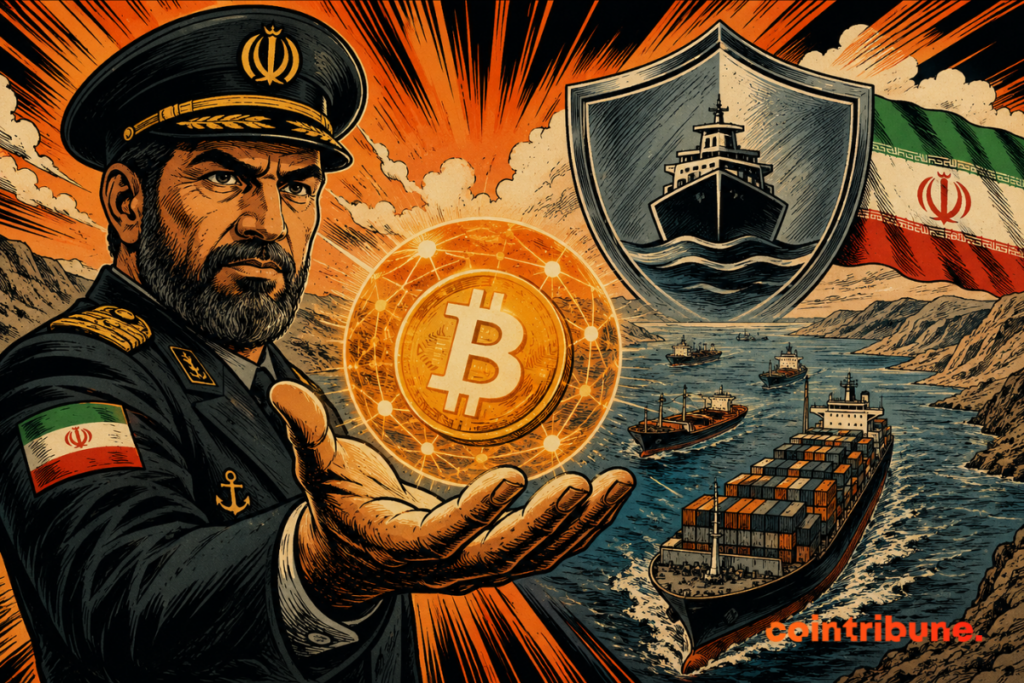
The Iranian government has introduced Hormuz Safe, a new maritime insurance platform intended for cargo crossing the Strait of Hormuz. According to several local media outlets, this system would use Bitcoin to validate payments and quickly activate insurance coverage. The announcement quickly circulated on social networks after a report by the Iranian news agency Fars News, which mentions a project supported by Iran’s Ministry of Economy and Finance. As Bitcoin begins to integrate with strategic infrastructures related to global energy trade, are we finally entering the era of PetroBitcoin?
In brief
- Iran has introduced Hormuz Safe, a Bitcoin-based maritime insurance platform for cargo transiting the Strait of Hormuz.
- The system would use the blockchain to confirm payments and quickly activate insurance coverage for ships.
- According to Fars News, the project could generate over 10 billion dollars, though no precise details have been published yet.
- With this initiative, Bitcoin now appears as a strategic tool linked to international maritime and energy trade.
Bitcoin at the heart of Hormuz Safe’s operation
Against the backdrop of geopolitical tensions in the region, the Hormuz Safe project would provide, according to the report published by Fars News, an Iranian state media affiliated with the Islamic Revolutionary Guard Corps (IRGC) and relayed by Bitcoin News, digital insurance policies for ships and cargo transiting the Persian Gulf and the Strait of Hormuz. The platform would use blockchain to confirm transactions and issue digitally signed receipts.
The announced operation relies entirely on Bitcoin for payments linked to insurance contracts. Once the transaction is confirmed on the blockchain, the cargo will automatically receive its coverage. This quick validation is one of the central elements of the project presented by the authorities.
The information also indicates that the Iranian ministry has been working on this platform since the beginning of Ordibehesht month, which started at the end of April 2026 in the Persian calendar. According to Fars News, the project could generate over 10 billion dollars in revenue, although no precise details on this calculation have been published.
The Strait of Hormuz represents a strategic passage for the global energy trade. About 20% of the world’s oil transits there each year. In this context, the use of Bitcoin appears as a financial tool to support maritime exchanges in this sensitive zone.
Iran presents the platform as a sovereign tool
State media describe Hormuz Safe as an initiative aimed at strengthening Iran’s financial control over this major maritime route. The Fars report emphasizes that the platform could allow Tehran to monetize cargo transit. This would limit traffic in the strait.
Iran has repeatedly mentioned the possibility of closing the Strait of Hormuz during regional tensions. In this new framework, the insurance platform appears as an economic mechanism linked to maritime transport.
However, the project raises several legal and technical questions. The full platform specifications have not yet been published. Moreover, the official website currently displays a “Coming Soon” page, showing that the service is still in an initial phase.
Western experts specializing in financial compliance also remind us that payments to entities supported by the Iranian state may expose some operators to risks related to international sanctions. Several analyses notably mention rules applied by the U.S. Office of Foreign Assets Control.
Meanwhile, some comments posted under the Fars News article express doubts about the real destination of future platform revenues. Other observers also recall that several cryptocurrency scams have already used fake Iranian government references in the past.
An announcement that already fuels international debates
After the original report was published on May 16, 2026, several international media outlets relayed the information. Kurdistan24 and Iran International notably repeated elements that Fars News disseminated concerning Hormuz Safe and its operation based on Bitcoin. The information also went viral on social networks, especially on X, where many internet users and crypto actors debated the geopolitical and economic implications of the project.
Discussions around digital payments in the Strait of Hormuz had already existed for several weeks. In early April, information mentioned the possible use of bitcoin, stablecoins, and the Chinese yuan to ease maritime passage in the region.
For now, it remains difficult to determine whether Hormuz Safe will become a large-scale operational platform. However, one thing is certain: this initiative shows that Iran is now publicly presenting bitcoin as an instrument linked to its strategic financial and maritime infrastructure.
Are we already back to the concept of PetroBitcoin?
With Hormuz Safe, Bitcoin takes a new step in its global evolution. Long presented as a digital store of value, the asset now appears at the heart of a project directly linked to international maritime and energy trade. In the Strait of Hormuz, a strategic area for global oil, Bitcoin is no longer just a speculative asset. It becomes a tool used to secure real exchanges and potentially generate billions of dollars.
This evolution strongly recalls the concept of ” PetroBitcoin “, an idea extensively developed by journalist Nicolas Teterel, according to which Bitcoin could gradually integrate into global energy flows. Unlike past projects that remained theoretical, Hormuz Safe now associates Bitcoin with a concrete maritime infrastructure. The message sent is strong: even in sectors historically dominated by banks and the dollar, cryptocurrencies are beginning to find a strategic place.
The choice of Bitcoin also strengthens its image as an international asset capable of functioning without traditional intermediaries. In a context of geopolitical tensions and increasing financial pressures, several states are now seeking alternatives to traditional systems. Hormuz Safe demonstrates that Bitcoin can also serve as a tool of economic sovereignty and commercial continuity in sensitive regions. If this platform becomes fully operational, it could represent a significant shift in the adoption of BTC in global trade related to energy and maritime transport.
Maximize your Cointribune experience with our "Read to Earn" program! For every article you read, earn points and access exclusive rewards. Sign up now and start earning benefits.

Journaliste et rédacteur web passionné par l’univers des cryptomonnaies et des technologies Web3. J’y traite les dernières tendances et actualités afin de proposer un contenu de haute qualité à un large public du secteur.
The views, thoughts, and opinions expressed in this article belong solely to the author, and should not be taken as investment advice. Do your own research before taking any investment decisions.