Jim O'Neill Changes His View On The Future Of BRICS Finance
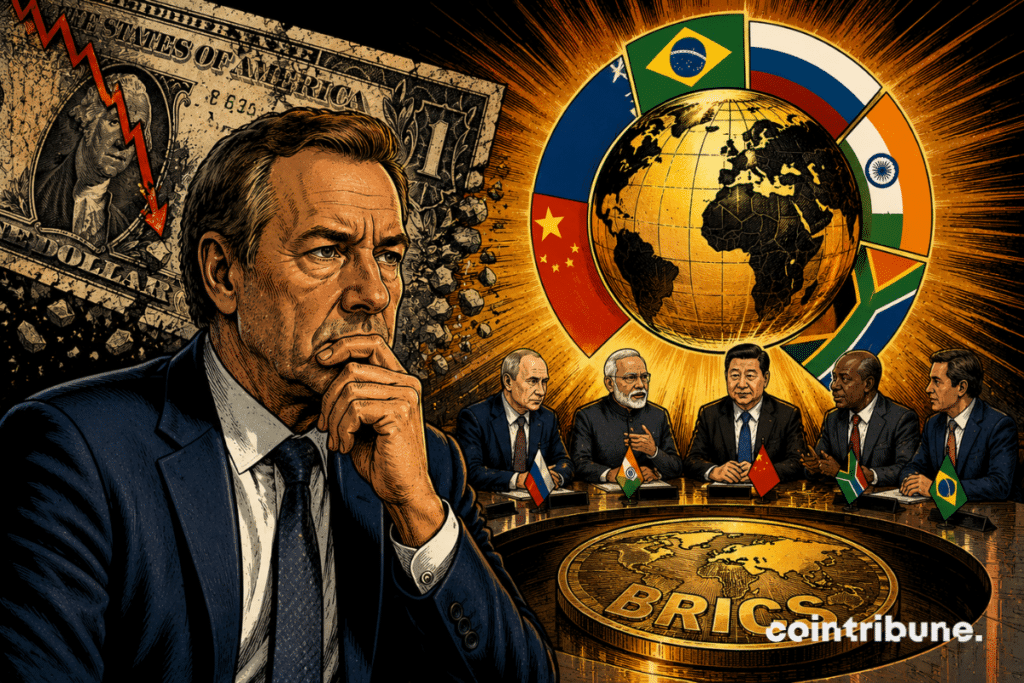
The project of a monetary system capable of competing with the dollar has long been considered an unrealistic ambition of the BRICS. This perception is now wavering. Jim O’Neill, the economist who popularized the acronym BRIC in the early 2000s, now recognizes that the major emerging economies have the means to build a credible alternative to the monetary order dominated by the greenback. This turnaround comes as geopolitical tensions intensify and payment infrastructures are transforming at high speed.
In Brief
- Jim O’Neill, inventor of the BRIC concept, admits that the creation of an alternative financial system to the dollar is no longer an illusion.
- The rapid rise of digital payment infrastructures and decentralized rails makes this monetary transition possible.
- Trade tensions and the repeated use of US sanctions push 75% of the global GDP to seek alternatives.
- The goal is not to eradicate the dollar, but to create a bilateral settlement currency based on a basket of currencies.
Jim O’Neill’s doctrinal shift in face of payment technology advances
Financial markets veteran Jim O’Neill has formally acknowledged that the creation by BRICS member countries of a financial vehicle alternative to the dollar no longer belongs to the realm of speculation, having just admitted that the G7 can no longer ignore the existence of the alliance. This admission marks a clear break with his historical stance, having previously qualified any monetary union within the bloc as an unrealistic endeavor given internal economic divergences. Several findings corroborate this turnaround :
- Jim O’Neill explicitly admits that his past vision is outdated in the face of market reality ;
- He states : “eighteen months ago, if you had asked me about the subject, I would have called the idea of BRICS countries creating any financial alternative pure fantasy” ;
- The role of technology : the rise of digital payment infrastructures over the past eighteen months is the main driver of this awareness ;
- The institutional record : the economist reminds that the New Development Bank (NDB) remains to date the only major concrete and operational achievement of the bloc.
This turnaround is mainly explained by spectacular technological advances made in the digital payments and trade digitization sector. Technical progress of financial infrastructures now allows for envisioning highly efficient cross-border interbank transfer networks, free from traditional circuits dominated by American institutions.
To deepen this transition, O’Neill dismisses the scenario of a unique global reserve currency abruptly supplanting the dollar in all its uses. He rather highlights the emergence of a commercial settlement instrument specialized and structured around a basket of currencies weighted by the respective economic weight of the participating nations. Despite this openness regarding the possibilities offered by new payment technologies, the analyst maintains a critical view on the historical record of the group. The bloc still needs to prove its capacity to transform these technological tools into sustainable structures able to rival the hegemony of the Western banking chessboard.
Global political catalysts and the temptation of monetary retreat
Beyond technological changes alone, the dedollarization dynamic is fed by a marked deterioration of international diplomatic and economic relations. The orientation of American trade policies, characterized by increased use of financial sanctions and recurrent resort to tariffs, accelerates the desire of third countries to guard against the risks of monetary exclusion.
Jim O’Neill highlights that all nations representing 75% of the non-American global gross domestic product show a growing willingness to trade in accounting units independent of Washington’s monetary policy decisions. This search for autonomy is reinforced by institutional uncertainties surrounding the financial management of the world’s leading economy, prompting trade partners to diversify their exchange reserves and settlement channels.
This desire for emancipation is no longer the prerogative of a few isolated regimes, but becomes a pragmatic strategy shared by a large segment of the global economy. By seeking to reduce their exposure to Washington’s political fluctuations, the major emerging nations lay the foundations for a bilateral trade network more immune to external pressures. This transition happens without a sudden break but by a gradual nibbling of the dollar’s market shares in the invoicing of raw materials and manufactured goods. The governments concerned now prioritize the security of their transactions over historical alignment with Western monetary standards.
Institutionalization of research and prospects for a new global balance
To accompany and theorize this structural transition of the global economy, the economist launched his own independent nonprofit analysis platform, called BRICS+ Thinking. This think tank will have the mission to produce research works, numerical data, and prospective indicators on the evolution of the expanded bloc and its financial interactions with Western markets. The creation of such an observation tool demonstrates that the rise of emerging economies now requires adapted measurement instruments, free from traditional analytical biases. This initiative attests to the progressive institutionalization of a field of study dedicated to the new balance of global economic powers.
The emergence of research organizations dedicated to the BRICS reflects the maturity reached by the debate on monetary multipolarity within expert circles. By precisely documenting alternative financial flows, these platforms offer investors and policy makers unprecedented tools to assess the risks and opportunities of this new environment. The analysis of produced data will measure the real efficiency of new payment mechanisms as they are deployed on the international stage.
Ultimately, the convergence between the evolution of digital payment infrastructures and the strategic independence sought by major emerging economies could profoundly redefine international financial flows.
While the dollar should retain a predominant role in the short term due to the unparalleled liquidity of its financial markets, coexistence with regional payment systems and decentralized settlement assets now seems inevitable. Jim O’Neill’s nuanced analysis thus invites banking actors and policy makers to monitor the emergence of a multipolar financial world, where monetary sovereignty will be decided as much on the field of diplomacy as on that of technological innovation.
Maximize your Cointribune experience with our "Read to Earn" program! For every article you read, earn points and access exclusive rewards. Sign up now and start earning benefits.

Diplômé de Sciences Po Toulouse et titulaire d'une certification consultant blockchain délivrée par Alyra, j'ai rejoint l'aventure Cointribune en 2019. Convaincu du potentiel de la blockchain pour transformer de nombreux secteurs de l'économie, j'ai pris l'engagement de sensibiliser et d'informer le grand public sur cet écosystème en constante évolution. Mon objectif est de permettre à chacun de mieux comprendre la blockchain et de saisir les opportunités qu'elle offre. Je m'efforce chaque jour de fournir une analyse objective de l'actualité, de décrypter les tendances du marché, de relayer les dernières innovations technologiques et de mettre en perspective les enjeux économiques et sociétaux de cette révolution en marche.
The views, thoughts, and opinions expressed in this article belong solely to the author, and should not be taken as investment advice. Do your own research before taking any investment decisions.