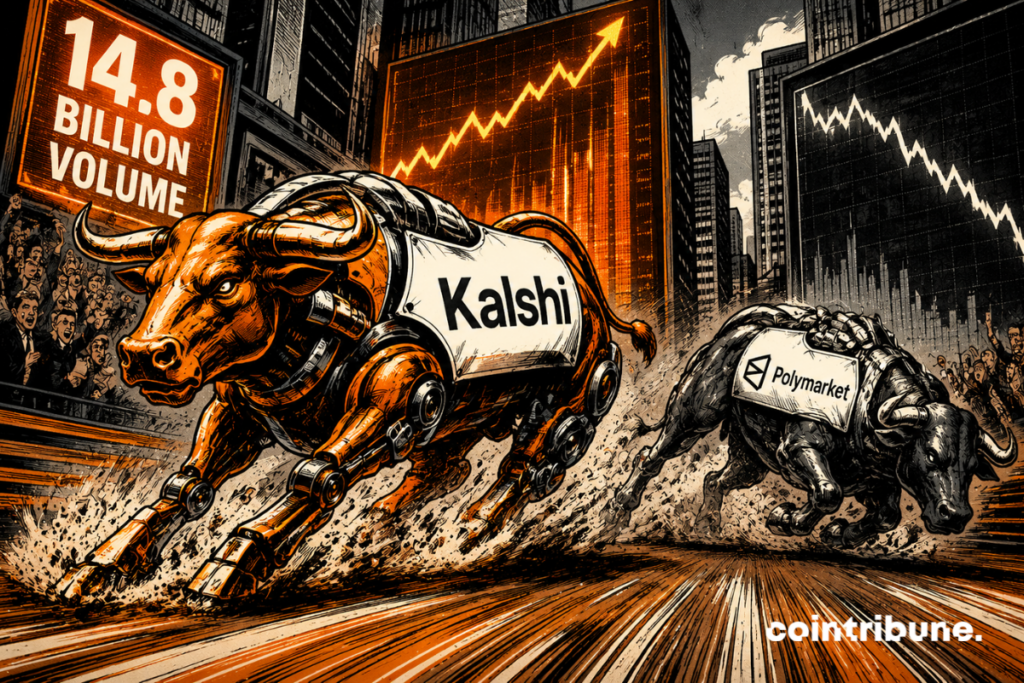
Kalshi surpasses Polymarket for the second consecutive month with $14.8B volume in April
Prediction platforms beloved by the crypto community now look like arenas under permanent tension. Between Kalshi and Polymarket, the battle no longer resembles a classic war. It rather looks like a strange digital chess game where each platform moves its pieces even before the opponent’s next move. The market grows suddenly while platforms already change their weapons, strategies, and domination mechanics in an almost surgical atmosphere.
In brief
- Kalshi now surpasses Polymarket with $14.8 billion monthly thanks to its currently solid American regulatory structure.
- Polymarket slightly declines despite continued global growth of predictive markets currently under close watch.
- Crypto platforms now deploy artificial intelligence, automation, and algorithmic systems capable of ultra-fast advanced execution.
- Several Polymarket accounts show suspicious behavior around particularly lucrative geopolitical events recently observed worldwide.
Kalshi turns the predictive market into a war machine while Polymarket declines slightly
Kalshi has again surpassed Polymarket with about $14.8 billion volume in April. The growth reaches 13%, while Polymarket falls by 8.9%. The platform thus falls to about $10.2 billion, compared to more than $11.2 billion in March. Yet, the sector does not slow down at all. Predictive markets now total nearly $29.8 billion monthly, up from $26.5 billion before.
Kalshi mostly benefits from its American regulatory anchor. Polymarket remains stuck in a fragmented architecture since its agreement with the CFTC in 2022. Its American app, launched at the end of 2025, remains separated from global liquidity.
This fracture resembles a multiplayer game divided between servers unable to exchange their strategic resources.
Crypto investors are thus beginning to view Kalshi differently. The platform no longer just sells event bets. It now sells an impression of almost clinical stability in a market where crypto traders seek solid infrastructures before thrills.
Crypto platforms become AI laboratories where algorithms already learn to speculate
The scene gets even stranger with the arrival of tools powered by artificial intelligence. Prophet has just launched a platform where an AI acts directly as a counterparty with real capital. This mechanism looks less like a simple market and more like an algorithmic testing room under permanent pressure.
MoonPay is also pushing its own AI tools aimed at predictive trading strategies.
The sector is therefore changing texture abruptly. Previously, platforms sold event contracts. Now, they sell speed, automation, and systems able to react even before human reflexes. Crypto investors thus witness a silent market mutation. Competition now plays on technical execution as much as on volumes.
Kalshi particularly benefits from this transition. Its American structure attracts more institutional investors seeking better-regulated environments.
Meanwhile, Polymarket retains a much rougher, almost anarchic image, appreciated by some crypto-sphere veterans. This opposition creates a strange balance between regulated finance and much wilder speculative instinct.
The global predictive casino now attracts players who seem to already know the next moves
The New York Times has just added an explosive layer to the file. The investigation mentions more than 80 Polymarket users showing suspicious behavior. Several accounts allegedly made perfectly synchronized gains on particularly sensitive military, geopolitical, or crypto events.
Some bets concern Israeli strikes against Iran. Others focus on Nicolás Maduro or international ceasefires. Several users reportedly opened their accounts only a few days before the related events. Some operations almost look like coordinated strategies in a gigantic tactical game under permanent surveillance.
This situation progressively turns predictive markets into a highly inflammable ground for American regulators. Elizabeth Warren and several lawmakers already demand tighter controls around insider trading risks. Kalshi, Polymarket, and the entire crypto industry now walk an extremely tightrope.
The numbers shaking predictive platforms
- Kalshi now reaches $14.8 billion total monthly volume;
- Polymarket drops to about $10.2 billion after several extremely aggressive months;
- Predictive markets now exceed $29.8 billion monthly combined globally;
- More than 80 Polymarket accounts display potentially suspicious behavior;
- Prophet introduces an AI using real capital directly on markets.
The regulatory climate becomes even more tense outside the United States. Brazil now targets Kalshi and Polymarket in its fight against international predictive markets. Authorities denounce risks linked to illegal betting and foreign digital platforms. This global pressure could rapidly turn the predictive crypto sector into a real regulatory minefield.
Maximize your Cointribune experience with our "Read to Earn" program! For every article you read, earn points and access exclusive rewards. Sign up now and start earning benefits.

La révolution blockchain et crypto est en marche ! Et le jour où les impacts se feront ressentir sur l’économie la plus vulnérable de ce Monde, contre toute espérance, je dirai que j’y étais pour quelque chose
The views, thoughts, and opinions expressed in this article belong solely to the author, and should not be taken as investment advice. Do your own research before taking any investment decisions.