Lula Dismisses BRICS Currency But Signals Financial Transformation
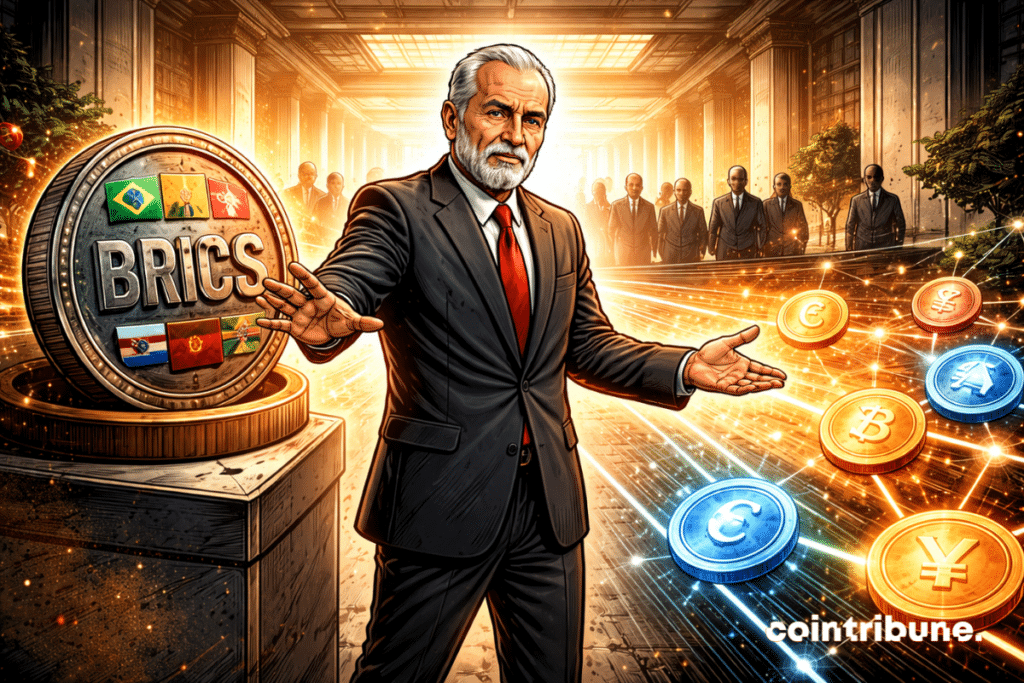
The BRICS currency does not exist, at least not yet. While Lula ends speculation about a common currency, a much deeper transformation is happening quietly. Behind this denial, the major emerging economies are accelerating the overhaul of international exchanges, gradually bypassing the dollar. Between political discourse and financial realities, a new global monetary architecture is already beginning to take shape.
In brief
- Lula ends speculation by stating that no common BRICS currency is currently being considered.
- The Brazilian president advocates a pragmatic approach aimed at diversifying exchanges without abruptly breaking with the dollar.
- Despite this denial, several countries in the bloc are already accelerating the use of local currencies in their trade exchanges.
- Major agreements, notably between Russia, China, and Brazil, illustrate this transition towards a system less dependent on the dollar.
Lula rejects the idea of a BRICS currency
Luiz Inácio Lula da Silva was keen to put an end to speculation about a common currency for the bloc. In an interview granted to India Today TV, he clearly states : “there is no project to create a BRICS currency. No discussion is underway within the bloc about the possibility of a new currency”. The Brazilian head of state emphasizes a misunderstanding of the debate.
Here are the main points to remember from this stance :
- The complete absence of any common currency project within BRICS ;
- The refusal of an “anti-dollar” interpretation of the bloc’s initiatives ;
- The willingness to offer more options in bilateral exchanges ;
- A publicly assumed position during an interview and confirmed at the Rio summit.
During the BRICS summit in 2025, Lula specified the direction envisioned: “the world must find a way so that our commercial relations no longer systematically pass through the dollar”. He mentions a gradual transition, guided by central banks, without a brutal challenge to the existing system. The use of local currencies thus appears as an adjustment lever rather than a radical change.
Financial infrastructures already bypassing the dollar
Alongside this official discourse, several concrete mechanisms attest to an ongoing transformation. Trade between Russia and China illustrates this evolution. According to Russian Finance Minister Anton Siluanov, 99.1 % of commercial payments between the two countries are now made in rubles and yuan. On their side, China and Brazil have set up a similar system since 2023, covering an estimated trade volume of about 100 billion dollars per year.
This strategy of the BRICS also relies on more structured tools. The president of the New Development Bank, Dilma Rousseff, emphasizes that “Operations in local currencies will remain a top priority to build a more diversified and balanced international financial system”. At the same time, the project “BRICS Unit” is taking shape. It is a settlement instrument based on blockchain, backed by 40% gold and 60% by a basket of the bloc’s currencies. Designed as an interbank clearing tool, it aims to bypass the SWIFT network and limit exposure to sanctions.
This evolution remains framed by significant constraints. Several Indian officials highlight the stabilizing role of the dollar in the global economy, while structural limitations persist, notably in terms of liquidity and convertibility. The momentum initiated by the BRICS fits into a gradual transformation. The dollar’s share in global reserves, which fell from about 70% to 59% over two decades, illustrates this trend. The bloc is advancing through successive adjustments, without an immediate break with the existing monetary order.
Maximize your Cointribune experience with our "Read to Earn" program! For every article you read, earn points and access exclusive rewards. Sign up now and start earning benefits.

Diplômé de Sciences Po Toulouse et titulaire d'une certification consultant blockchain délivrée par Alyra, j'ai rejoint l'aventure Cointribune en 2019. Convaincu du potentiel de la blockchain pour transformer de nombreux secteurs de l'économie, j'ai pris l'engagement de sensibiliser et d'informer le grand public sur cet écosystème en constante évolution. Mon objectif est de permettre à chacun de mieux comprendre la blockchain et de saisir les opportunités qu'elle offre. Je m'efforce chaque jour de fournir une analyse objective de l'actualité, de décrypter les tendances du marché, de relayer les dernières innovations technologiques et de mettre en perspective les enjeux économiques et sociétaux de cette révolution en marche.
The views, thoughts, and opinions expressed in this article belong solely to the author, and should not be taken as investment advice. Do your own research before taking any investment decisions.