Maduro captured, the dollar relaunched? Kiyosaki denounces a global maneuver
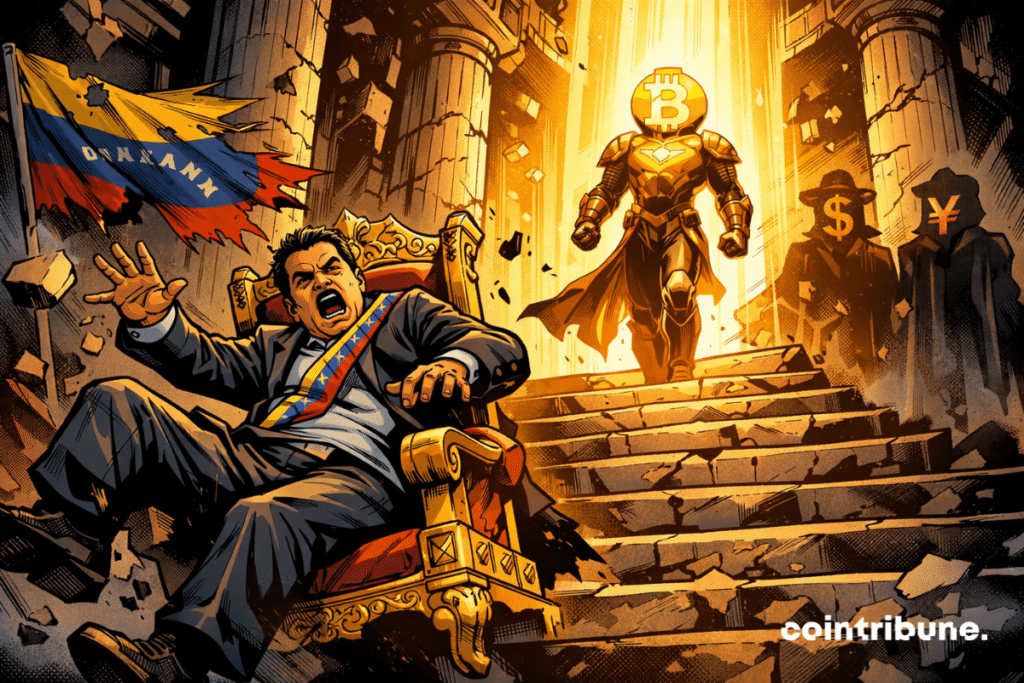
The arrest of Nicolás Maduro in the United States shook the international scene. But beyond the political dimension, it is the global financial market that wobbled. Venezuela, rich in oil and strategic in global energy flows, weighs much more than a simple sanctioned country. For Robert Kiyosaki, this case is the tree that hides a forest of monetary manipulations. The author of “Rich Dad Poor Dad” even draws lines to bitcoin, which he considers a shelter against a financial system that has become explosive.
In brief
- Kiyosaki sees Maduro’s fall as a maneuver against Venezuela’s financial emancipation.
- Venezuela sold its oil outside the dollar, through alternative channels controlled by China.
- American sanctions now target systems around oil, not just governments.
- Bitcoin becomes a bulwark according to Kiyosaki, against an international finance that has become too politicized.
Why Venezuela is a global systemic headache
When Maduro, also a rival of Guyana, was arrested and transferred to the United States, the world watched. But the markets reacted. Why? Venezuela holds one of the largest oil reserves in the world, with exports outside the classic circuit, often destined for China. This parallel model bypassed the dollar, which represents a direct challenge to American supremacy.
Robert Kiyosaki points out that:
Most people think that Iraq, Iran, and Venezuela are a story about oil. That’s just the surface. In reality, it’s a story about China.
According to him, the real stakes are monetary, systemic, invisible at first glance.
Sanctions no longer target countries but channels. Shipping companies, insurance, ports, settlement platforms… This is where the pressure is applied. For Kiyosaki, this is not a military war, but a war of systems. And Venezuela is the perfect symbol of this tension: rich in resources, financially isolated, dependent on alternative networks. An explosive equation.
Kiyosaki: Wars start with money
In a long Facebook post, Robert Kiyosaki reflects on a striking fact:
Today, wars no longer start with bombs. They start with money.
He cites Iraq, where Saddam Hussein’s attempt to sell oil in euros reportedly hurried his fate.
This parallel with Venezuela is not accidental. Maduro nurtured economic relations based on alternative currencies, oil contracts backed by debt and non-dollar payment circuits. For Kiyosaki, these elements make the country a threat to the established monetary order.
It is no longer just about energy, but monetary sovereignty. The dollar is at the center of the game, and any country that seeks to free itself from it is immediately targeted by unconventional means. Kiyosaki refers here to new forms of war: financial, digital, logistical.
And it is in this context that bitcoin emerges. For him, this crypto represents a financial system outside the control of central banks and governments. It is therefore, by essence, a response to the militarization of finance. A way for citizens and investors to protect themselves.
Maduro, bitcoin and the awakening of digital markets
Behind the missiles, another war is playing out: that of payment systems and currencies. For Robert Kiyosaki, Maduro’s capture is not an end but a warning signal. What Venezuela embodied—a petroleum state seeking to free itself from the dollar via China—was perceived as a strategic affront. In this context, bitcoin becomes a serious alternative again.
“When money becomes political, citizens are the first to suffer” he writes. And he adds that “if your reserves are frozen, your oil cannot be insured, your currency cannot settle transactions, your access to global payments is restricted, then you no longer control your country“.
Bitcoin, a borderless asset, without a banking system, without the need for institutional validation, appeals to those marginalized by the dollar. Kiyosaki is not mistaken: for him, the truly wealthy do not study politics, they study systems. And the dominant system is transforming.
It’s no longer about owning black gold, but controlling the global monetary plumbing. BTC could well become the escape of a world in transition.
5 facts to remember
- $91,278: bitcoin price at the time of writing this article;
- 700,000–900,000 barrels/day: Venezuela’s oil exports, mostly to China;
- $1.8 trillion: bitcoin capitalization just after Maduro’s capture;
- $60 million: short liquidations in one hour during the crypto rally;
- Sanction targets: shipping companies, ports, insurers, and payment rails — not the oil itself.
Maduro’s fall did not just disrupt diplomacy. It triggered a monetary earthquake whose shocks benefit the crypto industry. Bitcoin, in this context, surpassed $91,000, proving that it is no longer just an alternative asset, but a compass in the era of financial conflicts.
Maximize your Cointribune experience with our "Read to Earn" program! For every article you read, earn points and access exclusive rewards. Sign up now and start earning benefits.
La révolution blockchain et crypto est en marche ! Et le jour où les impacts se feront ressentir sur l’économie la plus vulnérable de ce Monde, contre toute espérance, je dirai que j’y étais pour quelque chose
The views, thoughts, and opinions expressed in this article belong solely to the author, and should not be taken as investment advice. Do your own research before taking any investment decisions.